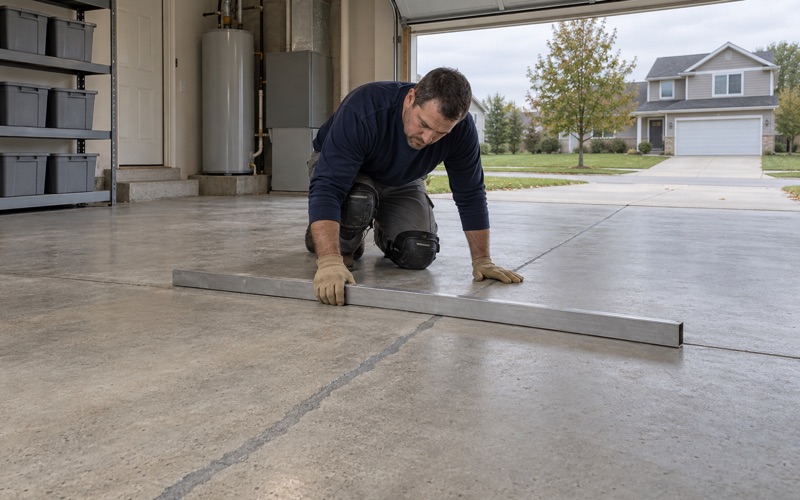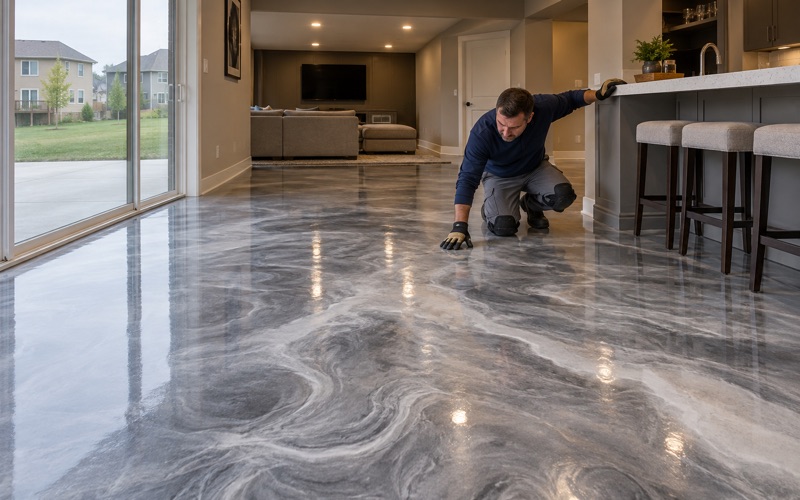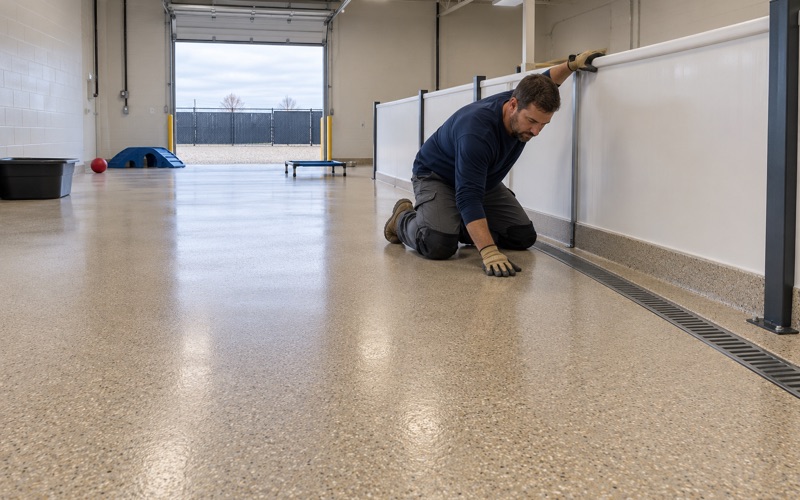
Urbandale Epoxy Flooring has spent more than 20 years putting epoxy flooring in Winterset garages, shops and basements, and the first thing we look at is not the color chart. It is the slab. A coating is only as steady as the concrete under it, so every job starts with a walk across the floor to see whether it is flat, sound and done moving.
That walk tells us which of two jobs we have. On most floors, the work is surface preparation, a moisture test and a system chosen for the way the space is used. On a settled slab that has dropped, tipped toward a wall or kept opening along the same crack, the honest answer is that the coating waits until the movement has been dealt with.
This page explains how we handle that second kind of floor: why slabs sink, why the rule is to stabilize first, how we watch a crack before we fill it, and what the coating looks like once the concrete has settled down for good. We do not lift slabs or drive piers ourselves; we tell you when that work has to come first.
A Foundation-Repair Maker on East Madison Street
Grip-Tite and a century of settling ground
Winterset, the Madison County seat about 35 miles south of Des Moines, is home to Grip-Tite Manufacturing on East Madison Street. Directory listings give the company an established date of 1921, and its line covers foundation repair and earth-anchoring products: push piers, helical piers and wall anchors. Its dealer materials describe the problems those products answer as bowed walls, sinking slabs, sagging floors and foundation settlement.
Grip-Tite’s helical foundation systems carry ICC-ES evaluation report ESR-3533, reissued in May 2026. The report describes the piles as used to transfer compressive, tension and lateral loads from a new or existing structure to a soil bearing strata. A pile is screwed in until it reaches a suitable bearing layer, and a bracket connects it to the concrete it is meant to hold.
What a pier maker tells a floor installer
We are not a Grip-Tite dealer, and the company is not a customer of ours. We mention it because a whole trade grew up in this town around one fact: concrete moves when the soil under it moves. That fact governs our work too, even though we sit at the opposite end of the job, on the top surface rather than underneath it.
A garage floor that has dropped an inch at the door, or a shop slab that has cracked across the middle and kept going, is a soil problem showing up in concrete. Epoxy, polyaspartic and urethane cement are thin surface systems. They follow whatever the slab does next, so the slab has to stop doing it before any of them goes down.
Why slabs sink, tip and keep cracking
Most settlement starts below the slab, not in it. Fill that was never compacted well, soil that softens when water collects against a foundation, or a void left when fine material washes away can leave part of a floor without support. The concrete bridges the gap for a while, then cracks and drops where the support is weakest.
The telltale signs show up before anyone measures. A floor drain that no longer sits at the low point, a garage door that leaves a wedge of daylight on one side, a crack whose two edges no longer line up in height. Any of those on a slab we are asked to coat moves the conversation from color to cause.
Looking for epoxy-flooring closer to Ames? See Ames Epoxy-Flooring.
Stabilize First, Then Talk About Coatings
Piers, lifting or replacement
When a slab has settled, the first decision belongs to a foundation or concrete contractor, not to us. Depending on what is going on underneath, the fix may be piers driven or screwed down to bearing soil, a slab lifted back toward grade, or a section cut out and poured again. Each one changes the floor we will eventually coat, so we want to know which happened.
We say this plainly when we map a floor before pricing. Cracks, spalls, low spots and old coatings go on the sketch, and if the slab should be stabilized, repaired or replaced before any coating, the quote says so instead of burying it in a line item. Selling a coating over a moving floor only produces a callback with your money in it.
What a coating cannot do
No floor coating can lift a sunken slab back to level, hold together a crack that is still opening or stop the soil from shifting. A 100% solids epoxy is hard and strong in compression, but it is bonded to the concrete, so when the concrete bends or separates, the coating breaks with it. Flexible topcoats do not change that; they sit on the same moving base.
That is why our warranty conversation happens before the sale. We explain what a coating warranty excludes, and moisture comes first on that list. Substrate movement sits right behind it, because a crack that reopens under a finished floor is a concrete event, not a coating failure, and you deserve to hear that while the decision is still yours.
Repaired concrete needs time and a fresh look
Lifted or patched concrete is a new substrate. Grout injected under a slab, new concrete poured into a replaced section and the old slab around it all behave differently under a grinder and absorb a primer differently. New pours also carry their own water, so we let the repair cure and then test the whole floor, not just the old part.
We also check the slope again after the stabilizing work. A slab that was raised may now drain differently toward the door or floor drain, and a glossy coating shows every puddle. If the slope needs correcting, that is settled in the concrete stage, because a leveling layer under the coating is a separate scope and gets priced as one.
Watching a Crack Before We Fill It
Is the crack still moving?
A crack that formed once and stopped is a repair item. A crack that is still opening is a symptom. The difference matters more than width, because a hairline crack that grows every season will reflect through any coating, while a wider crack that has sat still for years can be filled and coated with confidence.
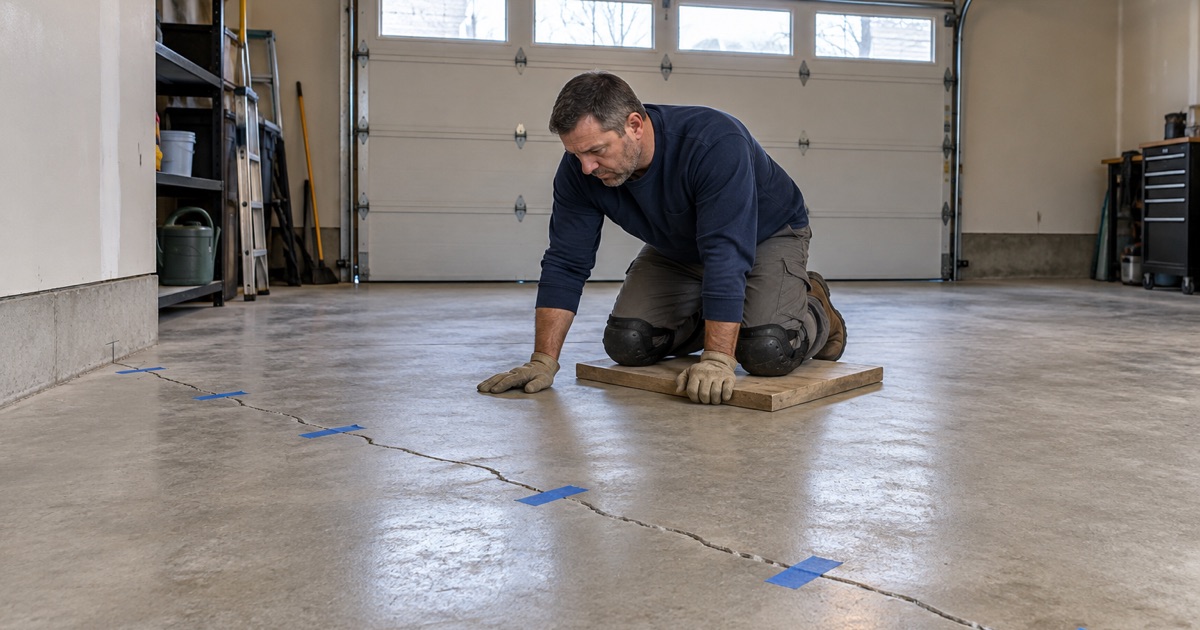
Crack monitoring does not need special equipment. Pencil marks across the crack at each end, a dated photo with a ruler, or a simple crack gauge glued across the gap will show whether the edges are moving apart or shifting up and down. After stabilizing work, we suggest the owner watch for a stretch before we fill anything, rather than trusting one look on bid day.
Reading what the marks say
If the marks have not moved, we treat the crack as dormant. If it has widened, or one side has dropped further, the concrete contractor goes back to the slab before we do anything. We would rather push a start date than coat over a crack that is telling us the support under it is still changing.
Watching also sorts out cracks that were never about settlement. Plastic shrinkage cracks, for instance, are common on garage slabs and usually stable. Mapping them alongside the settlement crack keeps one worrying line from turning the whole floor into a foundation job, and keeps a real settlement crack from being written off as cosmetic.
Repairing a dormant crack
Once a crack has proven still, we open it with a crack-chasing blade, vacuum it clean and fill it with a rigid epoxy or polyurea repair material, ground flush before the base coat. Spalled edges are rebuilt at the same time. The filled line may still show faintly through a solid color; a flake broadcast hides it far better.
The repair does not make the slab stronger than it is, and we will not describe it that way. What it does is give the coating a continuous surface to bond to. The support work was the piers, the lift or the replacement; our part is making sure the top surface matches the work that was done below it.
Coating a Slab That Has Stopped Moving
Grinding opens the surface
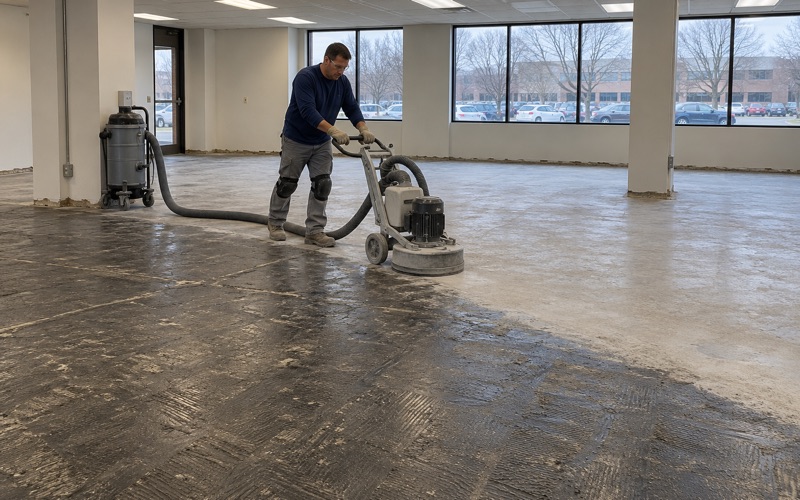
Every slab we coat is opened with a diamond grinder or shot blaster, never an acid etch. On a repaired floor that matters twice over: grinding takes the patched areas, the old slab and any grout residue down to one consistent profile, typically around ICRI CSP 2 to 3 for a thin-film system. Dust is captured at the machine by vacuum, not washed into a floor drain.
Grinding also exposes what the bid-day walk could not. A thin skim of old sealer, a weak top layer or a hollow spot under a patch shows itself under the diamonds. If something turns up, we stop and show you before we keep going, because finding a problem under the coating a year later costs far more than finding it at this step.
Moisture test before the system
A moisture test is written into our scope before the price is final, and it matters more after slab work, when fresh concrete or disturbed fill may have changed what is coming up from below. We use ASTM F2170 in-situ relative humidity probes or ASTM F1869 calcium chloride tests, and the reading decides whether a moisture-mitigation primer goes down first.
Whatever year the house was built, the garage slab gets tested. Winterset’s housing runs from homes built before 1940 to houses from the 2010s, and neither end of that range tells us how dry a floor is. A coating is never a vapor retarder, and no primer we install turns a wet slab into a dry one.
Choosing and checking the finish
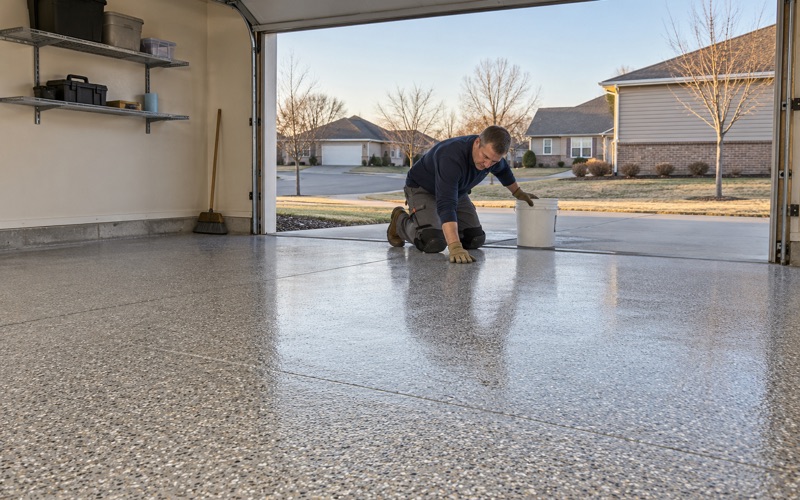
With the slab still and the reading in hand, the system choice is ordinary. Most Winterset garages get a 100% solids epoxy base with a vinyl flake broadcast and a polyaspartic topcoat that resists hot tire pickup and the brine and rock salt tracked in from November through March. Shops that take heavier abuse may call for urethane cement or a quartz aggregate broadcast.
The proposal names the product line, the number of coats and the finished thickness, so you can check the floor against what was quoted. Slip resistance comes from the broadcast and topcoat we specify, not a slogan. Cure times follow slab temperature and dew point, so an unheated garage in a cold stretch waits instead of being rushed.
- 20+ Years on Iowa Slabs
- Moisture Tested Before Pricing
- Coats and Thickness in Writing