Urbandale Epoxy Flooring has spent more than 20 years installing epoxy flooring in West Des Moines and across the metro, and the part of the job we take most seriously is one a customer rarely sees: the wording of the proposal. Every quote names the product line, the number of coats and the finished thickness, so the floor that goes down can be checked against the paper.
That habit matters most when a product arrives with a claim attached. Clinics, kitchens, daycare rooms and garages are all pitched coatings described as antimicrobial, and a buyer reasonably assumes the word says something about germs. This page explains what that label is legally allowed to mean, what it does not mean, and how we choose a system that stays clean because of the way it is maintained.
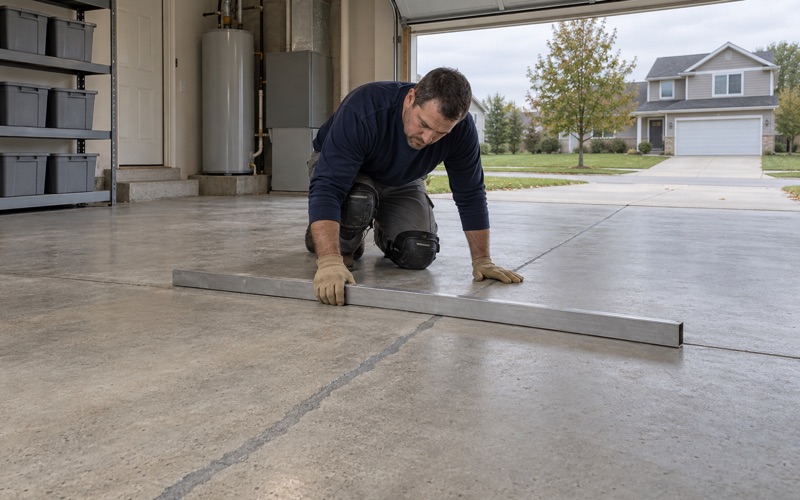
We open every slab with a diamond grinder or a shot blaster rather than acid, write a moisture test into the scope before the price is final, and map cracks and old coatings first. Those steps are the same for a two-car garage and a medical office. The difference is how much rides on the floor holding up to daily chemical cleaning.
A 24-Hour Hospital on 59th Place Shows What Floors Endure
Floors that never get a closed day
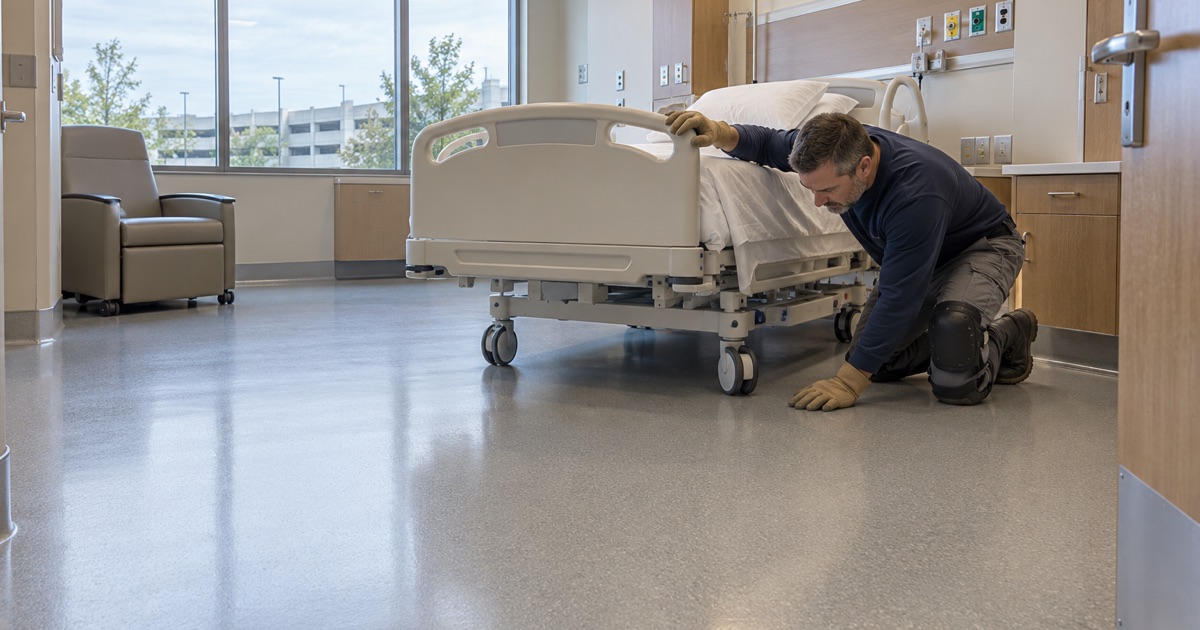
MercyOne West Des Moines Medical Center at 1755 59th Place is a 146-bed hospital open 24 hours, with emergency care, surgery and a Level II NICU. A building like that never has a quiet week for a floor to be closed, stripped and recoated. Its floors are walked, rolled over and wiped down around the clock.
We name it here as a reference point, not as a client. MercyOne is not a customer of ours, and we have not seen or assessed its floors or the products on them. What a hospital of that size illustrates is the extreme version of a question every smaller clinic, dental office and veterinary practice in West Des Moines faces when it chooses a coating.
Where the marketing pressure comes from
Health care owners are the buyers most likely to hear a coating described as antimicrobial, and the word tends to arrive with a promise stretched past what the label allows. The same pitch reaches commercial kitchens, fitness rooms and homeowners with a pet area in the garage. The legal limits on that word are identical in every one of those settings.
Our job is to sort the claim from the chemistry before anyone signs. A floor in a treatment room, a break room or a basement play area needs the same things: a seamless film, a texture suited to wet cleaning and a resin that tolerates whatever the owner actually puts on it. None of those depends on an additive.
Looking for epoxy-flooring closer to Waukee? See Waukee Epoxy-Flooring.
What the Treated-Article Exemption Lets a Coating Say
Protecting the coating itself
Coatings sold as antimicrobial usually rely on the federal treated-article exemption, written at 40 CFR 152.25(a). It covers an article treated with a pesticide to protect the article or substance itself, and the regulation’s own examples include paint with a preservative. In a floor coating, that means an additive can help keep mold or mildew from staining the film.
That is a real benefit in a damp basement or a wash bay, and we will say so when it applies. It is also where the claim ends. The exemption covers the product looking after itself; it does not reach the people walking across it, the carts rolling over it or the room around it.
What EPA says the exemption excludes
EPA’s PR Notice 2000-1 states that the agency does not regard the exemption as including articles bearing implied or explicit public health claims. Summaries of that notice add that unqualified antimicrobial language is read as such a claim, and that qualifying wording has to say the additive does not protect users or others against bacteria, viruses or germs.
So a product sheet that hints at a healthier room or a cleaner kitchen because of the resin is outside what the exemption allows. When we see that language, we treat it as a reason to read the rest of the data sheet more carefully, not as a selling point to pass along to a customer.
How our proposals word it
If a system we specify carries a film-protecting additive, our proposal says exactly that and no more: the additive protects the coating against staining organisms. A floor coating is not a disinfectant, and nothing we write will suggest that the floor cleans itself or makes a room safer simply by being there.
The same discipline runs through the rest of the quote. Slip resistance is specified by the broadcast and topcoat we use rather than promised as a slogan, and what the warranty excludes is explained before the job is sold. Moisture is the first exclusion we name, because it is the one most likely to matter.
Disinfectants Keep a Floor Hygienic, So the Floor Must Survive Them
Seamless surfaces and coved edges
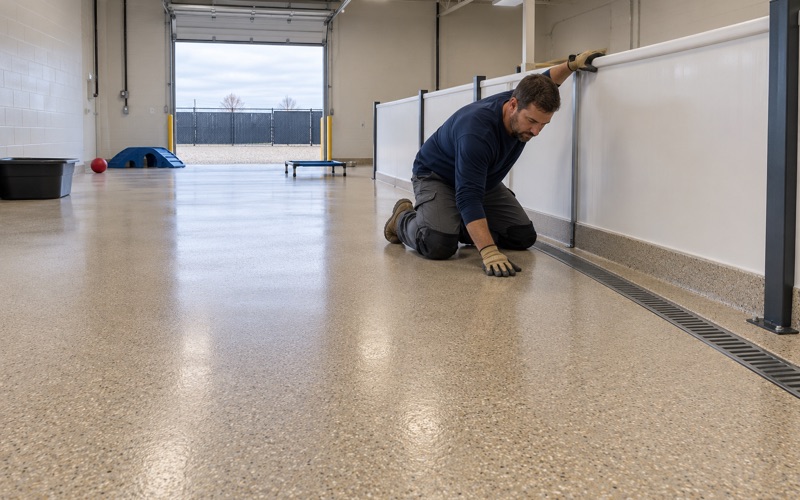
In any clinic, hygiene stays with the cleaning and disinfection routine the facility runs on its own schedule. What the floor contributes is a surface that routine can reach completely. A seamless resin system with no grout lines and no open joints leaves nothing for soil and moisture to collect in between wipe-downs.
Edges are where seamless floors usually fail. We plan coved bases where the floor meets the wall, so a mop or auto-scrubber meets a curve instead of a corner, and we map cracks and spalls before pricing. When a slab needs repair or replacement before it can carry a coating, we say so plainly rather than coating over the problem.
Compatibility with the cleaning cart
A coating that softens, dulls or yellows under the disinfectant a staff uses every shift will open up long before its expected life. Before we specify a system, we ask what products are on the cleaning cart and how often they reach the floor, then check them against the resin’s chemical resistance data. 100% solids epoxy and polyaspartic topcoats behave differently under repeated exposure.
For a wet room or a space washed down with hot water, we look at urethane cement, which handles thermal shock and frequent washdown better than a thin film. The right answer depends on the routine, not on a label. A floor that survives its own cleaning is the only kind that stays seamless for long.
Food floors under state inspection
Commercial kitchens add an inspector to the picture. Every food floor in West Des Moines, whichever of its four counties the address falls in, is inspected directly by the Iowa Department of Inspections, Appeals and Licensing Food Safety Bureau against the 2017 FDA Food Code with Supplement. No county health department is involved on any side of the city.
We plan those floors to that code: coved floor and wall junctures under 6-201.13, and a texture chosen for wet areas with the 6-201.11 antislip exception in mind. Grease interceptors and floor drains are worked around, never coated shut, and the finished floor is judged by the inspector rather than by us.
Preparing a West Des Moines Slab for a Seamless System
Opening and testing the concrete
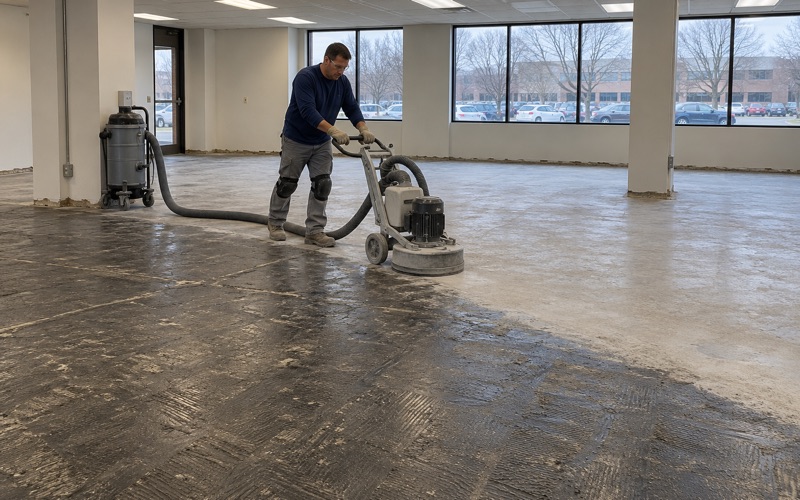
Every slab gets a mechanical profile from diamond grinding or shot blasting, matched to the ICRI CSP range the system calls for. Grinding dust is captured at the machine by vacuum instead of being washed toward a floor drain or storm inlet, which matters as much in a clinic corridor as it does in a garage.
Moisture testing is written into the scope before the price is final. Depending on the slab, that means ASTM F2170 in-situ relative humidity probes, ASTM F1869 calcium chloride tests or an ASTM D4263 plastic sheet check. Where readings run high, a moisture-mitigation primer goes into the proposal, because a coating is never waterproofing.
Ground and water under the city
West Des Moines sits on two different kinds of ground. Out by Jordan Creek, the Bemis-moraine edge of the Des Moines Lobe includes poorly drained Webster and Macksburg soils that hold water near the surface. Closer to the Raccoon River, the city depends on a levee system along the river and Walnut Creek, and the 1993 flood remains the flood of record.
Neither fact tells us what a given slab will read, which is why we test rather than assume. Basements are checked for past water first, with the sump pit and floor drain left open and working. A floor coating is never flood protection or radon mitigation, and we do not sell it as either.
Scheduling around a space that cannot close
Offices, clinics and flex buildings are phased around tenants and business hours, with night and weekend windows when a room cannot go dark. Low-odor products are available for occupied buildings and attached garages as a comfort choice, never presented as an Iowa legal requirement. Each phase is sequenced so finished, cured areas return to service first.
Cure schedules follow slab temperature and the dew point spread at the surface, not the calendar, so an unheated space in a central Iowa winter waits until conditions allow a proper cure. That patience costs less than amine blush or a soft film in a room that will be disinfected every day for years.
- 20+ Years on Iowa Slabs
- Moisture Tested Before Pricing
- Coats and Thickness in Writing