Urbandale Epoxy Flooring has spent more than 20 years putting down epoxy flooring in Waukee garages, and a growing share of the conversations we have there start with a question that has nothing to do with color or flake size. The caller rents. Before anyone talks about coatings, the first thing worth settling is who owns the concrete.
That question changes how we scope the job. A tenant coating a garage is altering someone else’s property, and a landlord coating a unit between tenants is making a decision the next renter will live with. Either way, the person who owns the floor has to agree to it in writing before a grinder touches the slab.
The rest of this page covers what Iowa’s rental deposit statute says about restoring a unit, what written consent should name, and how we handle a floor an owner orders at turnover. We are flooring contractors, not attorneys, and we have not read your lease, so treat what follows as general information and take questions about your own lease to the lease itself or to a lawyer.
Waukee’s Rented Townhomes and Their Garages
Who rents in Waukee
Waukee is a city in Dallas County and part of the Des Moines metropolitan area, and it has grown quickly: 23,940 people at the 2020 census and an estimated 34,890 in 2025. Census survey figures put 3,962 of its 11,830 occupied homes in renter hands, which is 33.5 percent, or about a third of the city.
The more telling number sits in the townhome-style housing. The same survey counts 823 renter-occupied single-family attached homes against 786 owner-occupied ones, so more of those attached houses are rented than owned. Where one of those homes includes a garage, the tenant who parks in it every winter is often the person most eager to see the floor coated.
What a rented garage floor goes through
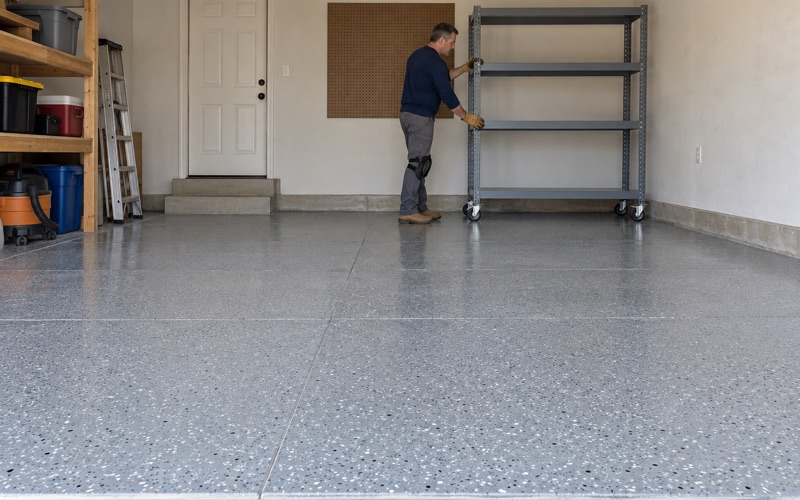
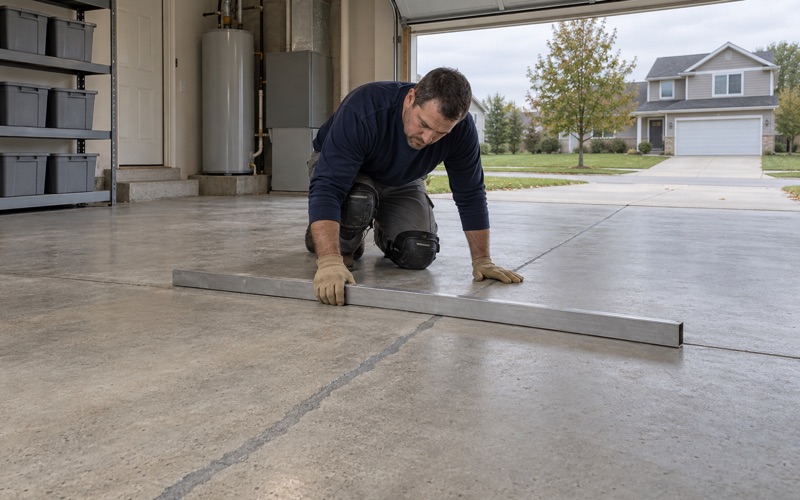
A garage floor in central Iowa takes brine and rock salt off the tires from November through March, along with whatever drips from the vehicle. On bare concrete that shows up as staining, and over several winters it can show up as freeze-thaw scaling at the surface. A renter looking at that floor sees an easy upgrade; the owner may see it differently.
The model residential code asks that a garage’s parking area slope toward a drain or the main vehicle door so liquids move off it. A coating follows that slope and does not create it. Meltwater still runs wherever the slab was built to send it, which is why the texture on the finished surface matters on a rental that someone else will walk across later.
Looking for epoxy-flooring closer to Saylorville? See Epoxy-Flooring in Saylorville.
Whose Floor Is It? Iowa’s Deposit Rules and a Coated Garage
What Iowa Code 562A.12 lets a landlord keep
Iowa’s rental deposit statute, Iowa Code 562A.12, caps a deposit at two months’ rent and limits what a landlord may withhold from it. One permitted reason is the amount reasonably necessary to restore the dwelling unit to its condition at the commencement of the tenancy, ordinary wear and tear excepted. That phrase is the one a coated garage floor gets measured against.
The statute also puts the burden of proving the reason for withholding on the landlord, and a landlord who keeps a deposit in bad faith can face punitive damages of up to twice the monthly rent. Those rules cut both ways for a coated floor. They protect a tenant from a vague deduction, and they give an owner a clear basis to charge for an alteration nobody approved.
Ordinary wear and tear versus a new coating
Tire marks, light staining and the slow dulling of a slab are the kind of change a garage picks up from normal use. A coating is not wear. It is a deliberate change to the surface, and if it went down without the owner’s agreement, a landlord could treat it as something the unit has to be restored from at move-out.
That is where a tenant-installed floor can turn expensive. A peeling or mismatched coating that has to come off means grinding it back to concrete, and the cost of that work can land on the move-out statement. A coating the owner agreed to in writing, installed as the system both sides named, is much harder to describe as damage.
The itemized statement within thirty days
Under the same section, a landlord has thirty days after the tenancy ends and the tenant’s mailing address arrives to either return the deposit or send a written statement giving the specific reason for withholding. If money is kept for restoration, that statement has to specify the nature of the damages rather than naming a lump sum.
A landlord who sends no statement within thirty days forfeits the right to withhold. For a garage floor, the itemized statement is where an unapproved coating would appear, described as the restoration needed. Keeping the consent note and our proposal with the lease gives both parties something concrete to point to if that line ever shows up.
Get Consent in Writing and Agree on the System First
What the consent should cover
We ask tenants to bring the owner’s written consent before we put a grind on the schedule. A text that says sure is better than nothing, but a short signed note naming the address, the garage, the system and whether the coating stays at move-out settles far more. Leases differ, and some may speak to alterations, so the lease gets read first.
The most useful line in that note covers the end of the tenancy. If the owner agrees the floor stays as an improvement, the note should say so. If the owner wants the original concrete back, the tenant learns before spending anything that removal is part of the bargain, and that usually decides whether the project is worth doing at all.
Our proposal as the shared record
Every proposal we write names the product line, the number of coats and the finished thickness, so the floor can be checked against the quote. On a rental that document does double duty: the owner can approve a specific system rather than a loose idea, and the finished floor can be compared with exactly what was signed.
Before pricing, we also map cracks, spalls and any old coating on the slab, and we say plainly when a repair or replacement should come first. That map records the condition of the concrete before the work, which is the same starting point the deposit statute measures restoration against. Whoever pays gets a copy, and both parties can keep one.
Preparation and moisture, whoever is paying
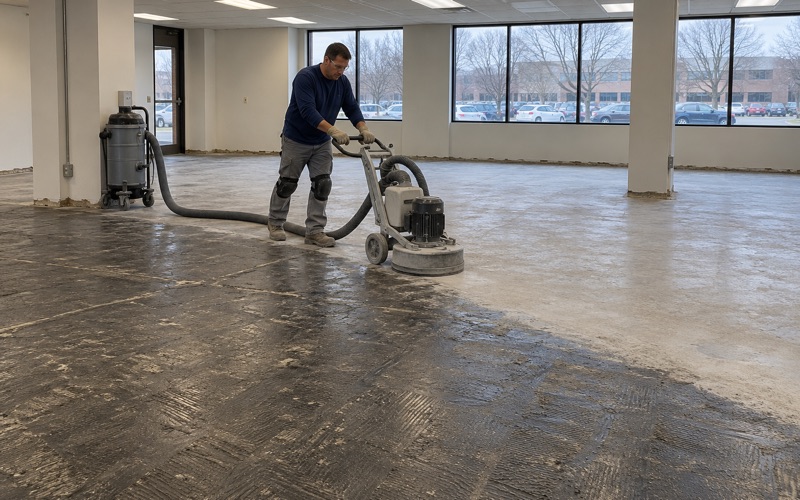
The prep does not change because the occupant rents. We open the slab with a diamond grinder or a shot blaster to an ICRI concrete surface profile the coating can bond to, never an acid etch, and the grinding dust is captured at the machine by vacuum instead of being rinsed toward a floor drain or out the garage door.
A moisture test is written into the scope before the price is final, however new the house is, because a newer slab is not proof of a drier one. Depending on the floor, that can be an ASTM F1869 calcium chloride test or ASTM F2170 relative humidity probes, and the result decides whether a moisture-mitigation primer goes down before anything else.
When the Owner Orders the Floor Between Tenancies
Coating at turnover
Some owners would rather settle the question themselves and coat the garage between tenants. Ordering the floor directly makes it part of the unit’s condition at the start of the next tenancy, which is the condition the deposit statute uses as its baseline. A move-in record that notes the coated floor keeps that baseline clear for everyone.
Turnover windows are short, so cure time becomes the planning problem. We set cure schedules by slab temperature and the dew point spread at the surface, not by the calendar, and an unheated garage in a central Iowa winter waits until conditions allow. A polyaspartic topcoat can shorten the return to service, and we say when that trade is worth making.
A system built for the next renter
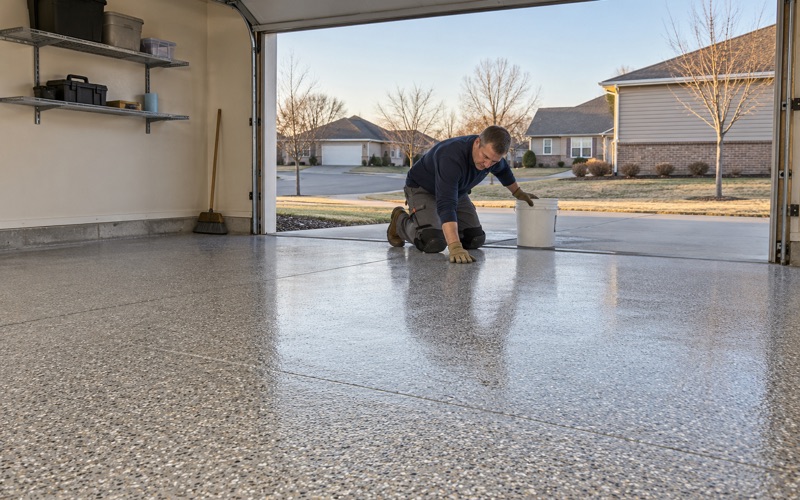
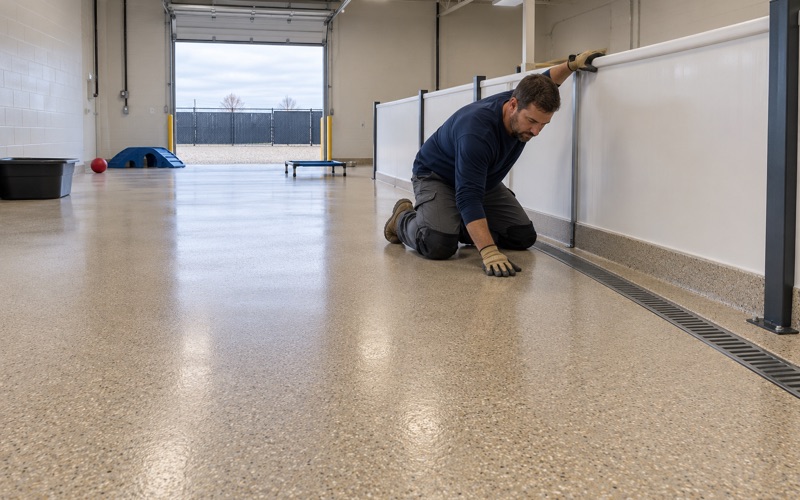
A rental garage gets parked in by people the owner may never meet, so we choose systems for the brine and rock salt that ride in on tires each winter and for resistance to hot tire pickup over a 100% solids epoxy base. A vinyl flake or quartz aggregate broadcast under the topcoat sets the texture, and slip resistance is specified by that broadcast, not promised.
We also explain what the coating warranty excludes before the job is sold, and moisture vapor transmission is the first exclusion we name. For an owner with several units, that conversation matters more than the color chart. A floor that fails from moisture rising through the slab is not a workmanship claim, and knowing that upfront is part of deciding whether a slab is ready.
Shared walls and the paperwork afterward
Attached homes share walls, and the household on the other side of one may be another tenant. We offer low-odor products for attached garages as a comfort and re-entry choice, never as an Iowa legal requirement, and we schedule the loud grinding for hours the owner and the neighbors can work around.
When the work is finished, the owner gets the proposal, the moisture result and the condition map together. Filed with the next lease, those papers describe the garage floor as it stood when the new tenancy began, which is the record anyone will reach for when the keys come back and the deposit is settled.
- 20+ Years on Iowa Slabs
- Moisture Tested Before Pricing
- Coats and Thickness in Writing