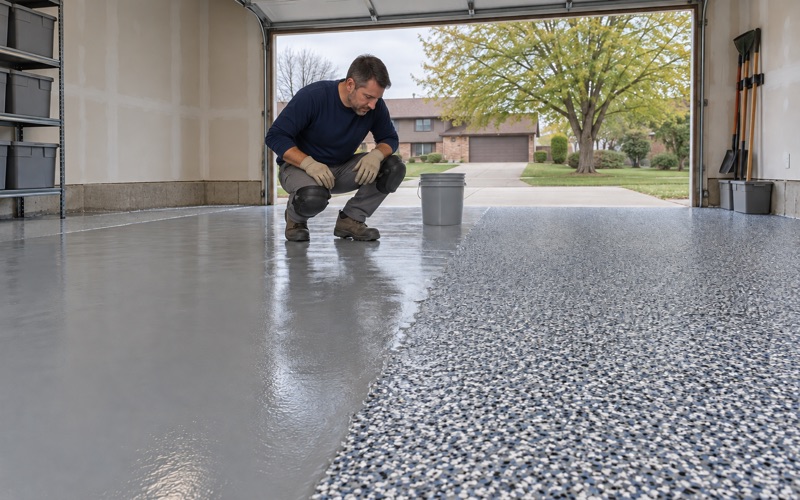
Urbandale Epoxy Flooring has spent more than 20 years putting epoxy flooring in Polk City garages, basements and work spaces, and on a newer house the first thing we ask about is not color. We ask how old the slab is and whether the first year of the builder warranty is still running. That answer decides what happens before any grinder touches the concrete.
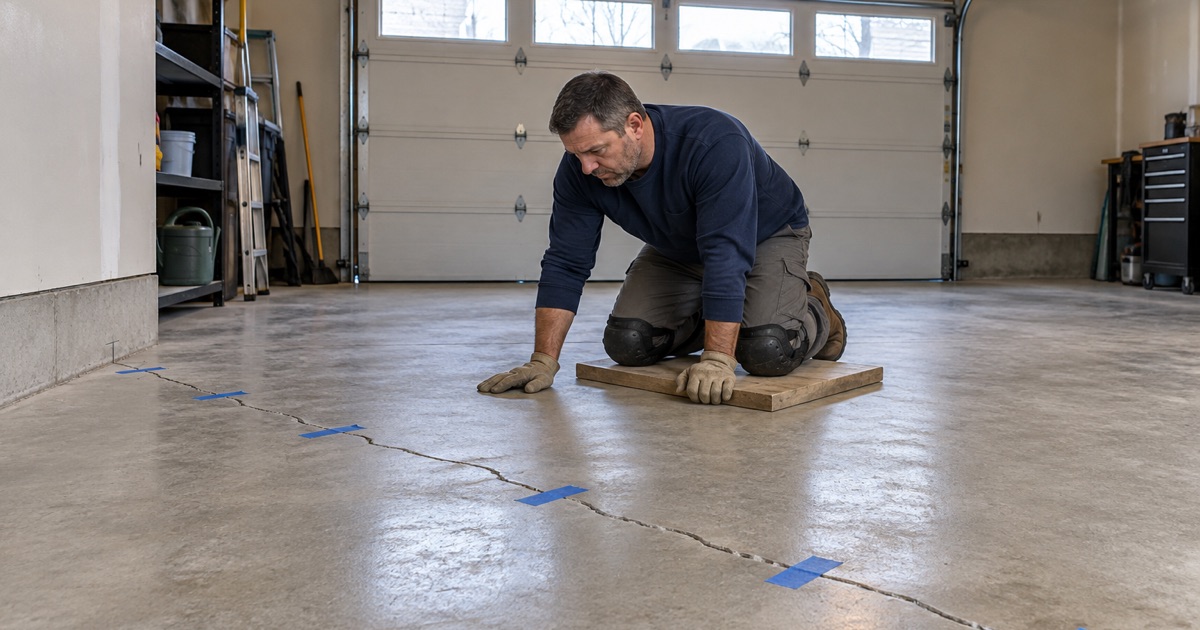
A coating covers more than oil stains. Once flake and topcoat are down, nobody can read how wide a crack was or whether one side sits higher than the other, and those two measurements are exactly what a new-home warranty tends to ask about. So on a young house we record the cracks first, let the homeowner settle any question with their builder, and coat afterward.
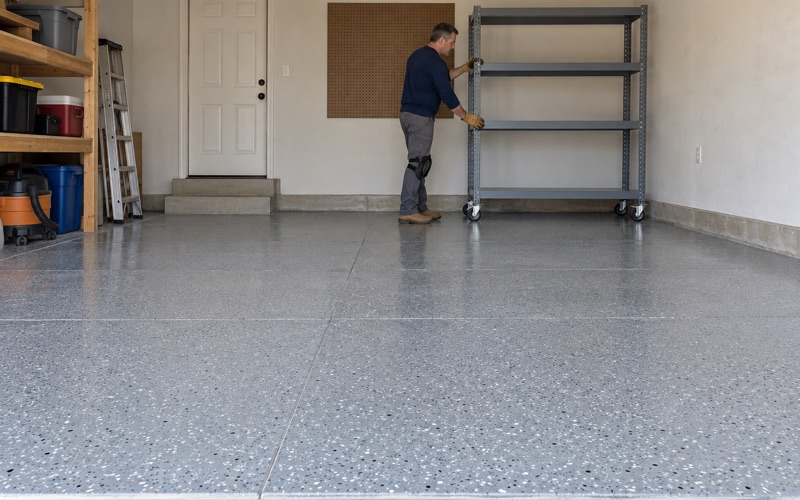
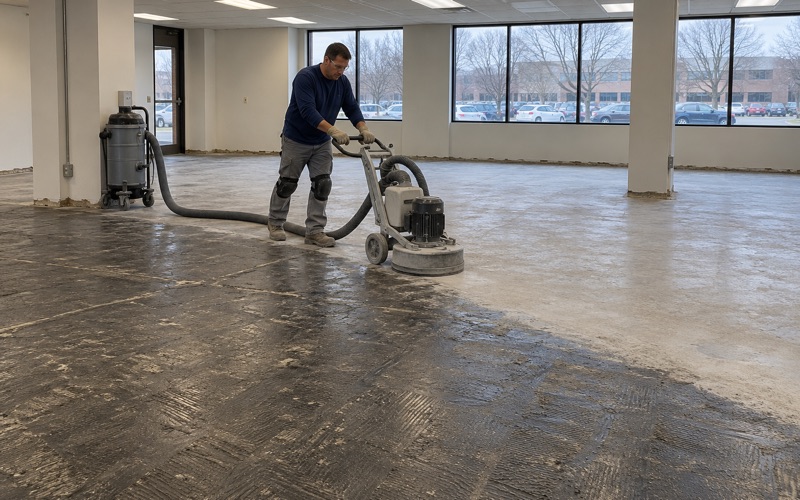
Everything else follows the way we work on any slab. We open the surface with a diamond grinder or a shot blaster, write a moisture test into the scope, and name the product line, coat count and finished thickness in the proposal, so the finished floor can be checked against the paper it was sold on.
Antler Ridge and the Newest Streets in Polk City
A third plat coming online
Polk City is still adding streets. Antler Ridge, south of the marina, began with a first plat of wooded executive lots on E Autumn Trail Circle. A second plat added 21 lots on E Red Cedar Drive, and a third plat of 25 lots is marketed as build-ready in summer 2026, with lots listed from .27 acre up to a full acre.
Those lots are sold bring-your-own-builder, and Lennar also lists plans for the community, including the Ringgold, a 2,533-square-foot plan with a 3-car garage shown as a future release. That mix matters to us. One street can hold houses from several builders, each with its own paperwork, and a three-bay slab is a lot of concrete to read before it is coated.
A young, owner-occupied housing stock
The neighborhood fits a larger pattern in town. Census estimates count 2,231 housing units in Polk City, and 601 of them were built between 2010 and 2019, with another 227 since 2020. Of the 2,184 occupied homes, 1,947 are owner-occupied, so most garages we walk into belong to the people who will live with the floor for years.
A newer house is not proof of a drier slab, so we test the garage whatever year it was built. What age does change is a different question: on a house still in its first year, the cracks in the garage floor may be a builder conversation before they are ours.
Looking for epoxy-flooring closer to Ankeny? See Epoxy-Flooring in Ankeny.
What a New-Home Warranty Says About Garage Slab Cracks
The 1/4 inch line in a common standard
Builders in this market use different warranty programs, and which one applies to a given Polk City house is something each homeowner confirms in their own documents. A widely published third-party standard, the Residential Warranty Company manual, shows how these programs tend to think. Under its Year 1 coverage, the builder will correct attached garage slab cracks that exceed 1/4 inch in width or in vertical displacement.
The same manual carries related items. Cracks in the concrete floor of unfinished areas use the same 1/4 inch threshold, and a floor crack that ruptures or significantly impairs a floor covering is corrected so it is not readily noticeable with the covering in place. Other published standards use the same figure, and one industry slide cites 3/16 inch for slabs, which is why the actual document matters.
Coverage that ends at year one
In that standard, these slab items sit under Year 1 coverage only. After the first anniversary, a garage crack that opens wider is no longer on that list. That timing is why we ask for the closing date early in a Polk City estimate, before anyone talks about flake blends or topcoat sheen.
We are not a party to any builder’s warranty, and we do not advise on how a claim should be argued. What we can do is make sure the floor’s condition is recorded before our work changes what anyone can see, so the homeowner holds the evidence if they decide to raise it.
Reading the paperwork you were handed
The Lennar community page for Antler Ridge carries a warranty and service request link but shows no warranty terms, so the terms live in each buyer’s closing documents. A bring-your-own-builder lot may come with an entirely different program. We ask homeowners to pull theirs out before our visit, because the threshold and time window in that document are the ones that count.
Look for the section on concrete or slabs, the size of crack it covers, whether it measures width, vertical displacement or both, and when that coverage ends. If the document is silent or unclear, the builder’s service department is the place to ask, and their answer shapes our schedule rather than the other way around.
The First Year: Measure, Photograph, Then Ask the Builder
What we record on a young slab
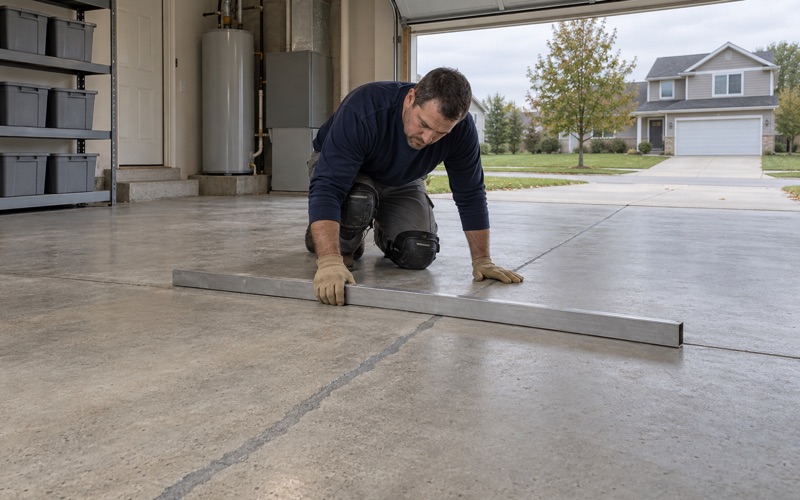
Before a first-year garage is priced, we map every crack, spall and patch, the same as we would on any slab. On a young house we add a tighter record: width at several points along each crack, any height difference across it, and its length and position relative to the door and walls. Each reading is photographed with a gauge or ruler in the frame.
Those photographs go to the homeowner with the dates on them. If a crack reaches the threshold in their warranty, they have something specific to put in front of the builder through the builder’s own service request process. If nothing comes close, the record still shows what the slab looked like the day before it was ground.
Why the coating waits
A coating ends the conversation the moment it cures. A flake broadcast over a pigmented base coat hides width and offset, and any repair a builder made later would mean cutting through a floor the homeowner just paid for. Waiting a few weeks for an answer costs far less than either of those outcomes.
So in a Polk City garage still inside its first year, we book the work after the warranty question is settled, one way or the other. The homeowner decides when that point arrives. We simply do not grind over a crack that someone may still want measured.
Shrinkage cracks are expected
Most cracks in a new garage are not warranty items at all. Concrete shrinks as it dries, and the RWC manual says plainly that shrinkage cracks are common and should be expected. Hairline cracks well under 1/4 inch, with no step across them, are the normal condition of a young slab rather than a defect.
We tell homeowners that early, because a garage with a dozen fine lines can look alarming. Those are the cracks we treat as part of the slab: cleaned out during grinding, filled where the system calls for it, and coated over. The ones worth a builder’s look are wide or offset, and the gauge settles which is which.
Coating the Garage Once the Warranty Question Is Settled
Prep and moisture, the same on every slab
Once the homeowner gives the go-ahead, the floor is prepared like any other. Diamond grinding or shot blasting opens it to the ICRI concrete surface profile the product calls for, never an acid etch, with dust pulled into a vacuum at the machine. Moisture testing, typically ASTM F2170 in-situ relative humidity probes or an ASTM F1869 calcium chloride test, is part of the scope before the price is final.
A new slab and a dry slab are not the same thing. The residential code lets many garage slabs go in without an under-slab vapor retarder, so the test result picks the primer. Where readings run high, a moisture-mitigation primer goes into the proposal, and moisture vapor transmission is the first warranty exclusion we explain before the job is sold.
Cracks that stay, and what a coating can do with them
A coating does not stop a crack from moving. Hairline shrinkage cracks are ground clean and filled before the base coat so they read as quiet lines instead of open seams. If a crack is still active, we say so and tell the homeowner it may show through again, rather than promising a floor the slab cannot deliver.
Where a slab has bigger problems, such as spalling, heaving or a section that rocks under weight, we say plainly that repair or replacement should come first. On a first-year house that conversation usually belongs with the builder, which is one more reason the measured record comes before the grinder.
A system built for an Iowa garage
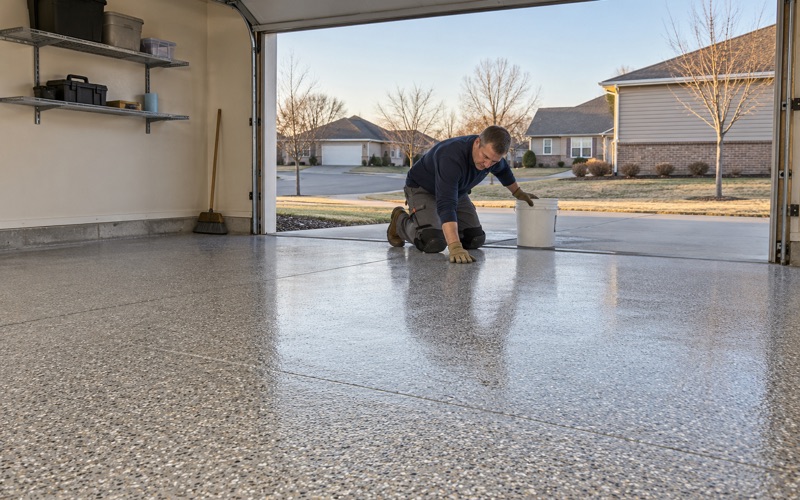
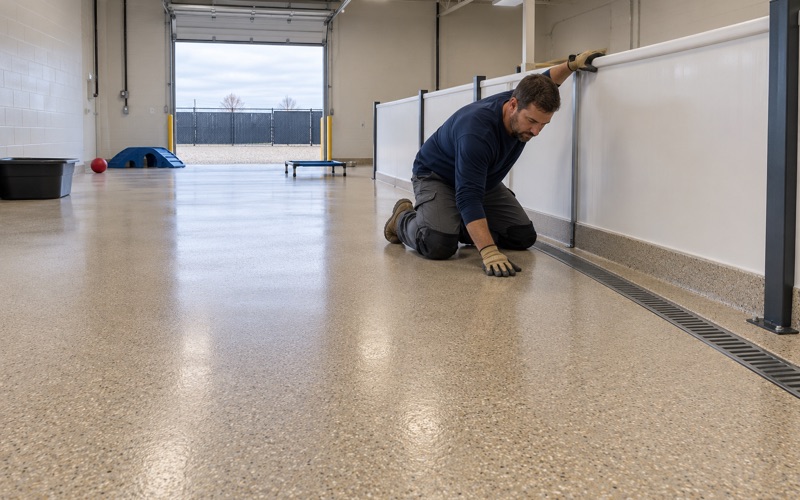
Garage systems here are chosen for the brine and rock salt that ride in on tires from November through March. A 100% solids epoxy base with a vinyl flake or quartz aggregate broadcast, finished with a polyaspartic or polyurea topcoat, holds up to calcium chloride deicers and hot tire pickup, and the broadcast and topcoat together set the slip resistance.
Cure follows slab temperature and the dew point spread at the surface, not the calendar, so an unheated garage in a central Iowa winter waits for the right conditions. Low-odor products are available for an attached garage as a comfort choice. The proposal lists product line, coats and finished thickness, so the new floor can be checked against what was quoted.
- 20+ Years on Iowa Slabs
- Moisture Tested Before Pricing
- Coats and Thickness in Writing