
Urbandale Epoxy Flooring grinds and finishes polished concrete floors in Urbandale, IA, serving surrounding cities including Clive, Grimes, Windsor Heights, Johnston, West Des Moines. With 20+ years of working Iowa slabs, we polish showrooms, offices, warehouses, basements and open living areas, and we start every polished floor with a test area on your own concrete rather than a promise drawn from a brochure.
Polished concrete is not a coating. The slab itself is ground with progressively finer diamond tooling, hardened with a densifier and refined until it reflects light, so there is no film on top to peel, blister or wear through at the traffic paths.
That also means the slab decides the result. The stone in the mix, the way it was troweled and every patch and crack already in it will show in the finished floor, which is why we grind a sample before anyone signs off on a look.
How a Polished Concrete Floor Is Built
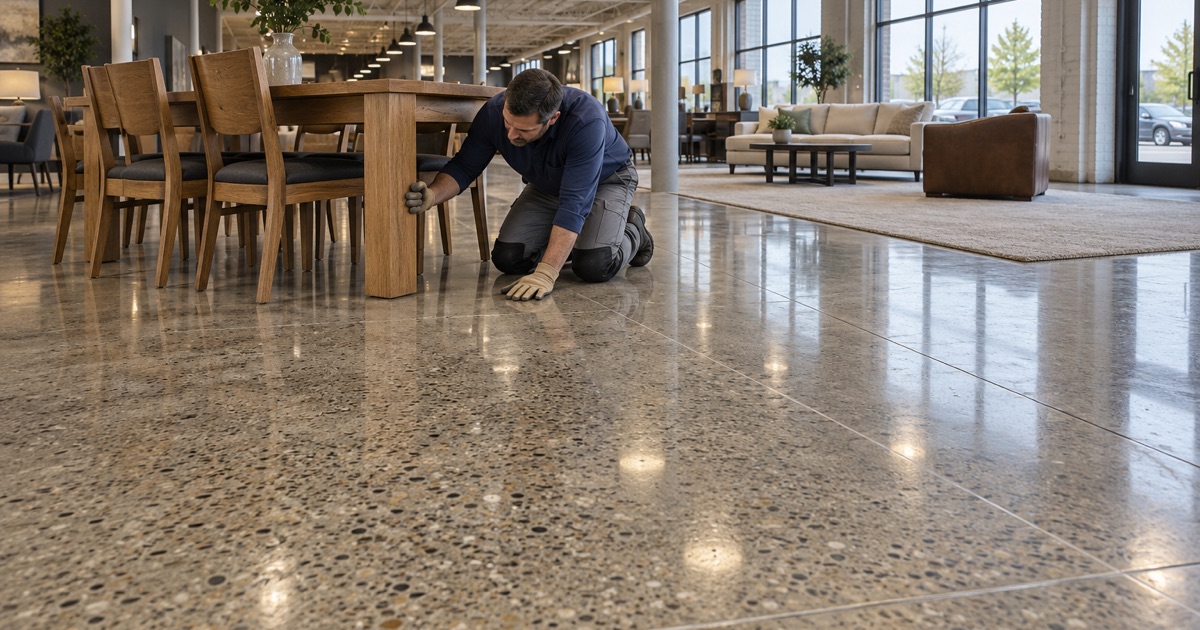
Grinding Through the Grit Sequence
Polishing begins with coarse metal-bond diamonds that open the surface and set the depth of the cut. Each later pass uses a finer grit to remove the scratches of the one before it, until the floor moves to resin-bond pads that build clarity and shine.
Skipping a step in that sequence leaves scratch patterns that show up as haze when the light hits the floor at an angle. On a big showroom floor those swirls are the first thing a customer notices, so each grit gets a full pass before we move on.
Lithium Silicate Densifier
Partway through the grind, we apply a lithium silicate densifier. It reacts with the free lime in the concrete to form a harder surface, which takes a better polish and holds up longer under foot and cart traffic.
Lithium densifiers penetrate without leaving the white residue some older sodium products did. On older slabs we may apply the densifier more than once if the concrete is soft or porous, and we test the hardness before the final polish passes.
Grout to Fill Pores and Pinholes
When grinding exposes aggregate, it also opens air pockets and pinholes in the paste. We work a grout coat into the surface during the early passes to fill them, so the finished floor reads as continuous instead of pocked.
This step matters most on salt and pepper and full aggregate floors, where the grind cuts into the stone and the paste between it. A floor polished without grout can trap dirt in every pinhole within the first year of service.
Guard and Final Sheen
A penetrating guard goes on near the end to resist staining, and the final pad sets the sheen. A satin polish hides scratches and dust in a busy space, while a high polish gives the mirror look you see in showrooms and lobbies.
The guard is a maintenance layer, not a coating, and it wears with traffic. Busy floors get a periodic cleaning and burnish to keep it working, and we leave a written care sheet that names the cleaner and the pad to use so a janitorial crew does not strip the shine with the wrong chemical.
Choosing an Aggregate Exposure
Cream Finish
A cream finish polishes the very top of the slab with almost no stone exposed. It keeps the troweled look of the original concrete and needs the shallowest grind, but it also shows trowel marks, color variation and old patches more plainly than a deeper cut.
Cream polish suits newer slabs that were finished flat and carefully, and rooms where the owner wants the floor to read as smooth gray concrete rather than terrazzo. On an older slab with years of patching, a cream finish can show every repair, so a slightly deeper grind is often the better trade.
Salt and Pepper
A salt and pepper finish grinds just deep enough to expose fine sand and small aggregate. It reads as a subtle speckle and hides wear well, which makes it a common choice for offices and retail floors that want texture without the bold look of exposed stone.
Because the grind is still fairly shallow, salt and pepper keeps the cost and dust of the job below a full aggregate cut. It is also forgiving of small dips in the slab, since the fine sand shows fairly evenly even where the floor is not perfectly flat.
Full Aggregate
Full aggregate exposure grinds deeper to reveal the larger stone in the mix. The look depends entirely on the stone the slab was poured with, and a slab that was poured flat may expose stone unevenly across humps and dips, which is why a test area matters most here.
The Concrete Polishing Council’s exposure classes rely on the mix, placement and finishing of the concrete already there, and its own chart calls for a mock-up on the actual slab. In Urbandale, Homemakers Furniture’s showroom renovation on Douglas Avenue mixed aggregate concrete with plank tile across its floor, a reminder that exposure is chosen room by room.
Where Polished Concrete Works Best
Showrooms and Retail
Retail and showroom floors get a lot of foot traffic and need to look good under bright lights. Polished concrete handles that traffic without a coating to wear through, and it can be phased in enclosed sections, early in the morning or overnight, so a store stays open.
Fixtures and displays move section by section, and the finished areas are back in use as soon as the last pass is done. Floor outlets, columns and racking anchors are worked around with hand grinders so the edges match the open floor rather than leaving a dull ring around every obstacle.
Offices, Lobbies and Open Living Spaces
Lobbies, open offices and finished basements benefit from a floor that reflects light and needs no wax. A salt and pepper or cream finish with a satin sheen suits most of these rooms, and the floor can take rolling chairs without the dents a softer floor would show.
In a basement, polishing makes sense only where the slab stays dry and sound, and it brings one advantage over a coating: there is no film for vapor to push off the floor. We still test the slab first, because a damp floor can show dark blotches and efflorescence that no polish will hide.
Warehouses and Light Industrial Floors
In warehouses, densified and polished concrete reduces dusting from forklift and pallet jack traffic and is easier to sweep. Where a floor sees chemical spills, oil or standing water, a coated system may suit it better, and we will say so when the use calls for it.
On a warehouse floor we also look at the joints. Forklift wheels batter open joint edges, so we fill them with a semi-rigid filler before polishing, and we can mark aisle lines and safety zones with a durable striping product that bonds to the polished surface.
Our Step-by-Step Polished Concrete Process
Step 1: Slab Survey and Test Area
We check the slab for cracks, patches, adhesive and old sealers, then grind a test area to show the exposure and sheen the floor can actually give. The proposal names the exposure class, the final grit and the sheen.
Step 2: Removal and Repairs
Old coatings, sealers and mastic are ground off, and cracks and joints are filled with a material chosen to match or contrast as you prefer. Repairs on a polished floor stay visible, so we agree on how they will look before filling.
Step 3: Grinding, Densifying and Grouting
The floor is ground through the metal-bond grits, densified, and grouted to fill pinholes. Dust is captured at the machine by vacuum throughout, so the rest of the building stays clean.
Step 4: Polishing and Guard
Resin-bond pads refine the surface to the agreed sheen, and the guard is applied and burnished. The floor is ready for foot traffic as each area is finished, since there is no coating that has to cure.
- 20+ Years on Iowa Slabs
- Moisture Tested Before Pricing
- Coats and Thickness in Writing