Urbandale Epoxy Flooring has spent more than 20 years on epoxy flooring in Pleasant Hill and across central Iowa, and a growing share of that work starts with a floor that already has something on it. Paint, an old epoxy, a worn urethane: before a new system goes down, the old film has to come off cleanly and the concrete underneath has to be opened up.
We open every slab with a diamond grinder or a shot blaster rather than an acid etch, which gives the new coating a real profile to bond to. The same pass that profiles bare concrete is the one that takes an old coating off, so removal and preparation are usually one step on our schedule, not two.
Before we price anything, we walk the floor and map cracks, spalls and whatever coating is already there. If the slab ought to be repaired or replaced before it is coated, we say so plainly. The proposal then names the product line, the number of coats and the finished thickness, so you can check the floor against what you paid for.
Southeast Polk’s Summer Flooring Renewal
A district-wide refresh ahead of the school year
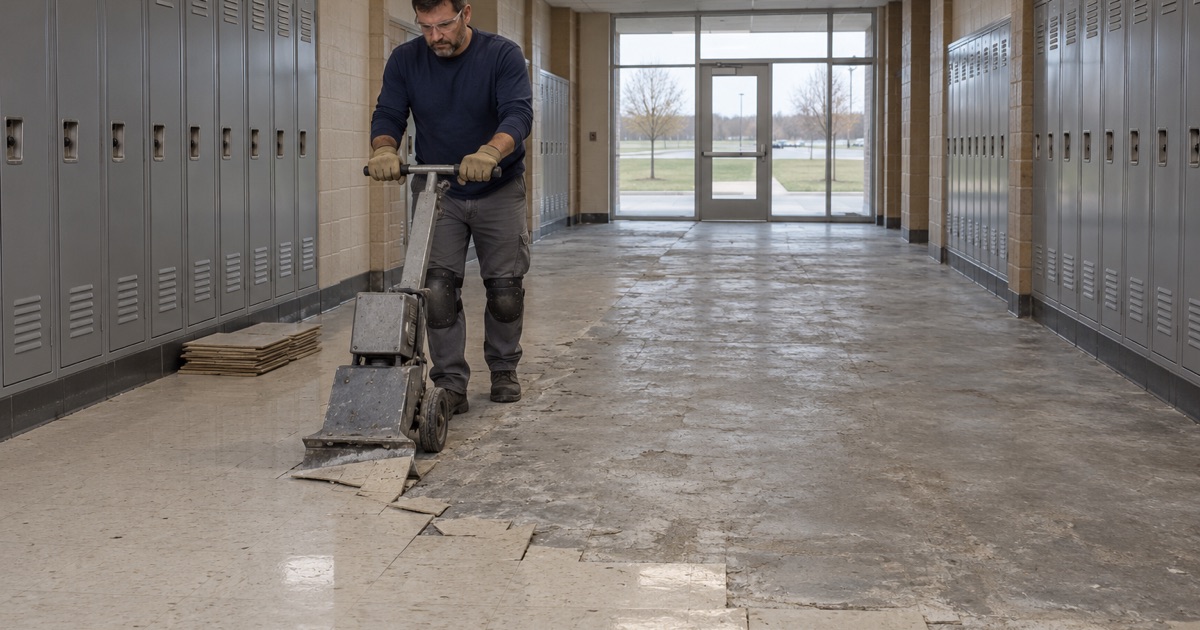
Southeast Polk, whose district office sits at 8031 N.E. University Ave. in Pleasant Hill, listed a set of summer 2026 facility improvements on its Construction Central page. Among them was the renewal of interior paint and flooring in selected areas of district facilities, targeted for August 2026, before the 2026-2027 school year began.
The district did not publish which buildings or rooms were included, and the work may have been carpet, tile or coatings. We had no part in it and have no relationship with the district. We mention it because it is the most visible example in town of a question every building owner eventually faces: what happens to the floor that is already there.
Why the old floor is the hard part
Laying a coating on clean, bare concrete is predictable. Taking a tired film off a slab that has carried years of traffic, spills and cleaning chemicals is where schedules slip and budgets stretch, because the old layer hides what is under it until it is gone.
That holds in a classroom, a plant break room or a two-car garage. The film might be a single coat of paint, a thick epoxy peeling at the edges, or a patchwork applied over the years by different owners. Each comes off differently, and the removal method decides most of what follows, from the equipment on site to how long the room stays closed.
More district work still ahead
Voters approved a 51 million dollar Southeast Polk bond in November 2025 with no levy-rate increase. Its list includes a junior high renovation that moves the main office to the building entrance and expands the student commons, plus transportation and maintenance facilities where earthwork and underground utilities were underway in June 2026.
Looking for epoxy-flooring closer to Altoona? See Epoxy-Flooring Services in Altoona.
Methylene Chloride Strippers: Banned for Commercial Use Since April 2026
What the federal rule says
For decades, the fastest way to soften an old coating was a methylene chloride stripper brushed on and scraped off. Under the TSCA rule at 40 CFR 751.107, industrial and commercial use of methylene chloride has been prohibited since April 28, 2026. Distribution to retailers was cut off in February 2025, and distribution for commercial use ended in January 2026.
The only paint and coating removal use left under the rule’s workplace program covers safety-critical, corrosion-sensitive components of aircraft and spacecraft. A concrete floor in a school hallway or a shop is neither. A separate interim allowance for refinishing wooden furniture and historic architectural fixtures runs to May 2029, and it does not reach a slab either.
What the rule does not say
The ban covers one chemical. Other stripper chemistries are still sold, and nothing in the rule makes every chemical stripper illegal. What changed is that the product that once cut through a thick floor epoxy quickly is no longer an option for a commercial crew on any floor.
For a floor that is about to be recoated, any chemical approach still ends with the concrete being ground or blasted to open a profile. We skip straight to the step that has to happen anyway, which keeps a second process, and a second set of fumes, out of the building.
Why our method did not change
Our own practice never relied on strippers or acid etching. We open slabs mechanically because a coating bonds to profile, not to concrete that merely looks clean. The rule left our method where it was, but it took away the one stripper that used to make a no-grind removal look tempting on a bid.
Grinding, Shot Blasting and Scarifying an Old Film
Diamond grinding with PCD tooling
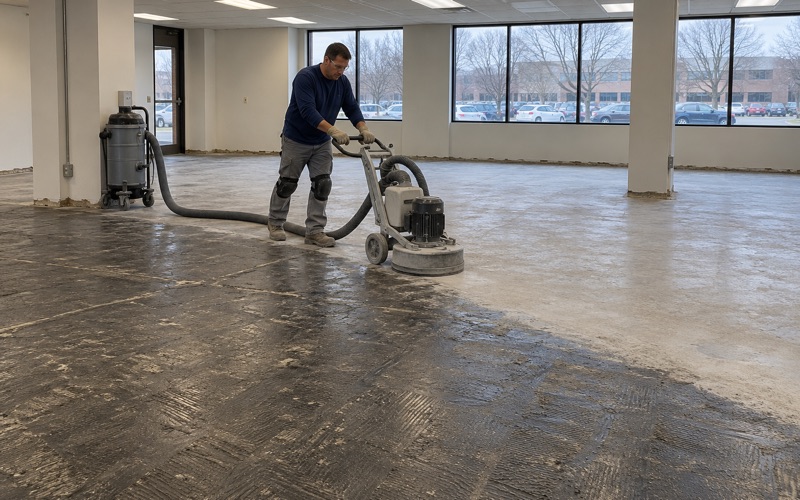
Diamond grinding is our default for most floors with an old film. Thick or gummy coatings load up ordinary diamonds quickly, so we start with PCD tooling, polycrystalline diamond segments that shear the coating rather than polishing it, then switch to metal-bond diamonds to set the profile. Edges and corners get a smaller hand grinder.
Grinding gives fine control over depth, which matters on a slab that has been patched or has thin spots. It typically leaves a profile in the ICRI CSP 2 to 3 range, which suits most 100% solids epoxy and polyaspartic systems without cutting deeper into the concrete than the coating needs.
Shot blasting for large open floors
On a large, open slab, a shot blaster throws steel shot at the surface, knocks the coating loose and recycles the shot through a vacuum separator. It covers open floor fast and leaves a rougher profile, which suits thicker build systems such as urethane cement in a plant or a commercial kitchen.
Shot blasting does not reach tight to walls or around columns, so grinding finishes the perimeter. It also leaves a visible pattern on any area that will not be coated, which is worth knowing before a blaster runs across a doorway into a finished room.
Scarifying when the layer is thick
A scarifier uses rotating cutter wheels to chip away a heavy buildup: many coats of paint, a thick mortar-filled system, or a high spot that needs leveling. It is aggressive and leaves deep grooves, so we follow it with grinding to bring the surface back to a profile a coating can use.
Scarifying is the right call less often than people expect. On most garage and commercial floors, one or two coats of old epoxy come off with PCD grinding, and the deeper cut a scarifier makes only adds patching. We decide after mapping the floor and trying a small area, not from a photo.
Dust, Noise and Pleasant Hill Floors With an Old Coating
Capturing the dust at the machine
Every grinder and blaster we run is hooked to a vacuum, so dust is pulled off the floor at the tool rather than swept, blown or washed toward a floor drain or a storm inlet. Old coating is part of that dust, and an occupied building, a shared townhouse wall or a neighbor’s open garage door is close enough to matter.
In a building that stays partly open, we isolate the work area with plastic sheeting and keep the vacuum running through cleanup. The goal is that the room next door never learns about the job from a film of gray powder on its shelves.
How removal sets the work window
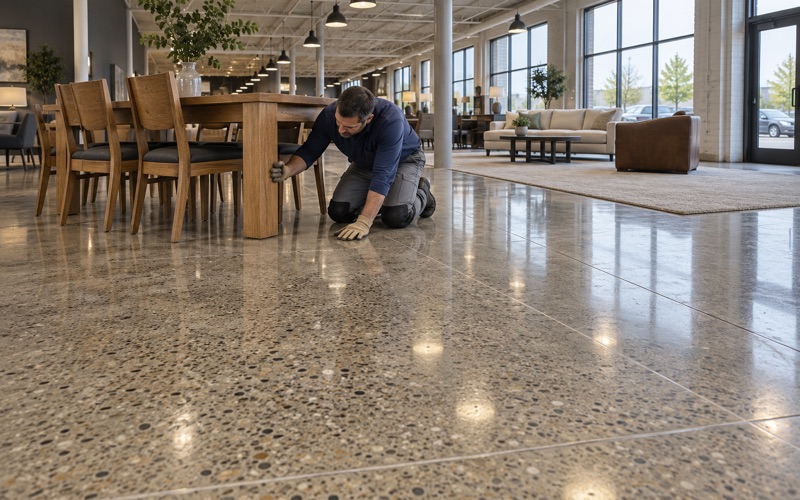
Removal is the loud part of a coating job. A grinder or blaster running on concrete is hard to work beside, so in offices, flex bays and warehouses we phase the floor around tenants and business hours, with night and weekend windows when a space cannot close.
Removal also sets how long the floor is out of service. A thin paint may come off in an afternoon, while a thick, well-bonded epoxy over a large room can take longer than laying the new system. Once the film is off, cure schedules follow slab temperature and dew point rather than the calendar, so the total window depends on both.
Garages, townhouses and shops
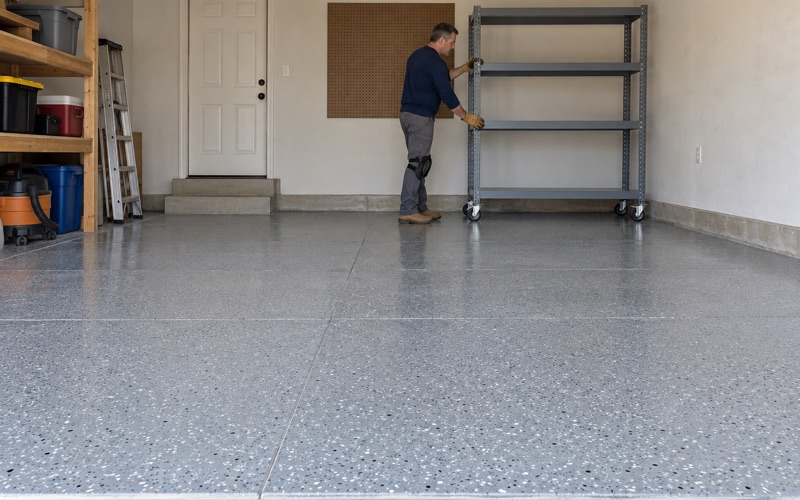
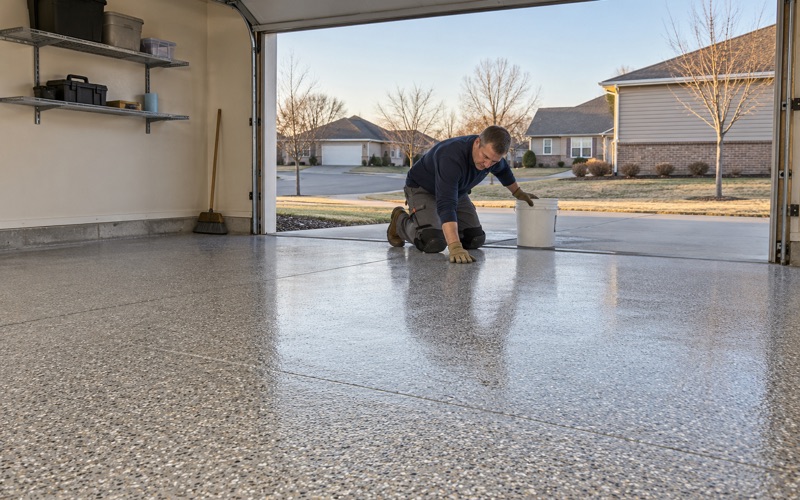
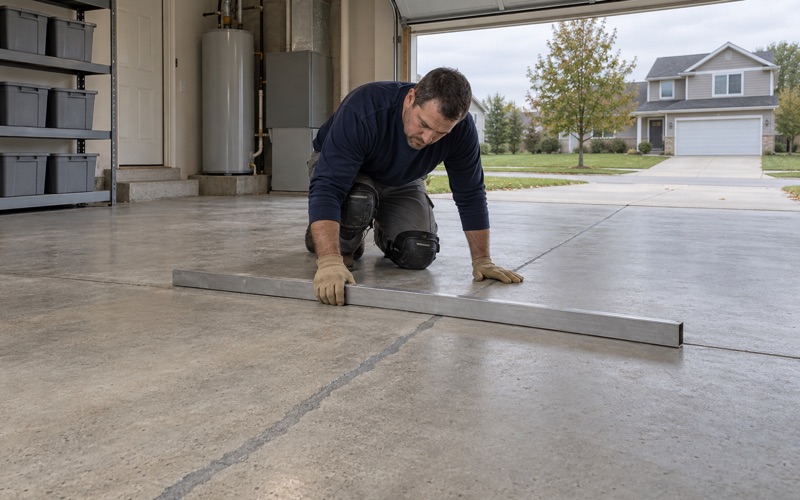
Most Pleasant Hill homes are fairly young: about two-thirds of housing units were built between 1990 and 2019, and roughly one owner in seven lives in a single-family attached home. Many of those garages carry an older floor paint or a kit epoxy, and when it starts lifting, the fix begins with taking it all the way off.
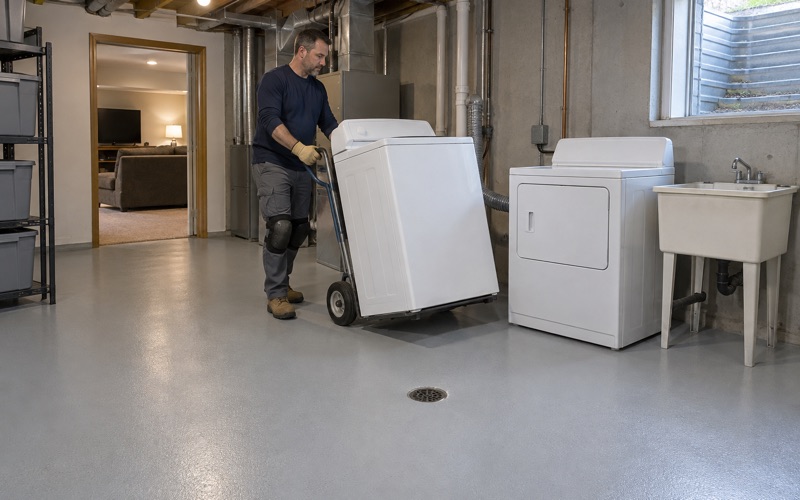
A newer house is not proof of a drier slab, so we test the garage floor whatever year it was poured, and the moisture test is written into the scope before the price is final. Moisture is also the first exclusion we name when we explain the warranty. The new system is chosen for the brine and rock salt that ride in on tires from November through March.
In an attached townhouse garage, we can offer a low-odor product as a comfort and re-entry choice. On the commercial side, Pleasant Hill holds part of Dee Zee’s operations, an aftermarket automotive accessories maker on the Greater Des Moines Partnership’s major employer list. With methylene chloride gone, any commercial coating removal on floors like those starts with a grinder or a blaster.
- 20+ Years on Iowa Slabs
- Moisture Tested Before Pricing
- Coats and Thickness in Writing