Urbandale Epoxy Flooring has spent more than 20 years installing epoxy flooring in Norwalk and across central Iowa, and the question that shapes a job most is rarely the color of the flake. It is who will be breathing the air in the building while the floor cures. For a garage behind a house, that is usually a family that can leave for a day. For a building where people live and sleep under staff care, the answer changes the coating we recommend.
So this page is about chemistry before it is about appearance. We explain what the common topcoats are made of, how we read a product’s safety data sheet before a date goes on the calendar, and how a work zone is closed, vented and reopened. Where a building cannot be arranged around that, we say so and price a different system.
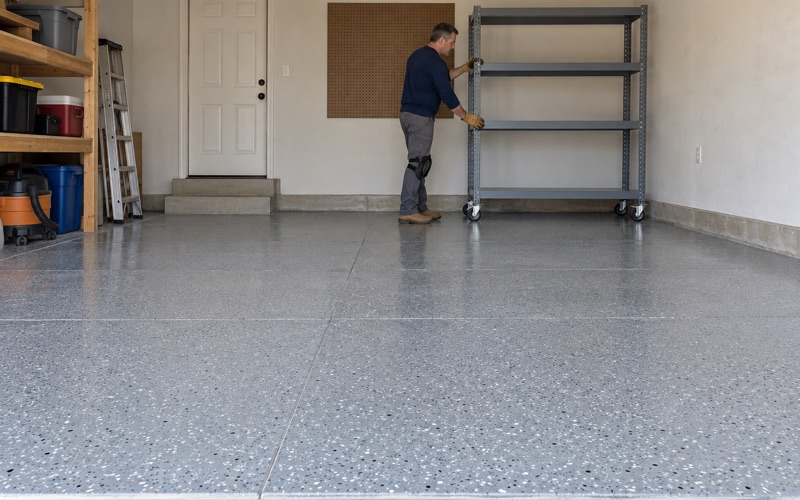
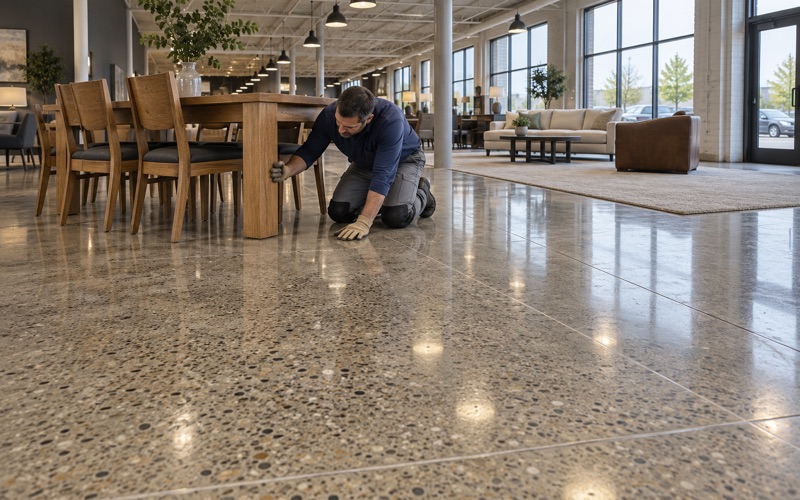
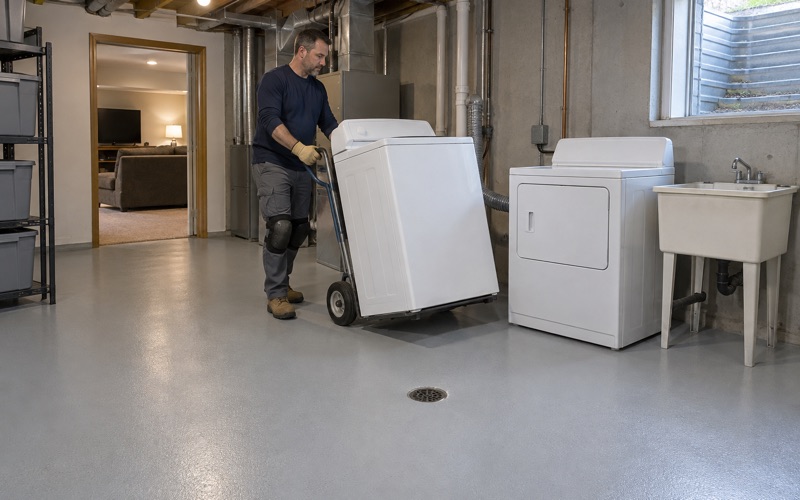
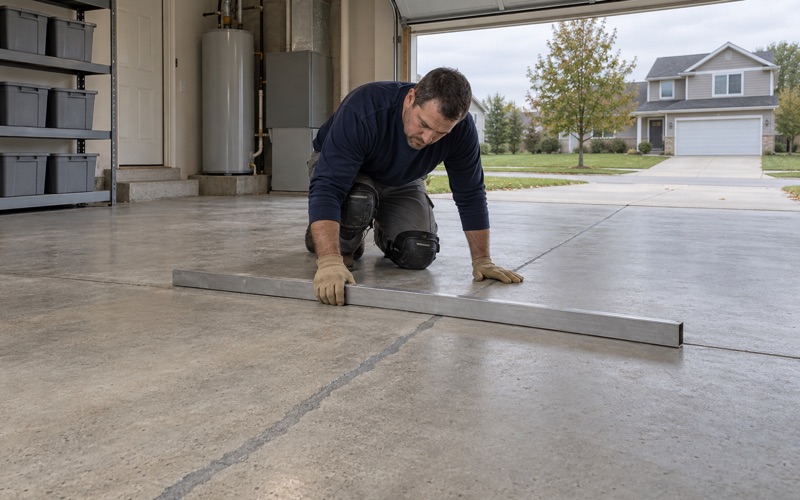
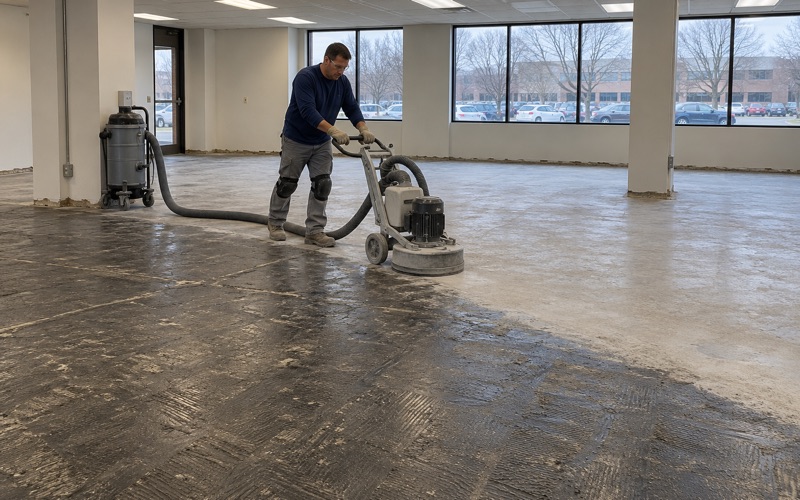
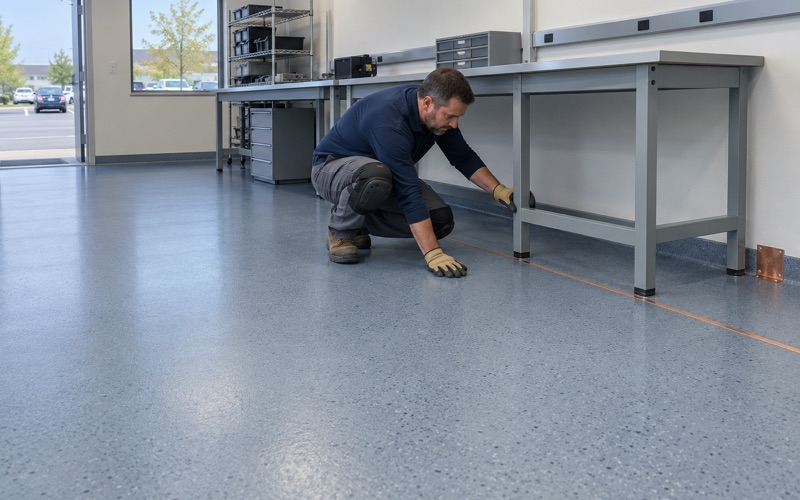
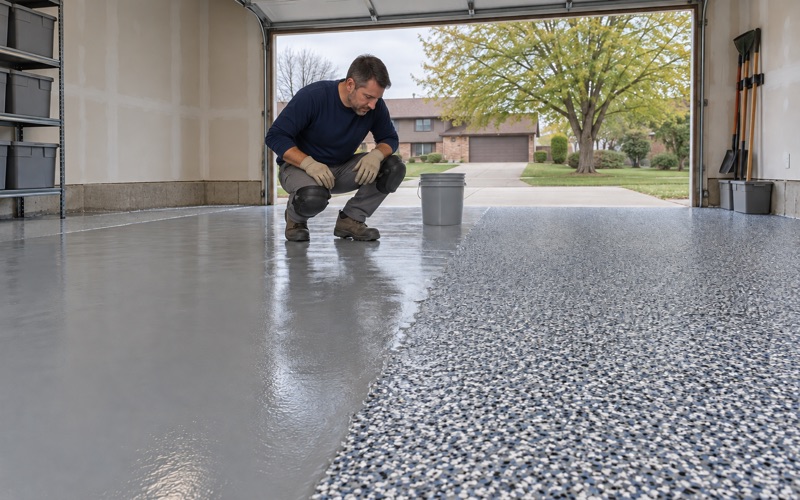
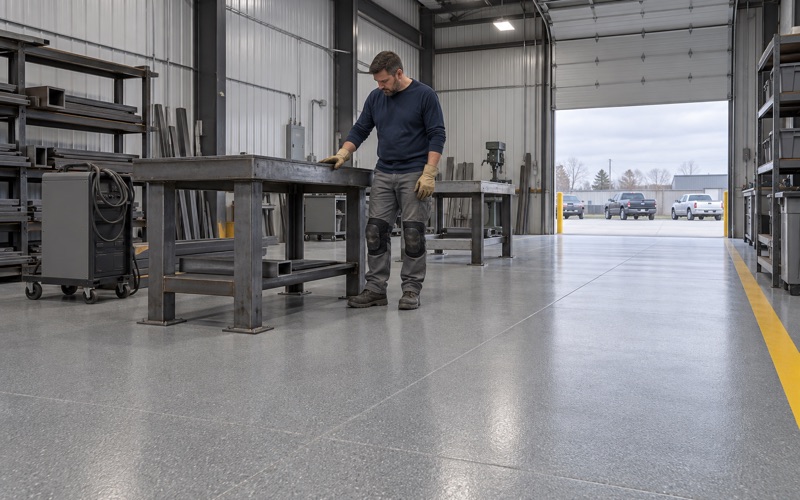
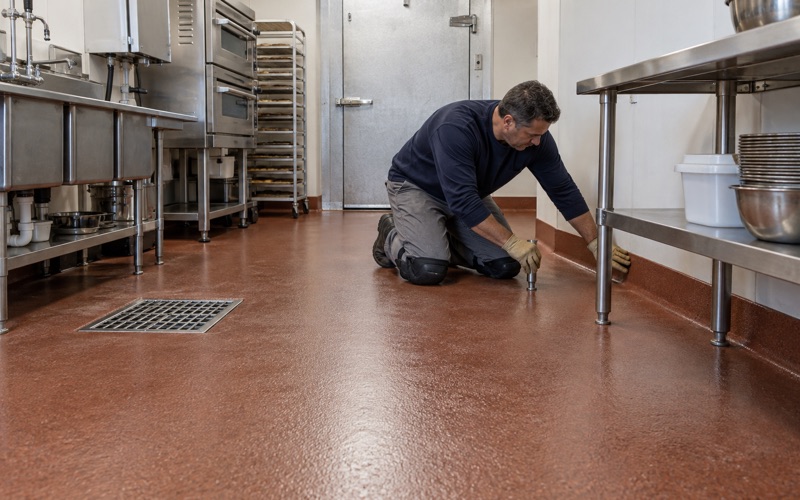
The surface work does not change with the building. Every slab is opened with a diamond grinder or a shot blaster rather than acid, a moisture test is in the scope before the price is final, and the proposal names the product line, the coat count and the finished thickness so the result can be checked against the quote.
Senior Living in Norwalk Never Empties
StoryPoint Norwalk on Cedar Street
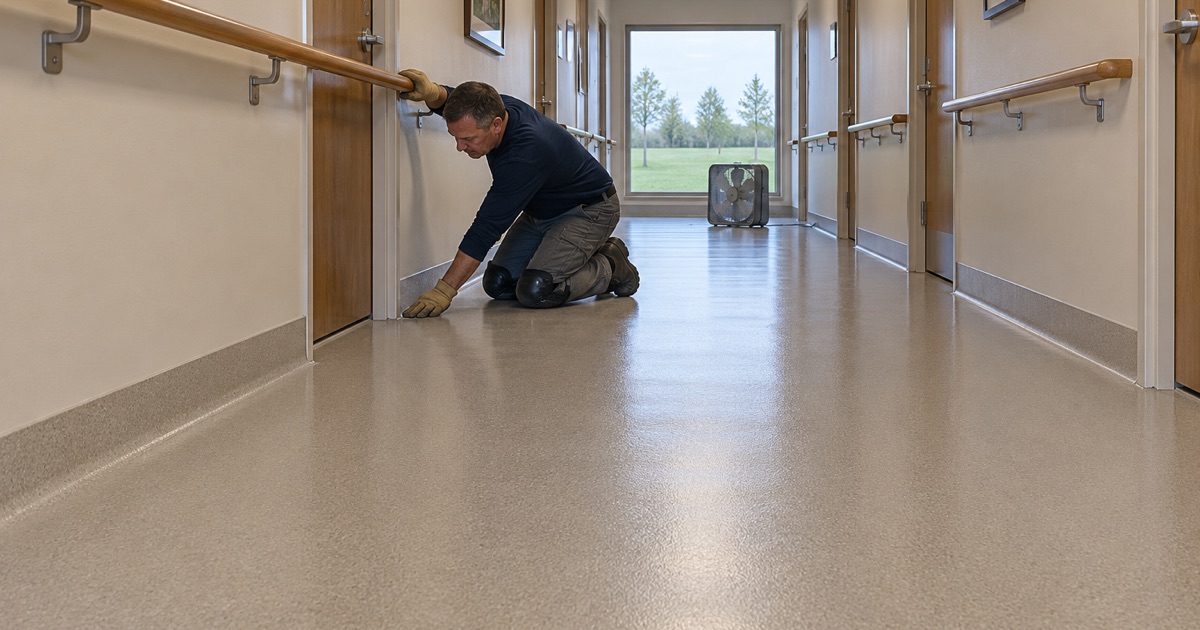
Norwalk has a cluster of senior residences, and StoryPoint Norwalk at 2901 Cedar Street is a clear example of the kind of building we plan around. The community, formerly known as Edencrest at The Legacy, offers assisted living and a secured memory care neighborhood, with 24-hour support in memory care and 24-hour assistance in assisted living. We have no relationship with StoryPoint and have done no work there.
What matters to a flooring contractor is the schedule that description implies. There is no closing time, no weekend when the halls empty and no evening when a crew can count on a dark building. Corridors, dining areas, service spaces and resident wings are all in use on the same day, and the people in them did not choose to live next to a job site.
Memory Care Changes the Plan
A memory care neighborhood is secured for a reason, and residents in it may not read a barricade, a sign or a strong smell the way a visitor would. A taped-off doorway is not a barrier for someone who does not register what the tape means. That puts the burden on the building’s staff and on us to keep the work zone physically separate rather than merely marked.
It also means the coating decision cannot be made in isolation. Before we recommend a system for any part of a building like this, we want to know which wings share air handling, where residents can be moved for a period, and whether the building can give up a section at all. Those answers come from the operator, and they decide the system more than the slab does.
Other Residences on the Same Pattern
StoryPoint is not alone. Holland Farms on Sunset Drive describes independent living, assisted living and memory care in one Norwalk community, and a search of Norwalk senior housing also turns up Alice Place, Regency Assisted Living and Norwalk Nursing And Rehabilitation Center. We have done no work at any of them, and nothing here describes their floors.
The point is the shared pattern. Wherever residents stay in the building while a floor is coated, the same three questions come first: what the topcoat cures with, what its data sheet asks for, and where people will be until the product’s guidance says the space can be reopened.
Looking for epoxy-flooring closer to Adel? See Adel Epoxy-Flooring.
What Goes Into a Polyaspartic or Urethane Topcoat
Isocyanate Chemistry in Plain Terms
Polyaspartic and aliphatic urethane topcoats are popular for good reasons. They resist yellowing, they cure fast enough to return a floor quickly, and they hold up well over a vinyl flake or quartz broadcast. Both are two-part systems, and in both the hardening reaction runs on isocyanates, a reactive family of chemicals that is well known in occupational health.
Fast cure is part of what makes these topcoats attractive in a commercial setting, and it is also why their chemistry deserves attention. A product that cures in hours is reacting during those hours, and the window when vapor and mist are in the air is the window that has to be controlled. That control is written into the job plan, not left to the crew’s judgment on the day.
What One Maker’s Data Sheet Says
One polyaspartic Part A safety data sheet we read, from ArmorGarage with a revision date of March 22, 2025, lists hexamethylene diisocyanate homopolymer at 50 to 75 percent of the component, with the HDI monomer at 0.1 to 1.0 percent. It carries the signal word Danger and hazard statement H334: ‘May cause allergy or asthma symptoms or breathing difficulties if inhaled.’
The same sheet lists H317 for an allergic skin reaction and H332 for harm if inhaled, with precautions that include avoiding breathing vapors and using the product only outdoors or in a well-ventilated area. For engineering controls it says to prevent vapor build-up by opening all doors and windows to achieve cross-ventilation, and it calls for respiratory protection where ventilation is inadequate.
Reading the Sheet Before the Date Is Set
We read the data sheet for the exact product line in the proposal before a start date is offered, not on the morning of the job. Formulations differ between makers and between one maker’s own products, so the sheet for the floor being quoted is the one that governs, and we share it with the building’s staff before anything is scheduled.
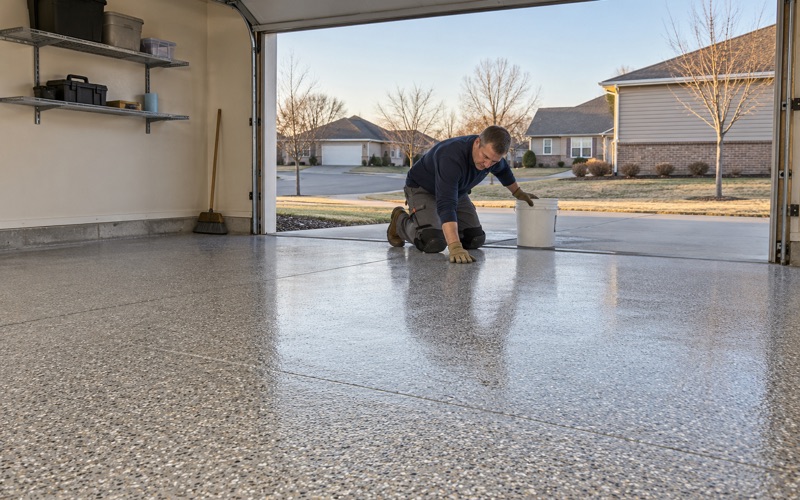
In a home garage, cross-ventilation means open overhead doors and fans. In a resident building with fixed windows and shared air handling, the same instruction becomes a design problem: where the outside air comes from, where the exhaust goes, and which rooms sit on the far side of a return vent. If the sheet cannot be followed as written, that product does not go down there.
Sealing, Ventilating and Reopening a Resident Wing
Closing the Zone
When an isocyanate topcoat is the right floor for a wing, we plan the job one closed section at a time. The work area is sealed from the occupied building with floor-to-ceiling barriers, doors leading toward residents are closed and covered, and the operator decides with us whether the air handling serving that zone is shut down or isolated.
Grinding comes first, and its dust is captured at the machine by vacuum rather than swept or washed toward a drain. That keeps the prep stage contained and gives the coating an ICRI concrete surface profile to bond to, with no acid etch involved. Cracks, spalls and old coating are mapped before pricing, so nothing surprises the schedule once a wing is closed.
Moving Residents Out of the Wing
We do not plan coating work in a wing that residents remain in. Whether that means a temporary move to another part of the building or a phased sequence of rooms is the operator’s call, and it is made around resident care, not around our crew. We price the job once that plan exists, because the phasing sets the number of mobilizations and the days on site.
Memory care adds a layer here. A resident who wanders back toward a familiar hallway needs staff between them and the zone, not a sign. We ask the building who will hold each door while work is open, and we keep our own crew inside the barrier so the zone stays sealed from both sides.
Re-Entry by the Data Sheet
Reopening a wing follows the product’s own cure and ventilation guidance, read together with slab temperature and dew point at the time of the job. A cool slab cures more slowly, so a schedule built on a warm-day cure time is not a re-entry date. We record the conditions at application and hold the zone until the product’s guidance is met.
We do not tell an operator that a space is ready because the smell has faded. Odor is not the measure the data sheet uses, and the decision to bring residents back belongs to the building once our part of the guidance has been satisfied. Our proposal states the expected hold time so staff can plan the move in advance.
When an Isocyanate-Free System Is the Better Choice
Building Around the Chemistry Instead
Some buildings cannot give up a wing, cannot isolate the air serving it, or simply prefer not to bring an isocyanate product inside at all. For those, we price an isocyanate-free system from the start rather than forcing a ventilation plan the building cannot support. A 100-percent-solids epoxy topcoat over a properly ground slab is the common alternative.
That choice has trade-offs we spell out. Epoxy cures more slowly than a polyaspartic, so the zone stays closed longer, and many epoxies yellow in sunlight near windows. Epoxy also carries its own hazard statements, so its data sheet is read the same way and its ventilation guidance followed just as closely. Different chemistry does not mean no precautions.
What Stays the Same Either Way
The moisture test happens on every slab, whatever the system and whatever year the building went up, because a coating over a slab pushing vapor fails no matter what it is made of. We use methods such as ASTM F2170 in-situ relative humidity probes, and the readings decide whether a moisture-mitigation primer goes under the system.
Slip resistance is specified by the broadcast and the topcoat, not promised. In corridors used by people with walkers and canes, that specification matters, and we show the texture on a sample before it goes down. What the warranty excludes is explained before the job is sold, with moisture vapor named first.
Questions for the City and the Building
Norwalk’s Community Development Building Department at 705 North Avenue handles permits and inspections. The city finalized the 2021 International Building Code and International Fire Code on September 26, 2024, and commercial plans must meet those codes. Whether a floor recoat in an occupied building needs a permit is a question we put to the department at 515-981-9530 rather than assume.
Inside the building, the questions go to the operator: which wings can close, for how long, and who signs off on reopening. With those answers and the product’s data sheet in hand, we can put a system, a coat count, a finished thickness and a hold time in writing before anyone commits to a date.
- 20+ Years on Iowa Slabs
- Moisture Tested Before Pricing
- Coats and Thickness in Writing