Urbandale Epoxy Flooring has spent more than 20 years on epoxy flooring in Johnston and across the metro, and the jobs that ask the most of us are rarely the biggest ones. They are the floors in buildings that never fully empty: a fellowship hall that becomes a classroom on Monday morning, a church wing where children nap after lunch, a basement that still hosts a meeting on Wednesday night.
A coating in a building like that is judged twice. It has to bond and wear like any commercial floor, and the work of putting it down has to leave the rooms clean enough for the people who walk back in. We plan both from the first visit, because the second part decides the schedule as much as the first decides the price.
Every slab we coat is opened with a diamond grinder or a shot blaster rather than an acid etch, which means every job we do makes concrete dust. How that dust is captured, cleaned up and kept away from occupied rooms is the subject of most of this page.
Church Buildings That Run as Child Centers on Weekdays
A weekday program inside a Sunday building
Johnston has more than one congregation whose building does double duty. Pathways Learning Academy operates at NorthPoint Church at 9901 NW 62nd Avenue, taking children from 6 weeks to 5 years old, Monday through Friday from 6:30 a.m. to 5:30 p.m. Farther along NW 62nd Avenue, The Bridge runs a preschool for 2- to 5-year-olds at number 10025.
We mention them because they show the pattern, not because we have worked there. We have not coated a floor at NorthPoint or Pathways, and we have not seen what their rooms are finished with. What the published schedule tells any contractor is simple: infants are in the building eleven hours a day on weekdays, and the congregation fills it on weekends.
Who is in the rooms, and when
That leaves a narrow set of hours when a floor can be ground, coated and cured without anyone underfoot. A crawling infant spends the day closer to the floor than any adult in the building, and a nap room is a closed, quiet space where fine dust settles and stays. Those facts shape our plan before a single product is chosen.
They also change who we talk to. A church facilities committee, a center director and sometimes a property manager each own a piece of the calendar. We ask for one person to sign off on the work window, the rooms closed off and the re-entry time, so nobody learns about a grinder on the morning it arrives.
Iowa’s center rules do not name a floor finish
Iowa’s child-care center rules, 441 IAC chapter 109, cover a lot of ground, and we have read them for floor language. They set usable floor space per child, require the premises to be sanitary, safe and hazard-free, call for a lead-hazard check in pre-1978 buildings and radon testing where program space sits at ground level or above a basement. None of them names a floor surface.
So we will never tell a director that epoxy, or any other finish, is required by Iowa’s child-care rules. A seamless coating is one reasonable answer to a sanitary, hazard-free standard, chosen on its merits. And because radon appears in those same rules, we say plainly that a floor coating is not radon work; testing and mitigation in Iowa take a state credential under Iowa Code chapter 136B.
Looking for epoxy-flooring closer to West Des Moines? See Epoxy-Flooring Services in West Des Moines.
The Silica Rule for Floor Grinders, in Plain Terms
Water or a 99 percent dust collector
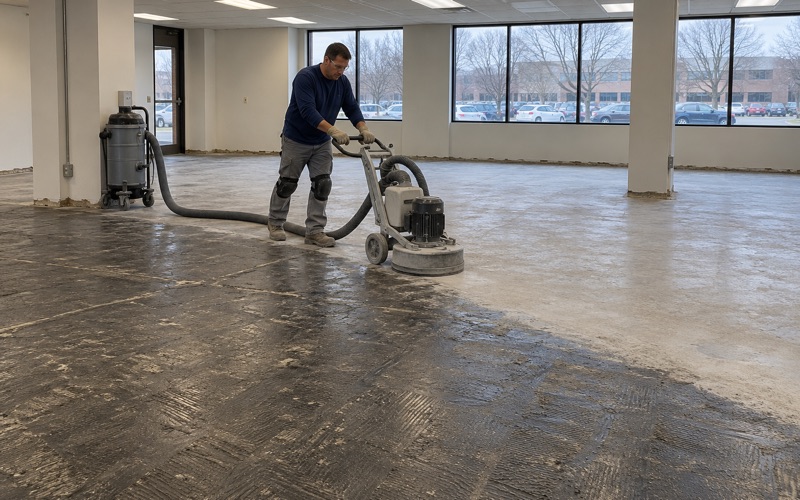
Grinding concrete releases respirable crystalline silica, and OSHA’s construction standard, 29 CFR 1926.1153, spells out the controls tool by tool in its Table 1. For a walk-behind floor grinder, the machine either feeds water continuously to the cutting surface or runs with the manufacturer’s dust collection system. That collector has to move at least the recommended airflow and carry a filter of 99 percent or greater efficiency with a filter-cleaning mechanism.
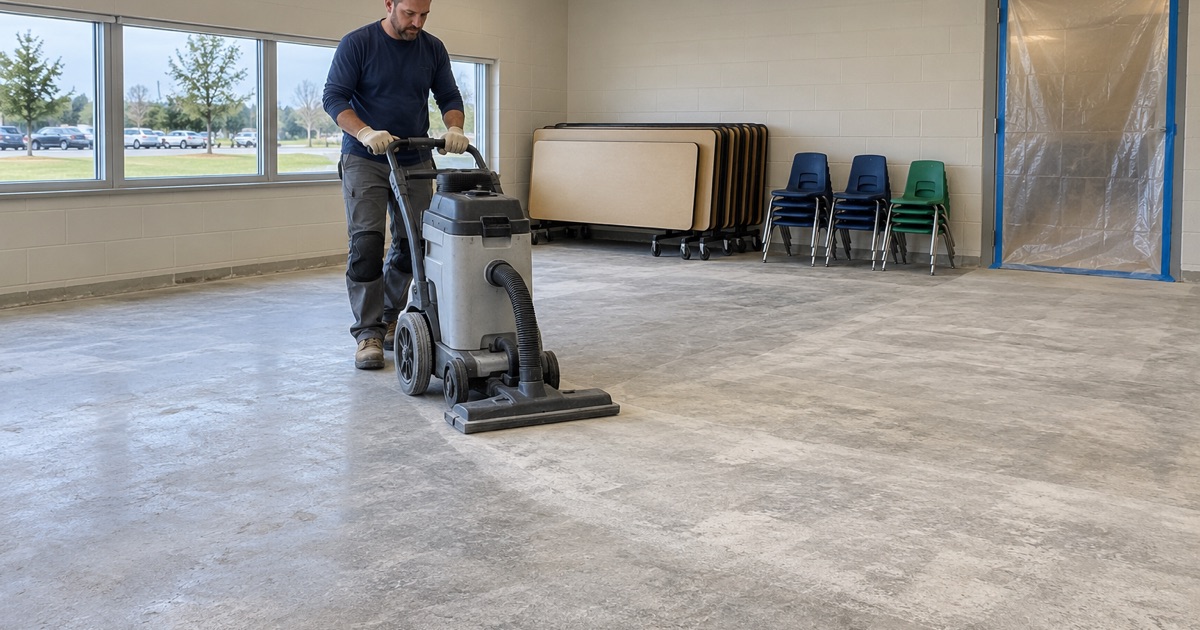
In occupied buildings we run walk-behind grinders with collection rather than water. Water keeps silica down but turns the cuttings into slurry that has to be squeegeed up and kept away from floor drains, and a wet slab then needs time to dry before a moisture test means anything. Captured dust goes into a sealed bag at the machine, not down a drain.
A HEPA-filtered vacuum between passes
Indoors or in an enclosed area, the same Table 1 entry adds one more step: a HEPA-filtered vacuum removes loose dust between passes. The standard defines a HEPA filter as at least 99.97 percent efficient at 0.3 micrometers. In practice our crew vacuums the slab after each grinding pass and before the next, so the grinder never rides over a layer of loose fines.
That step serves the floor as well as the air. Dust left on the slab under the next pass gets smeared into the surface, and the coating then has to bond through it. A slab vacuumed clean between passes shows the ICRI CSP profile we are actually reaching, which is the profile written into the proposal.
Edges, corners and the handheld grinder
A walk-behind machine cannot reach the last few inches along a wall, around a door frame or beside a cabinet base. That edge work is done with a handheld grinder fitted with a shroud and its own dust collection, which Table 1 sets at 25 cubic feet per minute or more of airflow per inch of wheel diameter, again with a 99 percent filter.
Edges are where an occupied building gets most of its dust when a crew cuts corners. The handheld grinder works closest to baseboards, gaps under doors and the return air grilles that carry fine particles to the next room, so we seal those openings before the edge pass starts and treat it as the dirtiest hour of the job.
No Dry Sweeping, and Where the Rule Stops
Cleanup by vacuum, not broom
Paragraph (f) of the silica rule bars dry sweeping or dry brushing where it could add to exposure, unless wet sweeping, HEPA vacuuming or another method is not feasible. It also bars compressed air for cleaning surfaces unless the dust is captured. A push broom and a blower are the two fastest ways to put settled dust back in the air, so neither comes onto our jobs.
Cleanup at the end of each shift is a HEPA vacuum pass over the slab, the tools and the plastic sheeting, with damp wipe-downs where a vacuum cannot reach. Hallways outside the work area get the same treatment, because dust travels on boots and cart wheels long after the machine is switched off.
Before the primer goes down
The last cleaning before primer is where shortcuts tempt a crew. Blowing the slab off with compressed air is quick, and it is exactly the uncaptured cleanup the rule steers away from. We vacuum the floor again, then wipe a dark cloth across the surface, because primer laid over fines bonds to the dust instead of the concrete.
What the rule protects, and what it does not
OSHA wrote these controls to protect the crew running the grinder. They are not a finding that a building is safe for children afterward, and no contractor can honestly promise a job without dust. What we can say is that the same controls that limit what a worker breathes also limit what drifts into a nap room down the hall.
Deciding when children come back into a space is the operator’s call, not ours. We give the director what that decision needs: which rooms were worked, how they were sealed, when the final vacuum pass happened and when the coating will be ready to walk on. Some operators add their own cleaning before reopening, and we schedule around that too.
Finding a Work Window Between Weekday Care and Sunday
Evenings, Fridays and long weekends
With children in the building from early morning to late afternoon and services on the weekend, the realistic windows are evenings and the stretch from Friday night into Saturday. Grinding and a first coat can often fit into one evening on a small room; a fellowship hall or a classroom wing usually needs a long weekend or a planned closure.
We phase larger areas room by room so the program keeps running. One classroom is sealed, ground, vacuumed and coated while the rest stay open, with plastic, a closed door and a negative-air setup between the two. It is the same way we phase a Johnston office or flex bay that cannot close, and a church wing is no different.
Cure schedules and odor
The coating’s clock, not ours, decides re-entry. We set cure times from slab temperature and the dew point spread at the surface, not from a calendar, and a cool room on a fall evening cures slower than the data sheet’s room-temperature figure. If a topcoat cannot cure before the doors open Monday morning, we change the plan rather than hope.
For rooms beside occupied space, we offer low-odor products and polyaspartic topcoats with shorter return-to-service times as a comfort and scheduling choice. They are not a legal requirement, and we do not present them as one. Faster cure carries its own trade-off, a shorter working time on the floor, which we weigh when deciding how much area to coat in one window.
Testing and pricing before the window is booked
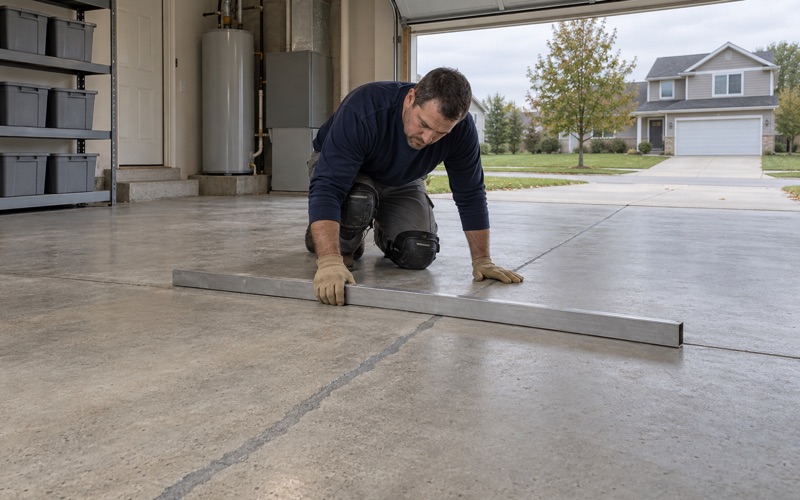
A work window is only as good as the scope behind it. Before the price is final we map cracks, spalls and old coatings and write a moisture test into the scope, using ASTM F2170 in-situ relative humidity probes or ASTM F1869 calcium chloride tests depending on the slab. If the slab needs repair first, we say so before anyone books a weekend.
The proposal then names the product line, the number of coats and the finished thickness, so a committee can check the floor against the quote. We explain what the warranty excludes before the job is sold, and moisture vapor transmission is the first exclusion we name. That paperwork lets everyone with a stake in the building agree on the plan before work starts.
- 20+ Years on Iowa Slabs
- Moisture Tested Before Pricing
- Coats and Thickness in Writing