Urbandale Epoxy Flooring installs industrial epoxy flooring in Urbandale, IA, serving surrounding cities including Clive, Grimes, Windsor Heights, Johnston, West Des Moines. With 20+ years of coating central Iowa slabs, we build floors for warehouses, light manufacturing, fleet and repair garages, and distribution space, specified for forklifts, pallet jacks, dropped loads, fluids and cleaning chemicals rather than for looks alone.
An industrial floor is judged on how long it holds up under work. The system has to match the heaviest wheel, the harshest chemical and the hottest washdown the floor will see, and it has to bond to a slab that may be decades old and stained with years of oil and sealers.
Our proposal names each layer, the finished thickness and the reason it was chosen, along with a phasing plan that keeps the operation running. A plant manager can compare it line by line with another bid instead of trusting that two quotes for industrial epoxy mean the same thing.
Systems for Industrial Floors
High-Build and Slurry Epoxy
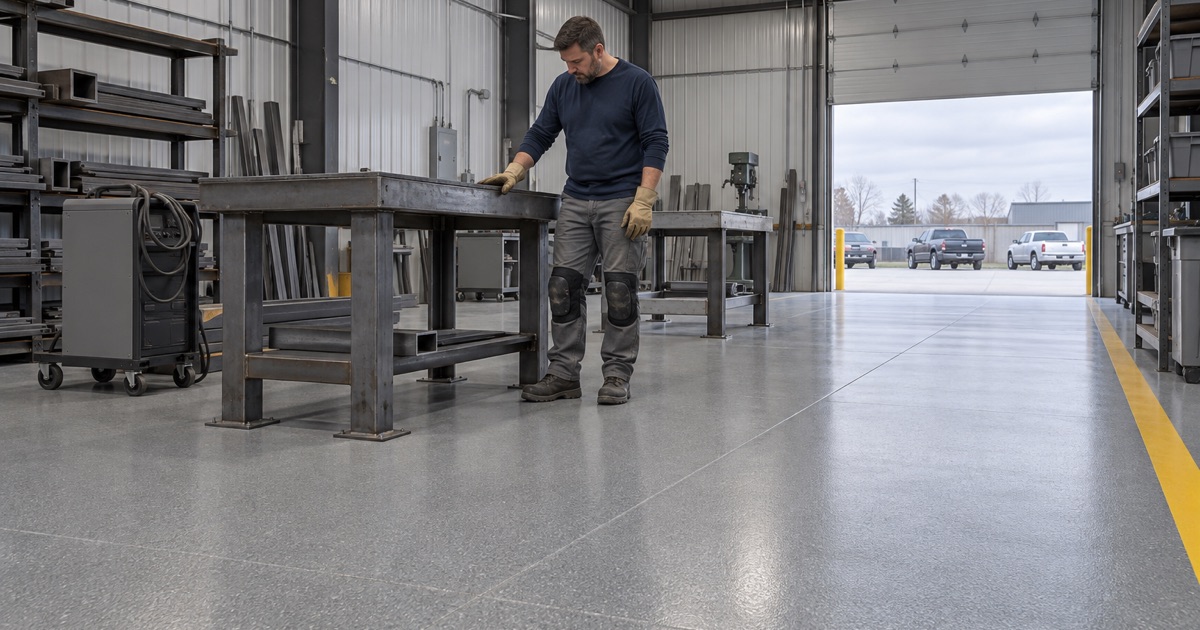
A 100% solids epoxy builds thickness in fewer coats and bonds well to a ground slab. In aisles and production areas we often use a high-build or slurry system, where epoxy is filled with aggregate to add body and impact resistance, and finish it with a hard topcoat.
The thicker build spreads the load of hard wheels and absorbs the impact of dropped parts and pallets. A thin coating on the same floor can chip at every turn and every drop, and it shows wear within months in a busy lane.
Urethane Cement for Heat and Washdown
Urethane cement handles hot water, steam cleaning, thermal shock and harsh cleaners that would soften or crack a standard epoxy. It is our usual choice for washdown areas, food and beverage processing rooms and any floor that is wet for most of the shift.
It also tolerates more moisture in the slab than many epoxies. Where a plant has both wet and dry zones, we often combine urethane cement in the wet areas with epoxy elsewhere, joined at a clean transition line.
Chemical-Resistant Topcoats
Repair shops and fleet garages see oil, brake fluid, coolant, fuels and solvents. A chemical-resistant topcoat keeps those fluids on the surface for cleanup instead of letting them soak into the concrete, and we match the topcoat to the specific chemicals on your floor rather than calling any coating resistant to everything.
We ask for the safety data sheets of the fluids and cleaners your crew uses most, then check them against the coating maker’s chemical resistance chart. A topcoat that shrugs off motor oil may still stain or soften under a particular solvent or a strong degreaser left to sit overnight.
Preparing an Industrial Slab
Shot Blasting and Grinding
Large open floors are often prepared with a shot blaster, which throws steel shot at the surface and vacuums it back, while edges, columns and tight spots are diamond ground. Both methods produce a measured ICRI concrete surface profile, and heavier systems call for a heavier profile than a garage coating.
All dust is captured at the machine by vacuum rather than swept or washed into floor drains and trench drains. In an occupied plant, work zones are closed off so production areas stay clean.
Oil-Soaked and Contaminated Concrete
Old industrial slabs carry oil, hydraulic fluid and sealers deep in the surface. Shot blasting and grinding remove most of it, and heavily contaminated areas may need degreasing and repeated passes before a coating will bond. We test those areas before pricing rather than discovering them during the install.
A simple water drop test shows where oil is still in the pores: clean concrete darkens as it absorbs water, while contaminated concrete beads it up. Areas that keep beading after cleaning are cut deeper or treated with a primer made for oil-tolerant bonding, and the proposal lists them separately.
Joints, Cracks and Damaged Edges
Forklift wheels batter open joints until the edges break down. We cut damaged joint edges back to sound concrete, rebuild them with epoxy mortar, and fill joints with a semi-rigid filler that supports the edges. Cracks and spalls are filled and ground flush, and we say plainly when a section of slab needs structural repair first.
Moisture and Older Slabs
Many older industrial slabs sit on grade with no vapor retarder under them. We test with ASTM F1869 or F2170 methods, and where the reading is high we use a moisture-mitigation primer or a moisture-tolerant system. Warranty exclusions for moisture vapor transmission are explained before the job is sold.
Running an Industrial Job
Safety Lines and Zones
Aisle lines, pedestrian walkways, forklift lanes and hazard zones can be built into the coating in contrasting colors and topcoated, so they last with the floor. We lay them out with your operations team before the coating goes down.
Built-in lines avoid the constant re-taping and repainting that worn floor marking demands in a busy warehouse. When the layout changes, a new line can be added over the existing topcoat.
Slip Resistance for Wet and Oily Areas
Where water, oil or coolant reaches the floor, we specify slip resistance by the broadcast and topcoat used, such as a quartz aggregate broadcast, rather than promising a floor is non-slip. The texture is set zone by zone, because a ramp, a wash bay and a dry storage aisle each need something different.
Phasing Around Production
Plants and warehouses rarely shut down. We divide the floor into zones and schedule them around production, using nights, weekends and planned shutdowns for areas that cannot close. Each zone gets its own cure time on the schedule, and fast-curing systems shorten the window where the operation cannot wait.
We also coordinate with the people who move equipment and inventory. Racking, machines and stored goods have to come out of each zone and go back in, and planning that sequence ahead keeps a phased floor from turning into a stalled one.
- 20+ Years on Iowa Slabs
- Moisture Tested Before Pricing
- Coats and Thickness in Writing