Urbandale Epoxy Flooring has spent more than 20 years coating concrete, and our epoxy-flooring in Huxley work increasingly reaches the small rooms that keep a household or an office connected. Think of the network closet, the mechanical room, or the basement corner where the modem, the furnace and the water heater share one slab. Those rooms ask for something different from a showroom garage floor.
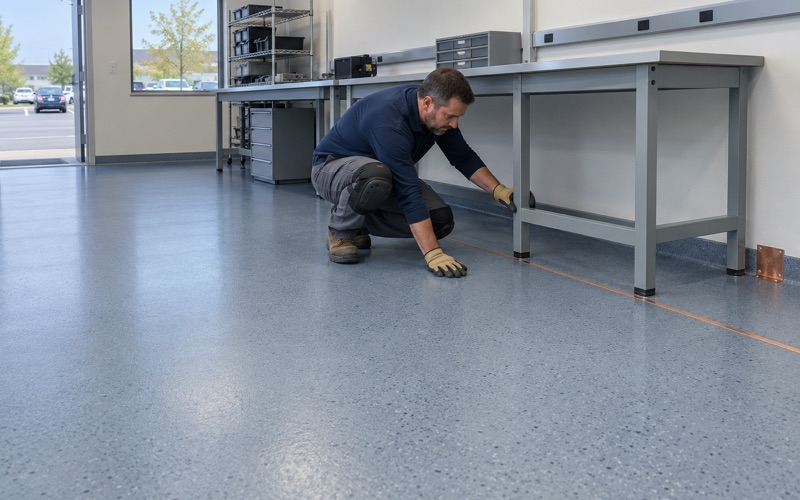
A room full of electronics wants a floor that stops shedding dust and helps the light do its job. That points toward a sealed, solid-color system in a pale shade rather than a dark decorative flake. It also points toward careful preparation, because a coating that peels becomes its own source of debris.
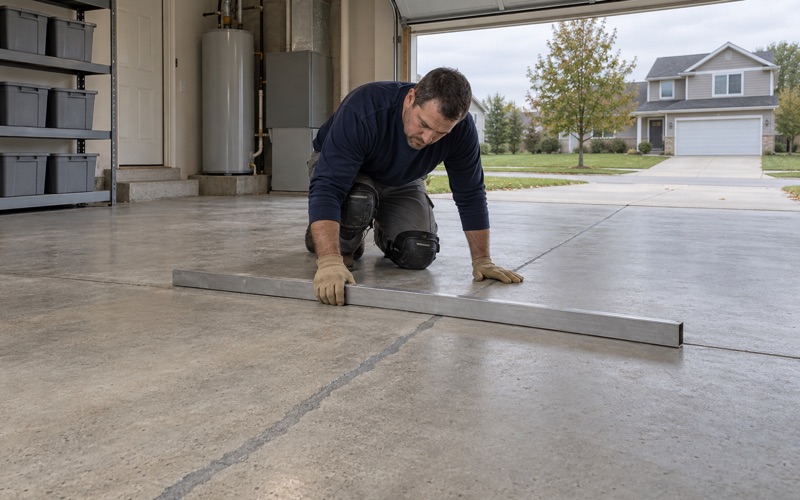
Every proposal we write names the product line, the number of coats and the finished thickness, so you can hold the floor up against the paper. A moisture test sits in the scope before the price is final, and cracks, spalls and old coatings are mapped first so we can tell you plainly if the slab needs repair before anything else.
Huxley’s Phone Cooperative and the Rules Written for Network Rooms
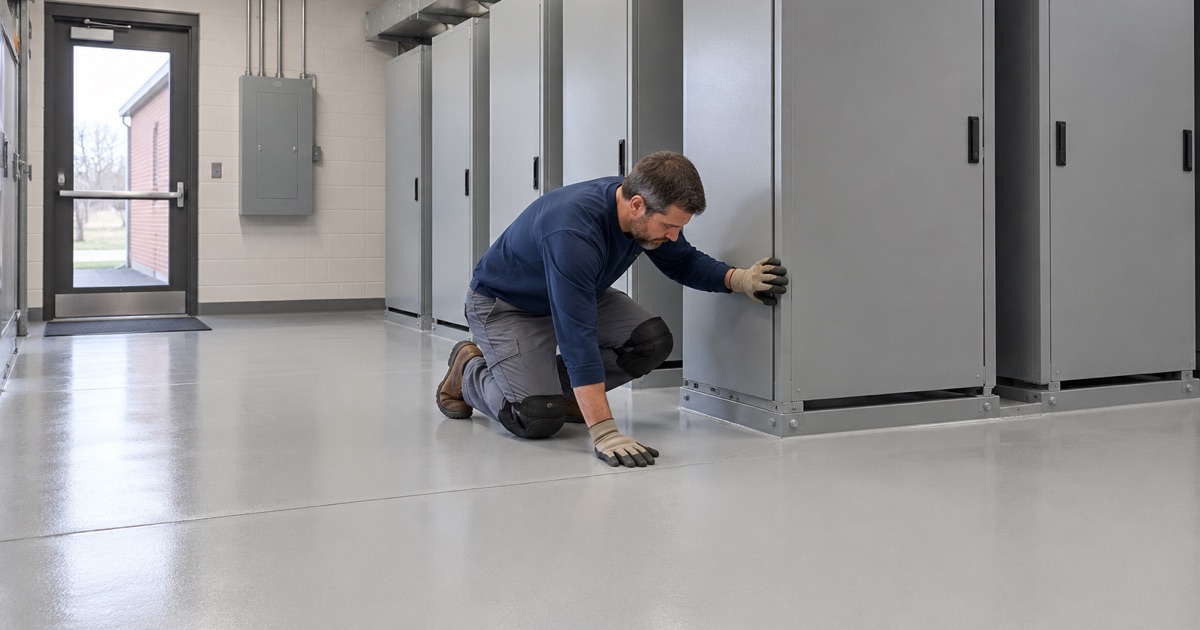
A switchboard on Main Avenue since 1933
Huxley is a Story County city inside the Ames metropolitan area, and it has something many towns its size lack: its own telephone and broadband cooperative. Huxley Communications bought the building that housed its switchboard in 1933, and by the company’s own history the switchboard is still there today.
In 1972 a larger equipment room was added to bring all of the machinery under one roof. The cooperative was one of the first companies in Iowa to put fiber to the home, in 2002, and in 2023 it opened new headquarters and facilities at 400 S Main Ave. We have no connection to the cooperative, and no source we have seen describes its floors.
What a typical telecom room standard says about the floor
Equipment rooms are written to their own rules. Campus wiring standards built on the TIA-569 family, such as the guideline Montana State University publishes, say floors shall be sealed to eliminate dust and that painted surfaces shall be light in color to enhance room lighting.
The same guideline calls for at least 50 foot-candles of light measured 3 feet above the finished floor and a minimum floor loading of 50 pounds per square foot. We have not read TIA-569 itself, and nothing we install is sold as meeting it. We treat these campus documents as a sensible description of what a network room floor should do.
What a coating can and cannot promise
That campus guideline also asks for anti-static properties where feasible. A standard epoxy or polyaspartic floor is not a static-control floor. Static-dissipative flooring is a separate product class with its own resistance range, and it exists only where a system is specified and tested for that purpose.
What an ordinary coating does well is close the surface of the concrete, give the room a floor that mops clean and hold a light color for years. If a room genuinely needs static control, that requirement belongs to whoever designs the equipment layout, and we would say so before quoting rather than after.
Looking for epoxy-flooring closer to Perry? See Perry Epoxy-Flooring.
Sealing Concrete Against Dust in an Equipment Room
Why bare concrete keeps shedding
Raw concrete is less stable than it looks. Its top layer, called laitance, is weak and powdery, and foot traffic, cart wheels and seasonal humidity swings keep wearing it loose. In a room where equipment fans pull air across the floor all day, that fine gray powder ends up in filters, vents and enclosures.
Sweeping moves the dust around rather than ending it. A sealed floor stops the surface from feeding new particles into the air, which is the plain intent of the guideline’s wording. It is a practical answer to dusting concrete, not a cleanroom floor, and we do not sell it as one.
Preparation decides whether the seal holds
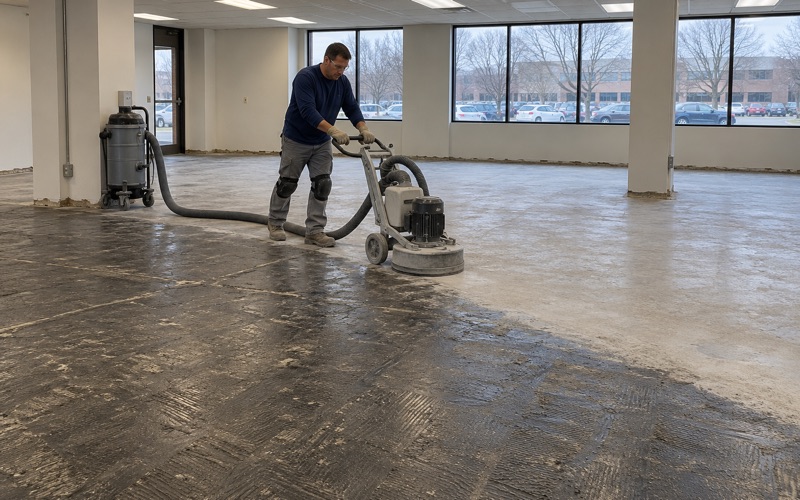
We open every slab with a diamond grinder or a shot blaster, never an acid etch. Sika’s epoxy application guide calls for mechanical preparation to a profile equivalent to ICRI CSP 3, and for removing existing paint, sealers, curing agents, laitance and oils before any resin goes down.
Grinding beside sensitive equipment raises its own dust question. Ours is captured at the machine by vacuum rather than swept up or washed toward a floor drain. In a working equipment space we plan the sequence with whoever owns the gear, so anything that must be covered or moved is settled before the grinder starts.
Moisture and temperature before the first coat
A sealed floor that lifts is worse than bare concrete, so a moisture test is written into every scope. Sika’s guide sets substrate moisture under 4 percent and a sound slab of at least 3,625 psi compressive strength, and we confirm conditions with methods such as ASTM F2170 relative humidity probes or ASTM F1869 calcium chloride tests.
Soils around Huxley are glacial till on the Bemis moraine, where well-drained Clarion loam sits beside poorly drained Webster clay loam with a seasonal water table near the surface. That patchwork is why each slab is tested rather than assumed. Coats are also timed to the concrete itself, which must be at least 50 degrees F and 5.5 degrees F above the dew point.
Light Colors and Light Levels on the Floor
Why the floor color matters under a rack
The campus guideline asks for light surfaces for a practical reason. Light bounces off a pale floor and up into the lower part of a rack or cabinet, where labels, ports and patch cords sit in the shadow of the equipment above. A dark floor absorbs that light and leaves someone working with a flashlight in their teeth.
The 50 foot-candle figure is measured 3 feet above the finished floor, roughly where hands meet the lower rack positions. A light gray or tan solid color works with the overhead fixtures toward that level, while a charcoal finish works against them. The floor is part of the lighting plan whether anyone intended it or not.
Solid color, not a dark flake
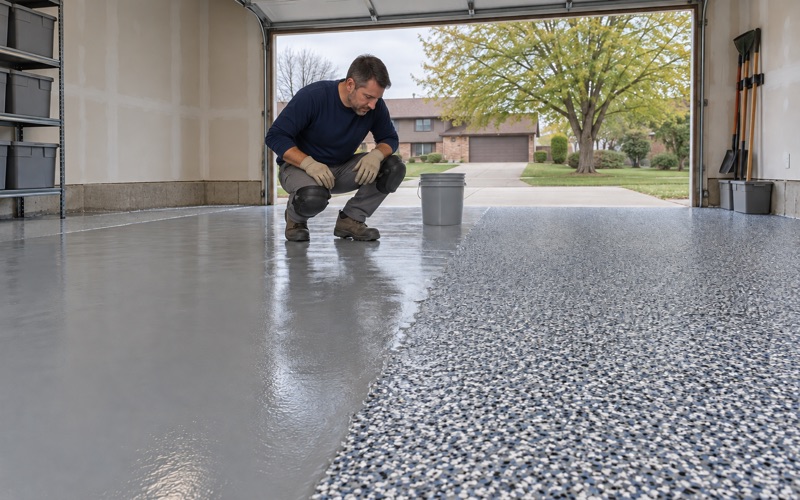
Vinyl flake broadcasts are popular in garages because they hide dirt and tire marks. In an equipment room that camouflage becomes a drawback. A busy dark blend hides dropped screws, cable clips and the very dust you want to see and remove, and it pulls down the light in the room.
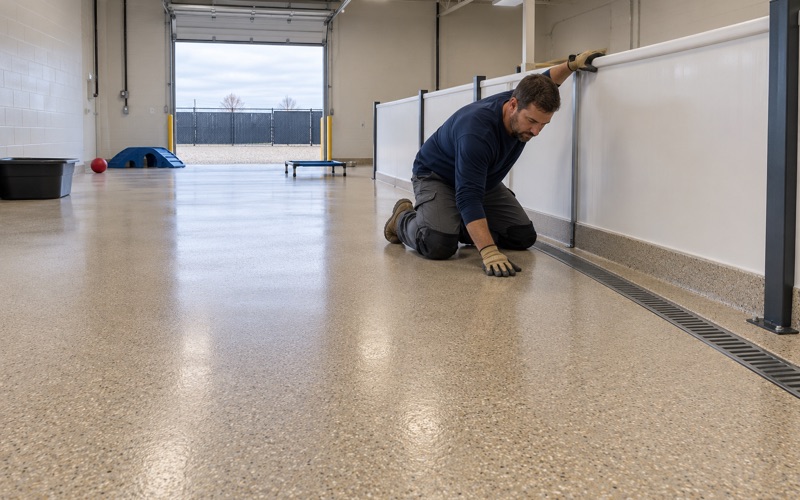
For network rooms we lean toward a solid-color, 100% solids epoxy base with a polyaspartic topcoat for wear. If some texture is wanted for footing, a fine quartz aggregate broadcast can be added. Slip resistance is set by the broadcast and topcoat we specify in the proposal, not promised as a slogan.
What actually rests on the coating
The guideline’s 50 pounds per square foot is a structural floor-loading figure, a question about the slab and what supports it, not about the coating. A coating adds no strength to a weak slab. What it must handle is the point load of rack feet, a battery cabinet or a shelf of backup units standing in one spot for years.
That is why we map cracks, spalls and soft areas before pricing, and why we will say plainly when a slab should be repaired or replaced before anything is applied. A thin system laid over a moving crack simply records that crack again in a new color.
Home Network Closets and Basement Mechanical Rooms
The closet that became a server corner
Fiber reached Huxley homes early, and in a town where about half the housing was built in 2000 or later, plenty of basements now hold a router, a switch and a battery backup beside the furnace. Those spaces rarely get any floor treatment at all. The concrete stays as it was poured, quietly dusting.
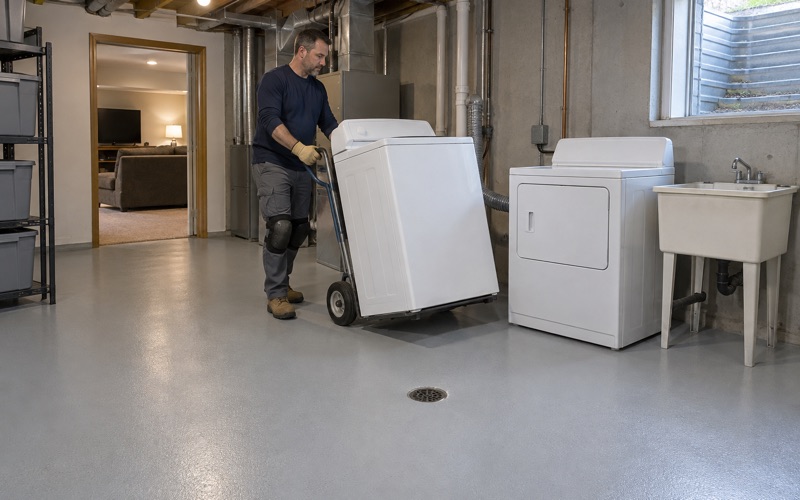
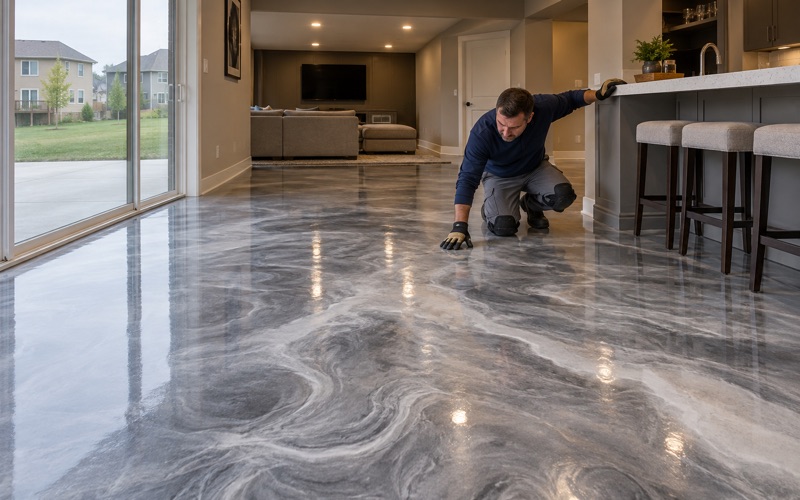
The same reasoning that serves a commercial equipment room applies at home on a smaller scale: a sealed surface that stops shedding, in a light solid color that brightens a corner usually lit by one bulb. In a lived-in basement we often suggest a low-odor product, offered for comfort and a quicker return to the space, not because Iowa requires one.
Mechanical rooms with a sump, a drain and a water heater
Basement mechanical rooms come with a water history. Before we coat one, we look for past seepage, efflorescence and staining, and we leave the sump pit and floor drain open and working. A coating does not stop water moving through a slab, and we never present one as a cure for seepage.
A leaking water heater or softener is easier to spot and wipe up on a coated floor. What the coating cannot resist is hydrostatic pressure pushing up from below. Moisture vapor transmission and hydrostatic pressure are the first exclusions we name when we walk you through the warranty, and that conversation happens before the job is sold.
Keeping a home online while the floor cures
A home office or network closet rarely can go dark for long. We plan the work so the equipment is moved or covered on a set day, grinding and the first coat happen together, and the topcoat cures on a schedule you know in advance, driven by slab temperature rather than the calendar.
Basement floors also sit over soil gas, and a coating is never radon work. Radon testing and mitigation in Iowa take a state credential under Iowa Code chapter 136B, so if radon is a concern we point you to that separate trade before the floor work begins.
- 20+ Years on Iowa Slabs
- Moisture Tested Before Pricing
- Coats and Thickness in Writing