Urbandale Epoxy Flooring has spent more than 20 years installing epoxy flooring in Grimes shops, garages and commercial spaces, and the floors we think hardest about here are the ones where diesel machines get serviced and refilled. A shop slab takes more than tire traffic and dropped tools. It takes whatever drips off a nozzle, and some of those drips do not behave like oil.
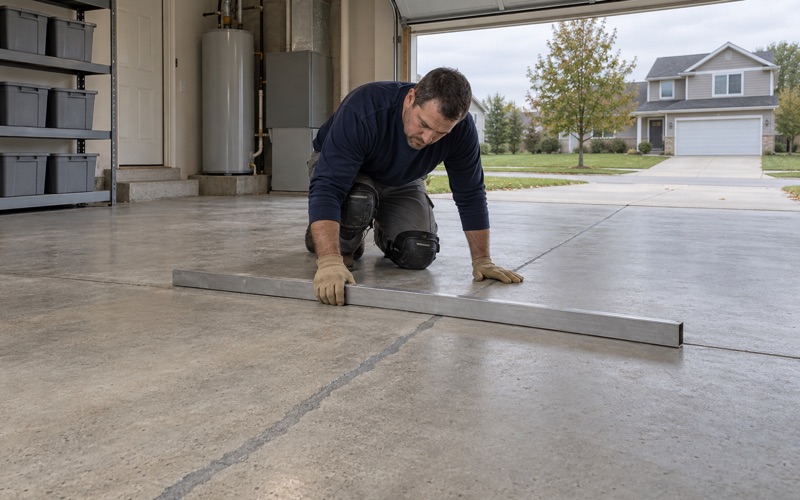
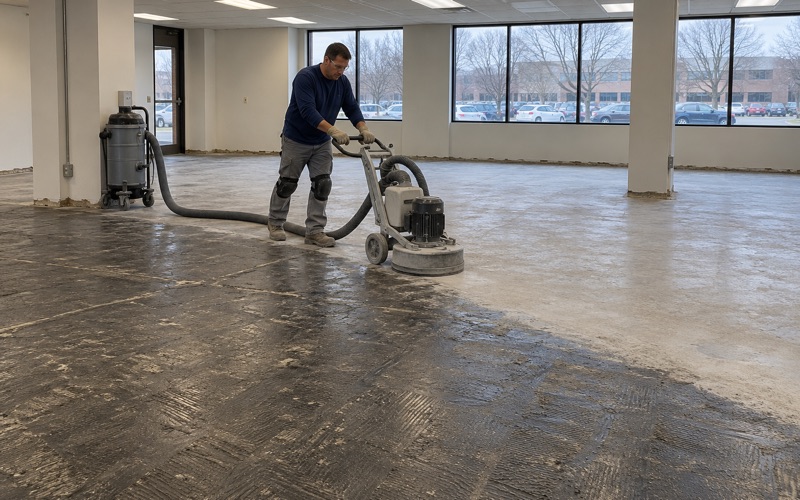
Every slab we coat is opened mechanically with a diamond grinder or a shot blaster, never acid etched, so the resin has a real profile to grip. Before a price is final, we map cracks, spalls and old coatings and write a moisture test into the scope. If a slab should be repaired or replaced before anything goes on it, we tell you that first.
Our proposals name the product line, the number of coats and the finished thickness, so an owner can hold the installed floor up against the quote. We also walk through what the coating warranty excludes before anything is signed, and moisture vapor transmission is the first exclusion we name. What follows is how we approach equipment floors in this part of the metro.
Equipment Service on SE Gateway Drive
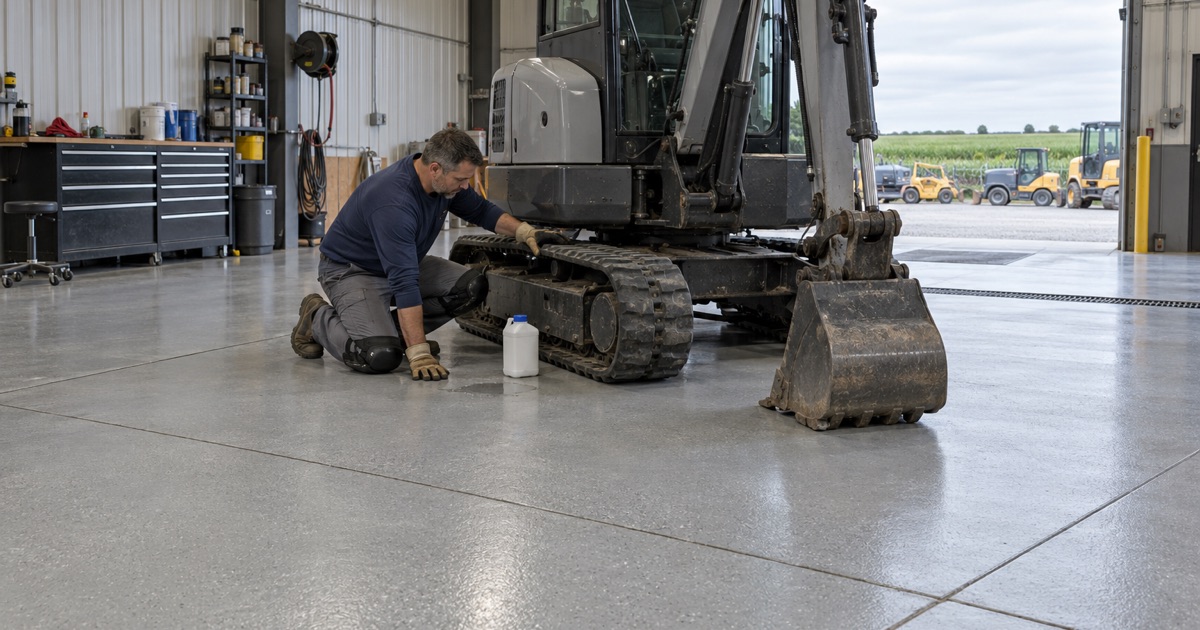
A crane and construction equipment dealer in Grimes
The southeast industrial district along SE Gateway Drive sits inside the City of Grimes, on the Polk County side of a city that also reaches into Dallas County. RTL Equipment operates from 3000 SE Gateway Drive, selling, renting and servicing construction machines and cranes. It is an authorized DEVELON dealer that also carries Bobcat, Kobelco and Tadano, with a parts department alongside its service area.
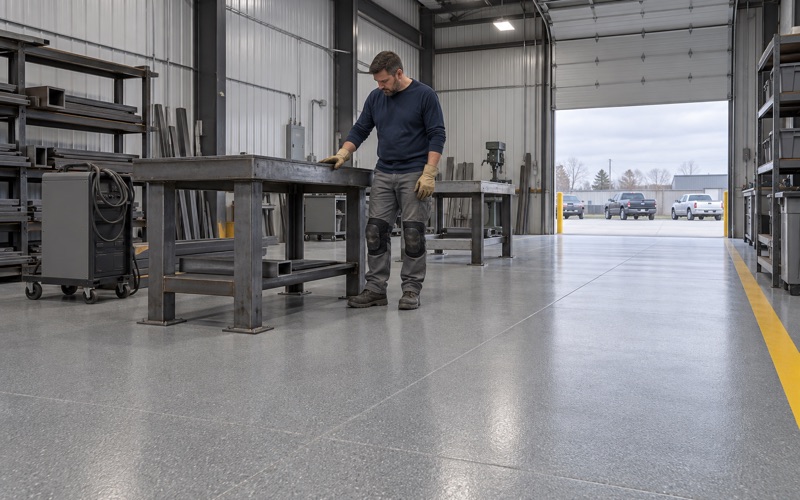
We name the dealer because it shows what kind of work happens on that street, not because we have worked on its floors. We have not seen RTL’s shop and have no relationship with the business. What matters for flooring is the category: a building where heavy diesel equipment is parked, repaired, washed and refueled day after day, by crews who need the floor to keep up.
Tier 4 engines and the DEF fill point
A 2016 Rental Equipment Register report noted that Tier 4 engines with selective catalytic reduction are used on diesel equipment of 75 horsepower and above. Those systems clean exhaust by injecting diesel exhaust fluid into it. Any shop servicing current machines in that class ends up handling DEF, topping off tanks in a bay or at a fill point near the door.
The same report says ISO and several manufacturers call for DEF to be handled within a closed system, because the fluid is easily contaminated; as little as a tenth of a teaspoon of many common elements can push a 5,000-gallon tank off-spec. In practice, nozzles still drip, jugs still get poured and filler caps still get opened over the floor.
Looking for epoxy-flooring closer to Windsor Heights? See Windsor Heights Epoxy-Flooring.
Why Urea and Bare Concrete Do Not Mix
What diesel exhaust fluid actually is
DEF is a simple liquid: 67.5 percent deionized water and 32.5 percent urea of automotive grade. It is water-based, clear and close to odorless, which is exactly why it gets overlooked on a shop floor. A drip does not leave a dark stain the way motor oil does, so it tends to sit until the water evaporates.
What it leaves behind as it dries is typically a white crust of urea crystals. On a coated floor those crystals sit on the surface, where they are easy to see. On bare, porous concrete the problem starts earlier, because the solution has already soaked into the slab before anyone notices it was there.
Dissolution, penetration and crystallization
A 2020 paper in the journal Materials examined cement paste exposed to urea solution. It attributed damage to concrete in urea production plants to physical phenomena: dissolution, penetration and crystallization of urea within the pores of the concrete. Liquid carries the urea in, the water leaves, and crystals form in spaces that were never meant to hold them.
The same paper notes that several deicers, including urea compounds, cause scaling of non-air-entrained concrete, while air-entrained concrete is not attacked. After almost a year in a 20 percent urea solution, the outer 20 millimeters of the test material had changed chemically, in phase and mechanically. Those are production plant and long immersion conditions, not a weekend of drips.
Keeping the research in proportion
We are careful with this point. DEF is not classified as a hazardous material, and a few spilled ounces will not ruin a slab; an earlier study cited in that paper found no destruction in urea solutions at all. What the research supports is narrower: urea working repeatedly into open pores is a mechanism worth keeping out of a floor you plan to own for decades.
A fill area is where that repetition happens. The same few square feet take a drip every time a machine is topped off, and bare concrete gives the fluid somewhere to go. Sealing that surface takes the pores out of the equation, so the urea stays on top, where a crew can actually see it and clean it.
Oil Pads Will Not Pick It Up
Absorbents built for a different liquid
Most service bays keep oil absorbent pads and granules within reach, and they work well for what they are made for. A spill-kit maker’s guidance on DEF says plainly that oil and fuel kits are not suitable, because their hydrophobic absorbents reject water-based chemicals. Put an oil pad on a DEF puddle and much of the fluid simply stays on the floor.
That guidance also says DEF spills should not be washed to the stormwater system or left to dry off, because residues remain and are still a pollutant risk when it rains. So the two easy habits in a busy shop, hosing a drip out the overhead door or ignoring it until it crusts, are both the wrong answer.
Water cleanup on a sealed surface
On a sealed epoxy or polyaspartic floor, a DEF drip is a simple job while it is still wet. It mixes with water, so a damp mop, a squeegee or a wet-vac lifts it, and the residue goes into a bucket rather than into the slab. Even dried crystals can be redissolved and picked up, because they are sitting on a nonporous surface.
That is the practical case for coating a fill area. It does not change how DEF has to be handled, and it does not replace a spill kit made for water-based fluids. It turns a stain that soaks in into a spill that can be wiped up, which is what a shop crew will realistically do between jobs.
Where the rinse water goes
Our own work follows the same logic. When we grind a shop slab, the dust is captured at the machine by vacuum rather than washed toward a floor drain or a storm inlet. A trench drain in a service bay is also the place to think about where DEF rinse water ends up, and we raise it when we walk the space with you.
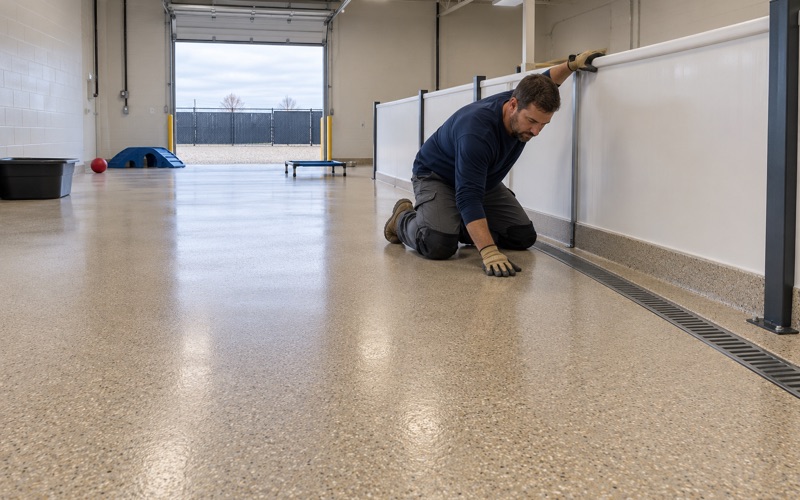
A floor coating is not drainage design, and it does not stand in for anything the City of Grimes building department requires of a shop. What we can do is leave a sealed surface that follows the slab’s existing fall and finish the coating edge cleanly at every grate, so rinse water has nowhere to creep underneath.
A Sealed Floor for Fill Points and Service Bays
Profile and moisture before any resin
A coating in an equipment bay has to stay bonded under steel tracks, dropped attachments and constant cleaning. We open the slab with diamond grinding or shot blasting to an ICRI concrete surface profile that matches the system, then test with ASTM F2170 in-situ relative humidity probes or ASTM F1869 calcium chloride kits. Moisture vapor rising through a slab is the most common reason a shop coating lets go.
Grimes has a great deal of recent construction, with close to half of its housing built in 2010 or later, and newer warehouse buildings on the southeast side as well. A recent pour is not proof of a dry one. If readings come back high, a moisture-mitigation primer goes into the scope before the price is final, not after the first blister.
Building the system for diesel equipment
For a service bay we usually start from a 100% solids epoxy base for thickness and build, finished with a polyaspartic or polyurea topcoat chosen for chemical and abrasion resistance. Where trucks and machines park warm, we plan around hot tire pickup and pick a topcoat suited to it. In harder thermal or impact zones, urethane cement can be the better answer, and we will say so.
Texture matters at a fill point, because a wet floor near a DEF tank is still a wet floor. Slip resistance comes from the quartz aggregate broadcast and the topcoat, and we specify both rather than promising a nonslip floor as a slogan. A smoother finish cleans faster, a coarser one grips better, and the right balance depends on how each bay is used.
Scheduling around a working shop
Equipment shops rarely close for a week. We phase the work bay by bay, with night and weekend windows when a space has to keep running. A fill area can often be done as its own small phase, so the spot that takes the most drips is sealed first and the rest of the floor follows on a schedule the shop can live with.
Cure schedules follow slab temperature and dew point rather than the calendar. An unheated bay in a central Iowa winter waits until the surface sits safely above the dew point, because coating a cold, damp slab invites amine blush and weak adhesion. We would rather move a start date than hand back a floor that peels under the first loader that rolls across it.
- 20+ Years on Iowa Slabs
- Moisture Tested Before Pricing
- Coats and Thickness in Writing