
Urbandale Epoxy Flooring provides concrete grinding in Urbandale, IA, serving surrounding cities including Clive, Grimes, Windsor Heights, Johnston, West Des Moines. Over 20+ years of coating and polishing Iowa slabs, we have found that most floor failures trace back to the surface preparation, so grinding is not a step we hurry: every slab we coat is opened with a diamond grinder or a shot blaster, never an acid etch.
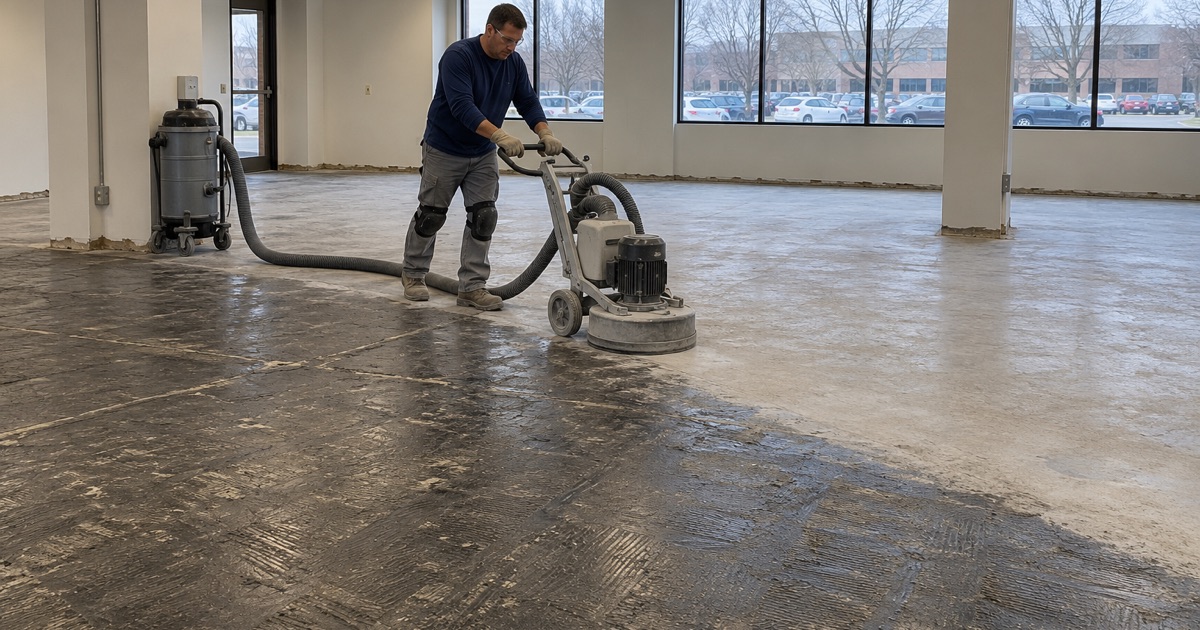
Concrete grinding uses heavy machines fitted with diamond tooling to cut away the top of a slab. It removes the weak surface layer, old coatings, sealers, adhesives and contamination, and it leaves a texture a new coating can bond to. Shot blasting does a similar job by throwing steel shot at the surface and vacuuming it back up, which suits large, open floors.
We grind slabs for our own coating and polishing work, and we also prepare floors for other trades. Either way, the proposal names the method, the profile we will reach and what the floor will be ready for when we leave.
Why Surface Preparation Decides the Floor
Removing the Weak Top Layer
The top of a slab is often its weakest part. Bleed water, overworking during finishing and years of wear leave a thin layer of soft cream, and a coating bonded to that layer can peel off with it. Grinding cuts through to stronger concrete beneath.
The same pass removes curing compounds, sealers, oil stains and the residue of past cleaners. Any of these can stop a coating from bonding, and many are invisible on the surface until a coating fails over them.
A Measured Profile, Not a Guess
Coating makers specify how rough the surface must be, using the ICRI CSP 1-10 concrete surface profile scale. Thin sealers need a light profile, most epoxy and polyaspartic systems need CSP 2 to 3, and urethane cement and mortar systems need a heavier one.
We choose diamond tooling or shot size to hit the specified range, then compare the floor with ICRI profile chips. That turns surface preparation into something that can be checked against the proposal rather than taken on faith.
Why We Never Acid Etch
Acid etching dissolves a little of the surface paste, but it leaves an uneven profile, does not remove sealers or oil, and can leave residue that weakens the bond. It also has to be neutralized and rinsed, and that wastewater goes toward a floor drain or out the door.
Mechanical grinding avoids all of that. The profile is consistent, the contaminants come off with the surface, and the dust is captured rather than washed into a drain or a storm inlet.
What We Grind Off
Old Coatings and Paint
Peeling garage epoxy, worn basement paint and failing warehouse coatings are ground off down to sound concrete. Thick or well-bonded coatings take several passes with coarse tooling, and we test any coating that seems firmly attached before deciding whether it can stay.
A new floor bonded over an old coating is only as strong as the old coating’s bond. That is why we would rather remove a questionable layer than gamble that it will hold under a new system.
Tile Mastic and Carpet Glue
Old floor coverings leave adhesives behind, from black tile mastic to carpet glue and thinset. We remove them with grinders and scrapers before coating or polishing, because adhesive left on the slab will soften or release under a new floor.
Some older black mastics contain asbestos. We raise that at the walk-through so the material can be tested before anyone grinds it.
Lips, Ridges and High Spots
Grinding also flattens. Lips at control joints, trowel ridges and high spots where a slab settled unevenly can be ground down so carts roll smoothly and a new coating lies flat, though a slab that is still moving needs structural repair rather than grinding.
Before a polished or metallic floor, we check flatness with a straightedge and grind the worst high spots first. Low areas are noted for filling or underlayment, since grinding can only take concrete away, and the proposal says which areas get which treatment so the finished floor can be checked against it.
How We Run the Job
Dust Captured at the Head
Concrete dust contains fine crystalline silica. Every grinder we run is fitted with a vacuum shroud connected to a dust extractor, so the dust is captured at the head and bagged. In attached garages and occupied buildings we seal doors to the rest of the space while we work.
Captured dust is bagged and hauled away with the job debris. It is never swept out the garage door, washed toward a floor drain or rinsed to a storm inlet, where concrete fines settle in pipes and carry into the creeks that drain the city.
Edges, Corners and Tight Spaces
Large grinders cannot reach walls, columns, stairs and floor drains, so those areas are finished with hand grinders fitted with matching tooling. Leaving edges unground is a common shortcut, and it is often where a coating starts to peel.
We also grind around floor drains, sump rims and door thresholds by hand, keeping slurry and dust out of drain lines. Those small areas take time, but they are the edges a finished floor is judged by, and they are where moisture and cleaning water collect first.
Working Around Tenants and Business Hours
In offices, flex bays and warehouses, grinding is loud. We phase the work around tenants and business hours and use night and weekend windows when a space cannot close, so the noisiest work happens when the fewest people are there.
In multi-tenant flex buildings, the slab in a bay often carries the sealers, paint or coatings of several past tenants. We grind a test patch to see what is there before pricing, because what the last tenant left decides how much grinding the bay needs and whether a new coating can bond at all.
- 20+ Years on Iowa Slabs
- Moisture Tested Before Pricing
- Coats and Thickness in Writing