
Urbandale Epoxy Flooring handles concrete floor repair in Urbandale, IA, serving surrounding cities including Clive, Grimes, Windsor Heights, Johnston, West Des Moines. With 20+ years of grinding and coating Iowa slabs, we repair cracks, spalls, scaled surfaces, pitted garage floors and battered control joints, either as preparation for a new floor or as a job of their own.
Every repair starts with a map. Before we price anything, we walk the slab and mark each crack, spall, patch and area of old coating, then decide what each one needs. That map goes into the proposal, so you can see exactly what will be repaired and with which material.
The map also tells us when repair is the wrong answer. When a slab has heaved, sunk, or broken into loose pieces, or when cracks keep moving, we say plainly that the floor should be repaired structurally or replaced first. A coating bonds to the concrete it is given, and it cannot hold a failing slab together.
Common Concrete Floor Problems
Shrinkage and Settlement Cracks
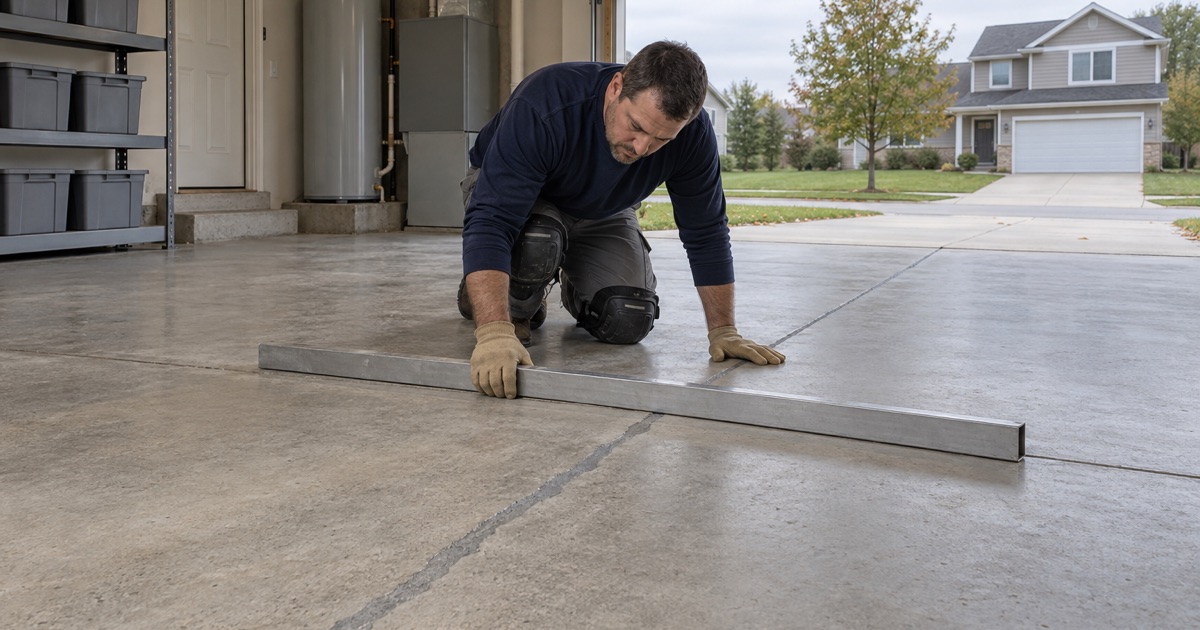
Almost every slab cracks as it cures and shrinks, usually along or near the control joints. Those hairline shrinkage cracks are stable and easy to repair: we open them slightly with a crack chaser, fill them with a rigid epoxy or polyurea filler, and grind the repair flush with the slab.
Settlement cracks are different. They form when the soil or base under a slab moves, and they often show one side sitting higher than the other. We check whether the movement has stopped before repairing, because a crack that is still moving will open again and reflect through any finish laid over it.
Spalled Edges and Pitting
Spalls are chips and broken pieces at joints, cracks and slab edges, often caused by hard wheels, dropped loads or freeze-thaw damage. Pitting is a field of small craters across the surface, common on older garage floors and floors where the top layer was overworked when the slab was finished.
We cut back spalls to sound concrete, clean them, and rebuild them with an epoxy mortar or a polymer-modified repair material. Pitted areas get a skim of filler that is ground flat, so the floor reads as one surface under a new coating.
Salt Scaling and Freeze-Thaw Damage
In central Iowa, calcium chloride and rock salt deicers ride into garages on every tire from November through March. On bare concrete that brine soaks in, freezes and expands, and the surface breaks off in thin flakes known as scaling. Driveway aprons and the area under parked cars usually show it first.
Repairing scaling means grinding off the weak, loose layer until we reach solid concrete, then rebuilding the low areas to a level surface. After that the floor needs a sealer or a coating, because without one the next winter of brine starts the same cycle again.
Damaged Control Joints
Control joints in warehouses, shops and busy garages take a beating from forklift, cart and jack wheels. Once the joint edges break down, every crossing makes them worse, and the bumps rattle loads and wear out wheels.
We rebuild broken joint edges and fill joints with a semi-rigid filler that supports the edges while still allowing the slab some movement. On a coated floor, we decide with you whether joints are filled flush and coated over or kept visible as a clean line.
Repair Before a Coating
Why Repairs Come First
A coating is a thin film, and it shows every dip, crack and spall underneath it. Repairs done properly before the coating disappear under a flake broadcast, while repairs skipped or rushed show through as lines and craters on the finished floor.
Repairs also affect bond. Loose concrete at a spall or a weak scaled surface will let go under a coating, taking the coating with it. Cutting back to sound concrete is what keeps the repaired area from becoming the first place the new floor fails.
Matching Repair Materials to the System
The repair material has to be compatible with the coating going over it. We use fast-setting epoxy and polyurea fillers under epoxy and polyaspartic systems, so repairs can be ground and coated the same day, and repair mortars where a deeper rebuild is needed.
On a polished concrete floor, repairs stay visible. We choose a filler color to blend with the concrete or contrast with it on purpose, and we agree on that before any filling starts.
Moisture and Repairs
A crack that weeps water or leaves a damp line is telling us something about the slab. We test the slab for moisture before any repair and coating, using an ASTM D4263 plastic sheet test and calcium chloride or relative humidity tests where needed, because a repair cannot stop water any more than a coating can.
When Replacement Is the Better Answer
Heaved or Sunken Sections
When a section of slab has heaved from frost or sunk from a washed-out base, the floor is no longer flat and the movement may continue. Grinding a small lip at a joint can make a stable floor usable, but a section that is still moving needs the base under it corrected or the concrete replaced by a concrete contractor.
In a garage, frost heave often shows at the apron, where the slab meets the driveway and water collects against the door. We note that edge at the walk-through, because a coating carried across a joint that lifts every winter will crack along it, and the fix may be drainage at the door rather than anything on the floor.
Slabs Broken Into Loose Pieces
A slab broken into many loose pieces, often where heavy loads crossed an unsupported area, cannot be held together with fillers. We tell you that before pricing a coating, so you do not pay to coat a floor that will crack apart again under the first heavy load.
Honest Advice Before Pricing
Our proposals say plainly when a slab should be repaired or replaced first. Sometimes that means a smaller job for us, but a floor that fails a year after it was coated costs the owner far more, and the advice is part of what the crack map is for.
Our Step-by-Step Concrete Floor Repair Process
Step 1: Crack and Damage Map
We walk the slab, mark every crack, spall, joint and patch, and test for moisture. The map and the repair plan go into the written proposal with the material named for each repair.
Step 2: Cutting Back to Sound Concrete
Damaged areas are cut or ground back to solid concrete, and cracks are chased open so the filler can bond along their full depth. Dust is captured at the machine by vacuum throughout.
Step 3: Filling and Rebuilding
Cracks, pits and spalls are filled with the specified materials, and joints get their filler. Deeper repairs are built up in layers where the material calls for it.
Step 4: Grinding Flush and Next Steps
Repairs are ground flush with the surrounding slab once they cure. From there the floor is ready for a coating, a sealer or polishing, or it can be returned to service as a repaired bare slab.
We walk the repaired floor with you before leaving and point out any repair that will stay visible under the finish you chose. If a crack was flagged as active, we note where it is so you can watch it over the next season and know what you are looking at if it opens again.
- 20+ Years on Iowa Slabs
- Moisture Tested Before Pricing
- Coats and Thickness in Writing