Urbandale Epoxy Flooring brings more than 20 years of work to epoxy flooring in Clive, and a growing share of the questions we field are about floors that hold vehicles rather than people alone. A showroom, a display hall or a heated storage room asks a coating to sit under rubber for days at a time. That is a different test from foot traffic or a rolling cart, and it deserves a different plan from the first site visit onward.
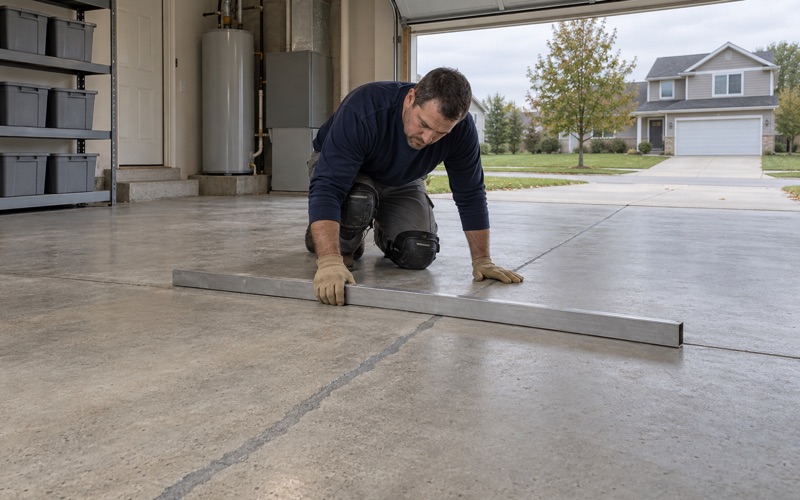
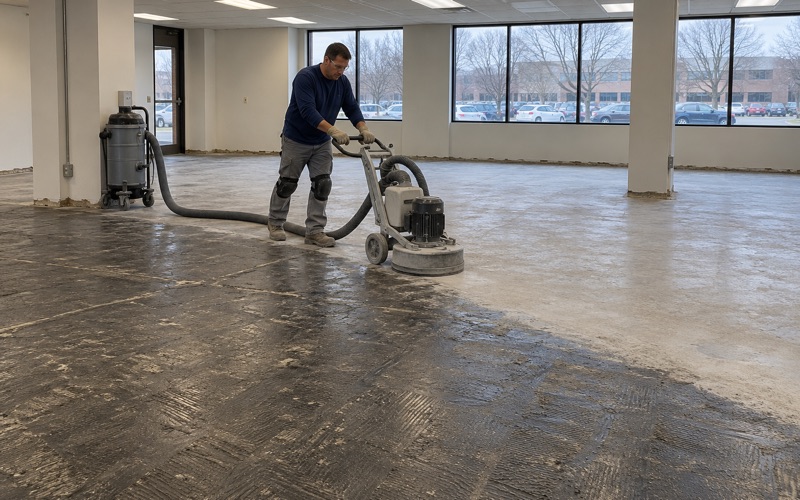
Our plan starts with the slab itself. Every floor is opened with a diamond grinder or a shot blaster, never an acid etch, so the primer has a real concrete surface profile to bite into. Grinding dust is pulled into a vacuum at the machine instead of being rinsed toward a floor drain. The written proposal then names the product line, the coat count and the finished thickness, so you can hold the finished floor up against the quote.
Before a price is final, a moisture test goes into the scope, and we map cracks, spalls and old coatings so nothing surprises anyone halfway through. We also walk through what a coating warranty leaves out before the job is sold, with moisture named first. On a display floor, tire staining belongs on that same list, and the rest of this page explains why it earns the attention.
A Display Floor on NW 100th Street
A Clive lot with a Des Moines address
Willis Lexus publishes its address as 2131 NW 100th Street, Des Moines, yet the Census geocoder places that lot, and 2121 NW 100th Street beside it, inside the City of Clive in Polk County. The dealership is open six days a week. In June 2016 it marked a $4 million renovation with a grand reopening, and the report on that project described a larger showroom that had nearly doubled in size.
We have never worked on that building, and nothing we read describes what its showroom floor is made of. It could be coated, tiled or polished concrete. We bring it up because a Clive dealership is the clearest local example of a floor type with one problem most owners never hear about until the first stain appears under a display car.
What a showroom asks of its floor
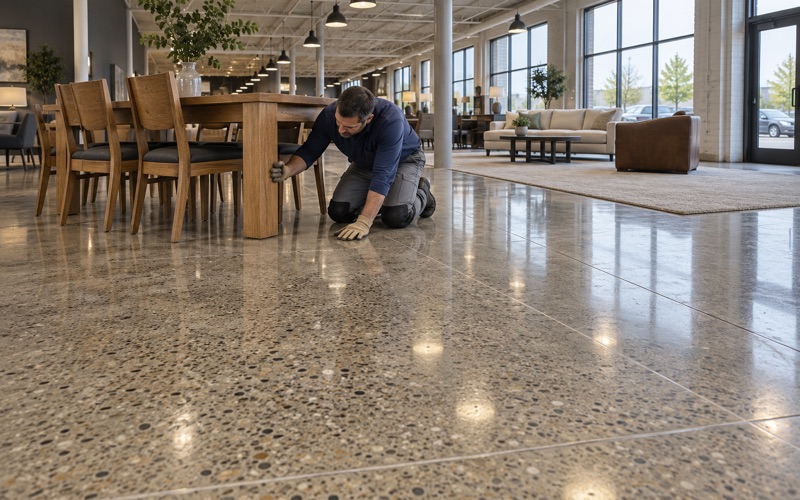
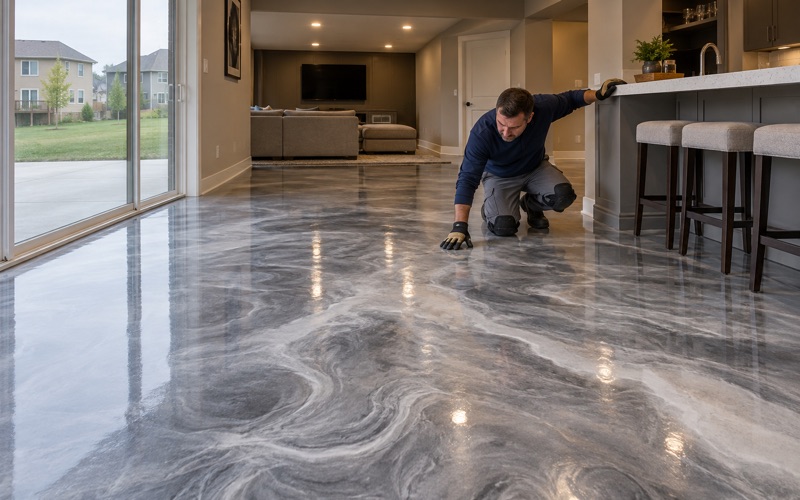
A showroom floor is chosen for presentation. Owners tend to favor light, glossy finishes that bounce light onto paint and chrome, and the vehicles on display stand on the same spots for days or weeks before they are sold or rotated. Few floors in any building carry a load that stays this still for this long, and that stillness matters more to the coating than the weight does.
Up the same street sits Horizon Events Center at 2100 NW 100th Street, a concert hall, sports court and ballroom venue listed for 25 to 3,000 guests. Its floors are judged on crowds, setups and teardown. A showroom is judged on something quieter: what happens under four tires that do not move for weeks at a time, in a room built to be looked at closely.
Looking for epoxy-flooring closer to Grimes? See Epoxy-Flooring Services in Grimes.
Why Parked Tires Stain a Coated Floor
Antiozonants that travel out of the tread
Tire rubber is compounded with antiozonants, chiefly 6PPD and IPPD, that protect it from cracking. A technical note from Dulux, an Australian coatings maker whose product line is not sold here, explains that these chemicals progressively migrate through the rubber and onto the surface of the tire. The mechanism is general, so the note applies to epoxy and polyurethane floors whatever brand is on the label.
When a tire rests on a coating, those compounds pass into the finish and oxidize there, which is why the color develops over time instead of appearing at once. The result is a black, brown or sometimes yellow stain in the tread pattern, exactly where the vehicle sits when parked. Because the color forms in the coating rather than resting on top as dirt, it behaves differently from an ordinary scuff.
A stain is not a skid mark
The note draws a clear line between this staining and a skid mark. A skid mark is rubber rubbed off by a turning or braking tire. Tire staining shows up when tires are at rest on the painted surface for some duration, so a floor can look clean on delivery day and later show four neat tread prints under a display car that has not moved.
It is also separate from hot tire pickup, where a warm tire softens and lifts a weak or poorly bonded coating as it pulls away. Pickup is a bonding and product problem that surface preparation and the right system address. Staining can occur on a well-bonded, well-chosen floor, because it is chemistry moving between two materials rather than a failure of either one.
What makes one floor stain more than another
The tech note lists the variables: the age of the tire, its tread compounds, how long it stays in contact, the tire’s temperature, the type of coating, how far the coating has cured, and its color. Most of those sit with the vehicle, not the floor. The three a floor owner controls are the coating, its cure and its color, which is where our planning goes.
Color carries the most visible weight. The note states plainly that lighter colors tend to show staining to a greater extent. A bright white or pale gray showroom finish, glossed for presentation, is the combination most likely to show tread marks, while the same chemistry on a darker floor can pass unnoticed. Neither color stops the chemistry; one simply hides it far better than the other.
Seven Days Before the First Vehicle Parks
Partly cured is not cured
The same note says epoxy and polyurethane are only partly cured several days after application, and that vehicles should not be parked on them until the cure is essentially complete, typically around seven days. A floor that feels hard underfoot on day two is still mid-cure, and state of cure is one of the listed variables. Rolling inventory back early invites marks in a brand-new floor.
For a dealership or display room, that week has to be planned rather than hoped for. We set the date the vehicles come off the floor and the date they may return before work starts, and we put both in writing. If the business cannot close a full room for that long, the floor is split into sections and coated in turns, with night and weekend windows where they help.
Slab temperature and dew point set the clock
Seven days is a typical figure, not a promise. Our cure schedules follow slab temperature and the dew point spread at the slab surface rather than the calendar, because a cold slab cures slowly and a narrow spread invites amine blush, a waxy film that weakens the bond of the next coat. An unheated building in a central Iowa winter waits longer than a heated showroom in May.
We read those conditions at the slab, not from a forecast, and we keep reading them through the cure. When the numbers say the floor needs more time, the vehicles wait. That can be inconvenient for a business that sells off its floor, but a few extra days cost far less than a showroom that shows the outline of last month’s inventory every day after.
Moisture comes before any of it
None of the cure math holds if the slab is pushing moisture up from below. A moisture test is written into every scope before the price is final, using ASTM F2170 in-situ relative humidity probes or ASTM F1869 calcium chloride testing as the slab calls for. Where readings run high, a moisture-mitigation primer goes down first, and that choice appears in the proposal by name.
Mats, Darker Colors and Topcoats for Display Floors
Protect the spots where tires rest
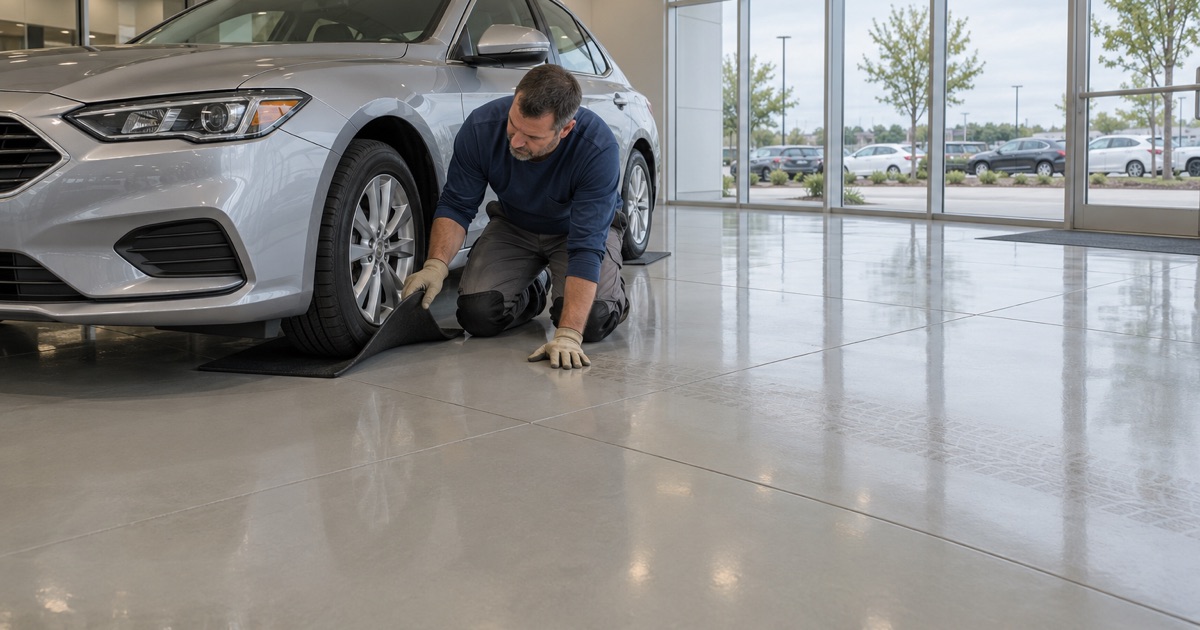
The most direct defense in the tech note is simple: put mats or an impermeable sheet material where the vehicle tires will be when parked. On a showroom, that means marking the display positions and treating them as working spots, with pads under each tire that move with the vehicle when the floor is rearranged. The coating between those spots stays open to view and to foot traffic.
The note also advises against parking hot or wet tires on a coated floor. A car driven in from a test drive, or brought inside carrying slush and brine from November through March, is often both. Letting it cool and dry near the door before it rolls onto its display spot costs a few minutes and takes two of the listed variables off the table.
Choosing color with staining in mind
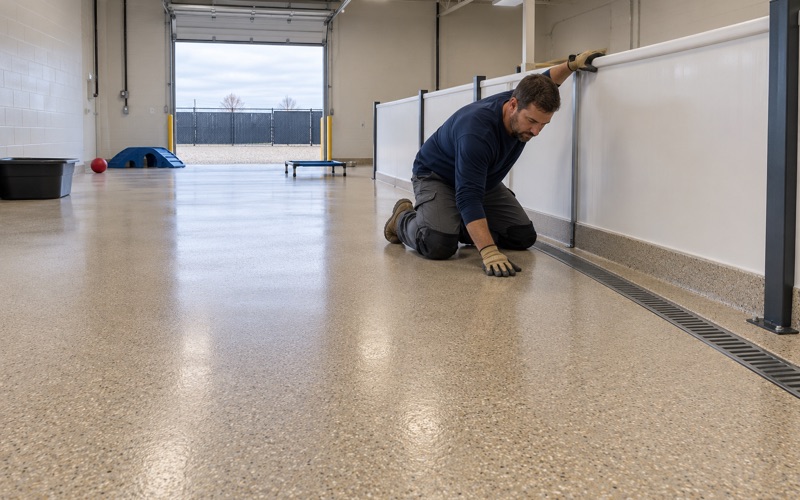
Because lighter colors show staining most, color is a performance choice on a display floor and not only a look. A mid-tone or darker base, or a vinyl flake broadcast that breaks up the field, will hide what a solid pale finish puts on show. We lay samples side by side so an owner can weigh presentation against how the floor will read after a season of parked inventory.
If a light floor is non-negotiable for the brand, we say so in writing: that floor will need mats under parked tires and more patience during cure. Slip resistance is handled the same way, through the broadcast and topcoat we specify, such as quartz aggregate in a walkway lane, rather than promised as a slogan on a brochure.
Topcoats and what we will not promise
The topcoat is the layer the tire actually touches. A 100% solids epoxy body coat under a polyaspartic or polyurethane topcoat is a common display-floor build, and our proposal names the exact product line, the number of coats and the finished thickness so the result can be checked. Coating type is one of the listed variables, so that choice deserves a conversation with staining in mind.
What no system can be is tire-stain proof, and we will not describe one that way. Dulux itself disclaims any warranty on tire staining. We explain that exclusion, along with moisture and the other limits of a coating warranty, before the job is sold, so an owner on NW 100th Street or anywhere else in Clive knows what the floor is built to resist and what still depends on how it is used.
- 20+ Years on Iowa Slabs
- Moisture Tested Before Pricing
- Coats and Thickness in Writing