Urbandale Epoxy Flooring has spent more than 20 years on epoxy flooring in Boone and across central Iowa, and the floors that teach the most are the ones where vegetable oil meets concrete. Pump pads, process rooms and loading areas each get a system picked for what actually lands on them, not a stock garage coat stretched to fit a plant.
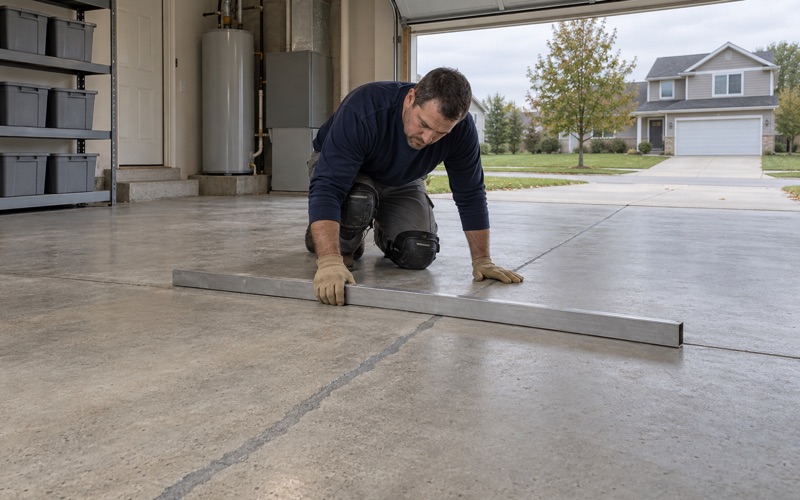
Every job starts the same way. We open the slab with a diamond grinder or a shot blaster rather than an acid etch, map cracks, spalls and old coatings before pricing, and write a moisture test into the scope before the number is final. When a slab should be repaired or replaced before it is coated, we say so plainly.
The proposal names the product line, the coat count and the finished thickness, so anyone can hold the finished floor up against the quote. What the warranty leaves out is explained before anything is signed, and moisture is the first exclusion on that list.
Oil and Glycerin Refining in the Boone Industrial Park
What moves through the industrial park
The Boone Industrial Park is home to AgCertain Boone at 977 Quartz Avenue. According to the Iowa Soybean Association in April 2024, the plant runs three refineries that purify vegetable oils and one refinery for glycerin. It was designed to process a wide range of oils, including soybean, corn, walnut and watermelon seed oil, and its food-grade oil work dates to 2019.
The Ames Regional Economic Alliance has described AgCertain’s Phase III expansion on its 120-acre Boone campus, including a new Rail Spur B for added loading, unloading and storage. The company receives and sends glycerin and edible oils by rail. AgCertain is not a customer of ours and we have not seen its floors; it is simply the clearest picture of what moves through Boone.
Where oil reaches the floor
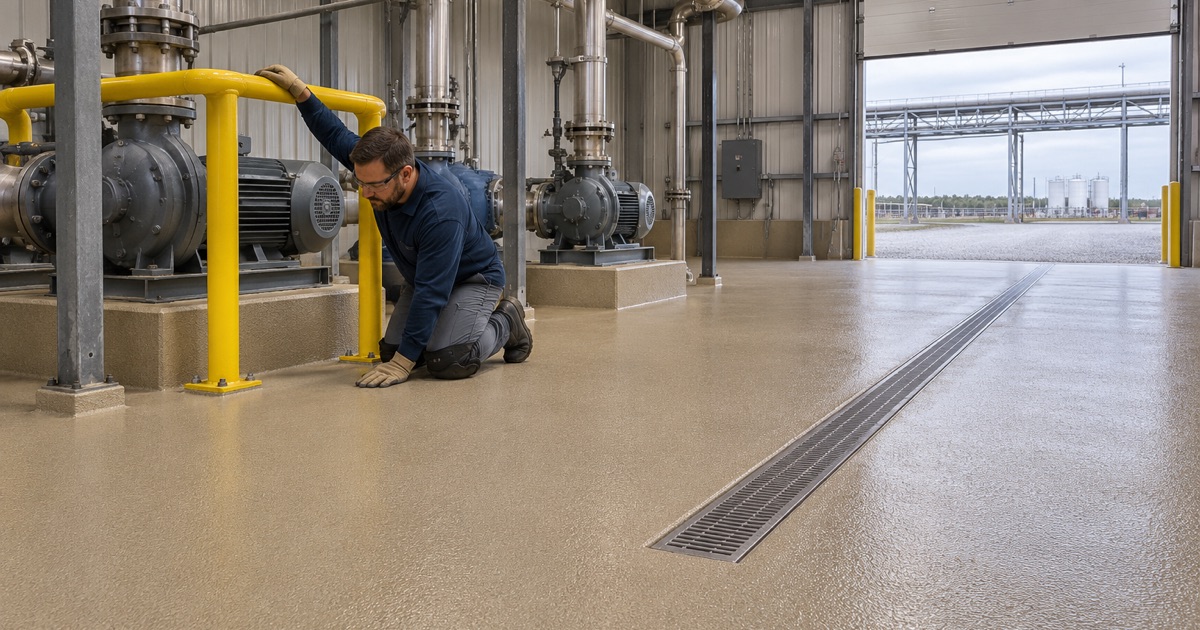
In any oil-handling operation, the floor meets the product at transfer points: pump skids, hose connections, drum filling, tote staging and the spot where a rail car or tanker is unloaded. A coupling that weeps a few drops a shift, or a hose set down without a cap, puts oil on concrete every working day.
Those spots are small next to the size of the building, but they decide whether a floor holds up. Daisy Brand is also building a large dairy plant in the same park along U.S. Highway 30, so food ingredients move through this corner of Boone in bulk. For any owner here, the practical question is what the drip zones are sitting on.
Looking for epoxy-flooring closer to Clive? See Epoxy-Flooring in Clive.
What Vegetable Oil Does to Bare Concrete
The chemistry under the stain
Most people think of oil on concrete as a stain and a slip hazard. Vegetable oil is worse than that on bare concrete. Its fatty acids react with the alkaline cement paste through saponification, the same reaction that turns fat and lye into soap, leaving fatty acid salts and glycerin inside the slab itself.
A Japan Concrete Institute paper describes how those salts can expand in the capillary pores and damage the microstructure of the paste. The surface may look sound for a long time while the paste just beneath it loses its grip on the sand and stone, which is why a darkened pump base deserves a closer look than a wipe.
What the lab measured
Researchers at RUDN University, publishing in Construction and Building Materials in 2022, soaked mortar and concrete samples in corn, olive and palm oil at room temperature. After 60 days the samples had lost an average of 61.2 percent of their strength, and after 90 days some began to collapse on their own.
That is a lab immersion result, not a measurement of any floor in Boone, and a slab with drips is not a sample sitting in a bath. What the study shows is direction: fatty acids open micro-cracks that grow into larger fractures, and edible and technical vegetable oils generally cause the problem. Repeated exposure works in the oil’s favor.
Why the damage stays quiet
Saponification does not announce itself the way a pothole does. Concrete around a pump base slowly softens, dusts and crumbles at its edges, often hidden under the dark staining oil leaves behind. By the time a pallet jack wheel breaks through, the weakened layer can run deeper than the stain suggested.
When we survey a slab like that, we grind test areas to find sound concrete and map the soft zones before pricing. Sometimes the right call is to cut out and replace a section before any coating goes down, and we would rather say that at the start than bond resin to paste that is already failing.
Choosing a Floor for Oil, Heat and Washdown
Matching resin to the oils in use
A floor in an oil-handling area gets a resin system rated for the oils and cleaners actually on site, not a general-purpose coating. 100% solids epoxy is a common base, and urethane cement is often the tougher choice where hot water washdown and thermal shock are part of the daily routine.
Before we pick a product, we ask which oils, temperatures and cleaning chemicals the floor will see, and where hoses and drums sit during a normal shift. The answer usually means different systems in different zones of one building, with the heaviest build at the transfer points and a lighter one in dry storage.
Heat matters as much as chemistry. Warm oil runs thinner and finds joints and pinholes faster than cold oil, and a floor cleaned with hot water every shift cycles through expansion and contraction all year. Those are the conditions where urethane cement tends to outlast a thin epoxy film.
Preparing an oil-soaked slab
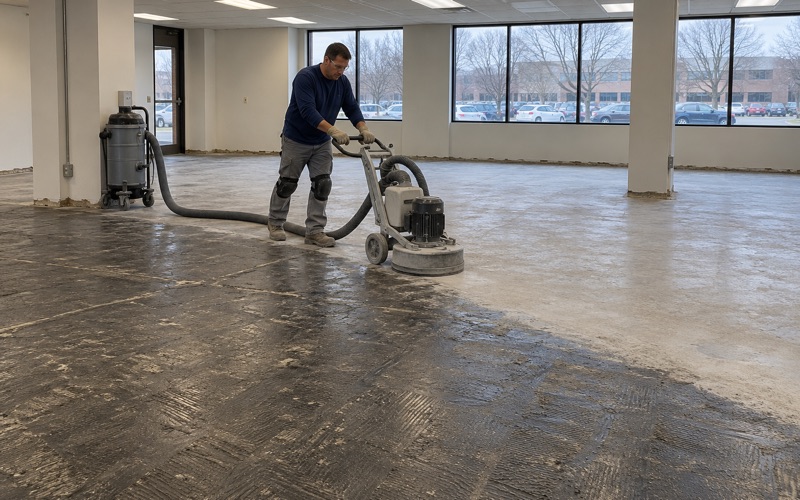
Coatings do not bond to oil. A slab that has taken drips for years needs contaminated concrete removed by diamond grinding or shot blasting down to a clean profile on the ICRI CSP scale. Grinding dust is captured at the machine by vacuum rather than rinsed toward a floor drain or a storm inlet.
Where oil has soaked deep, grinding alone may not reach clean concrete, so patching or partial replacement comes first. We also test slab moisture with methods such as ASTM F2170 relative humidity probes before the price is final, because a floor that traps vapor can lift no matter how well it resists oil.
Planning work around a running operation
Plants and transload areas rarely close for a week. We phase the work in sections around production and shipping, with night and weekend windows when a space cannot stop. Cure schedules follow slab temperature and dew point rather than the calendar, so a pump pad coated in a cold January bay waits longer than one coated in June.
Before work starts, we agree which zones close in which order, where product and equipment move while a section cures, and when foot and forklift traffic can return. Low-odor products are available where an occupied office shares air with the shop floor, offered for comfort and re-entry rather than as a legal requirement.
Code questions and the city building official
Whether a slab replacement, a new trench drain or a change of use needs a permit is a question for the City of Boone building official. The posted code of ordinances adopts the 2012 International Building Code with local amendments, but that online library runs only through 2019, so we confirm the current edition before relying on any section of it.
Traction Where Floors Stay Oily
Texture chosen for the conditions
A smooth, glossy resin floor with a film of oil on it is one of the slickest surfaces in any building. Slip resistance comes from what is broadcast into the resin and how the topcoat is applied, usually a quartz aggregate broadcast locked in by the final coat. We specify it by broadcast and topcoat, not as a slogan.
The texture has to balance two jobs. Too fine, and an oily boot still slides; too coarse, and the floor holds oil and is hard to clean. Around pumps, hose racks and rail unloading, we usually step the texture up compared with the dry areas of the same building.
Keeping traction from fading
Texture wears down where traffic and pallet jacks concentrate, and the drip zones are often the very places people stand to make connections. Planning a renewable topcoat in those areas keeps traction from fading as quietly as the bare concrete beneath it once did.
Containment helps the floor too. Coved edges at walls and curbs, and a resin surface pitched to carry spills toward collection rather than into joints, keep oil from finding the one unsealed seam in an otherwise protected floor.
Salt, slush and Boone garage floors
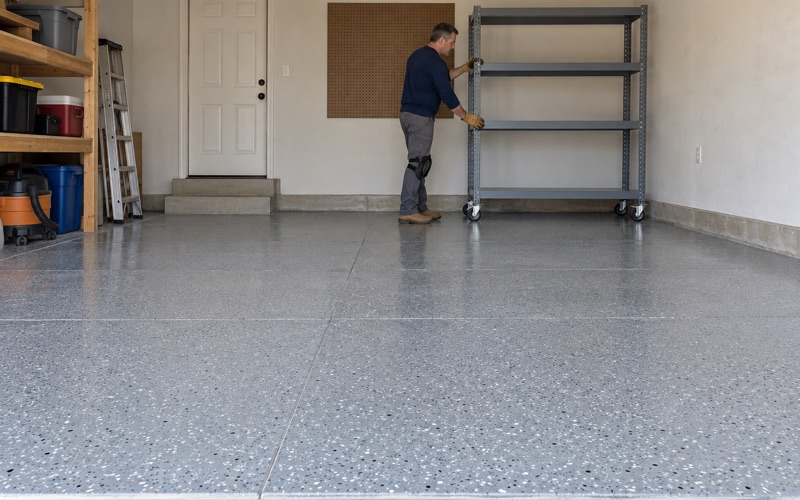
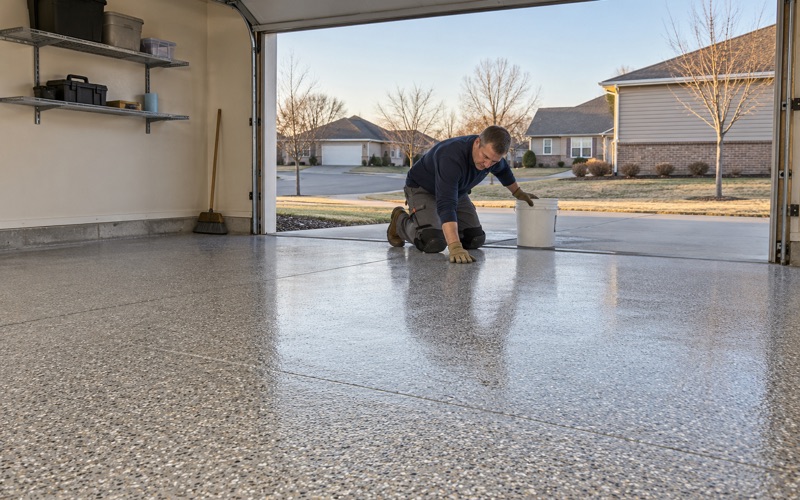
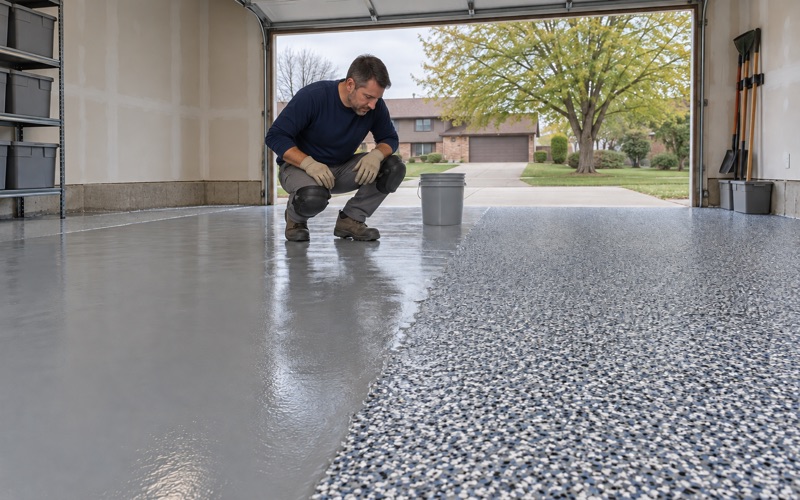
Outside the industrial park, most of Boone’s floors are in homes. About 39 percent of housing units here were built in 1939 or earlier, and most are owner-occupied detached houses. Garage slabs take the brine and rock salt that ride in on tires from November through March, so we choose a vinyl flake broadcast and topcoat that stay grippy when wet.
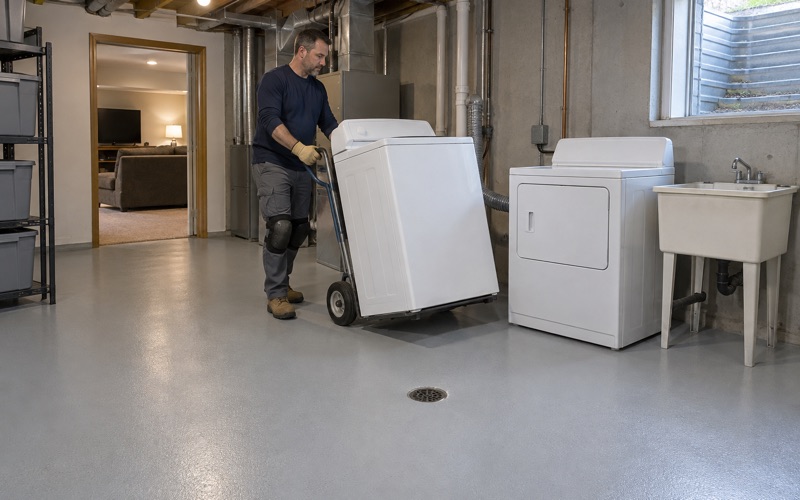
Basements in older houses get their own check. We look for signs of past water first, leave the sump pit and floor drain open and working, and test for vapor before a coating is chosen, because hydrostatic pressure under a basement slab will push past any coating sooner or later.
Boone sits on Des Moines Lobe glacial till, with well-drained Clarion soils on the rises and poorly drained Canisteo and Coland-Spillville soils in low spots, so two slabs in one town can carry very different moisture. We test the garage slab whatever year the house was built. A floor coating is never waterproofing, radon work or flood protection, and we say so before anyone signs.
- 20+ Years on Iowa Slabs
- Moisture Tested Before Pricing
- Coats and Thickness in Writing