
Urbandale Epoxy Flooring installs basement floor epoxy in Urbandale, IA, serving surrounding cities including Clive, Grimes, Windsor Heights, Johnston, West Des Moines. In more than 20 years of coating central Iowa slabs, we have learned that a basement floor is a moisture question before it is a color question, so every basement we coat starts with a look at the slab’s water history and a written moisture test.
A basement slab sits in the ground, surrounded by soil that holds water after every rain. That is not a reason to avoid coating it, but it is the reason the preparation and the testing matter more downstairs than anywhere else in the house.
Our proposal for a basement names the moisture test, the product line, the number of coats and the finished thickness. It also lists what the coating warranty excludes, and moisture is the first exclusion we name, because a homeowner deserves to hear it before the job is sold rather than after a wet spring.
The Moisture Question Comes First
Reading the Slab’s Water History
Before testing anything, we look for the signs a basement has already left behind: water lines on walls and stored boxes, rust stains at the base of metal shelving, dark patches near the walls, and white powder on the floor. Each of those tells us where water has come from and how recently.
We also ask about the house. When the sump runs, whether the floor drain has ever backed up, and whether the gutters and downspouts carry water well away from the foundation all shape the plan. A coating can only be as dry as the slab it sits on.
Testing With ASTM Methods
We start with an ASTM D4263 plastic sheet test as a quick screen, taping a sheet to the floor and checking for condensation underneath. Where the screen raises a question, we use ASTM F1869 calcium chloride kits to measure vapor emission or ASTM F2170 probes set into the slab to read relative humidity.
The results are compared with the coating maker’s limits and with the ASTM F710 thresholds that flooring installers use. A reading over the limit points to a moisture-mitigation primer or, in a worse case, to a drainage fix before any coating goes down.
Efflorescence and What It Means
White, powdery deposits on a basement floor are efflorescence: salts carried up through the concrete by moisture and left behind as it evaporates. They are a sign the slab is moving water, not a cosmetic problem to sweep up and ignore.
We grind the salts off and test the slab beneath. Coating over efflorescence without addressing the moisture behind it traps the next round of salt under the film, where it pushes the coating up in blisters.
Planning Around Basement Systems
Sump Pits and Drain Tile
Many basements stay dry because drain tile collects groundwater around the footing and carries it to a sump pit. The coating has to work around that system, so we finish neatly at the sump rim, keep the lid removable and never pour or roll anything into the pit or its lines.
If the sump pump runs often, we take that as information about the soil and the water table rather than as a nuisance. A slab over saturated soil can carry more vapor than a slab on a dry rise, and the moisture test is how we find out.
Floor Drains
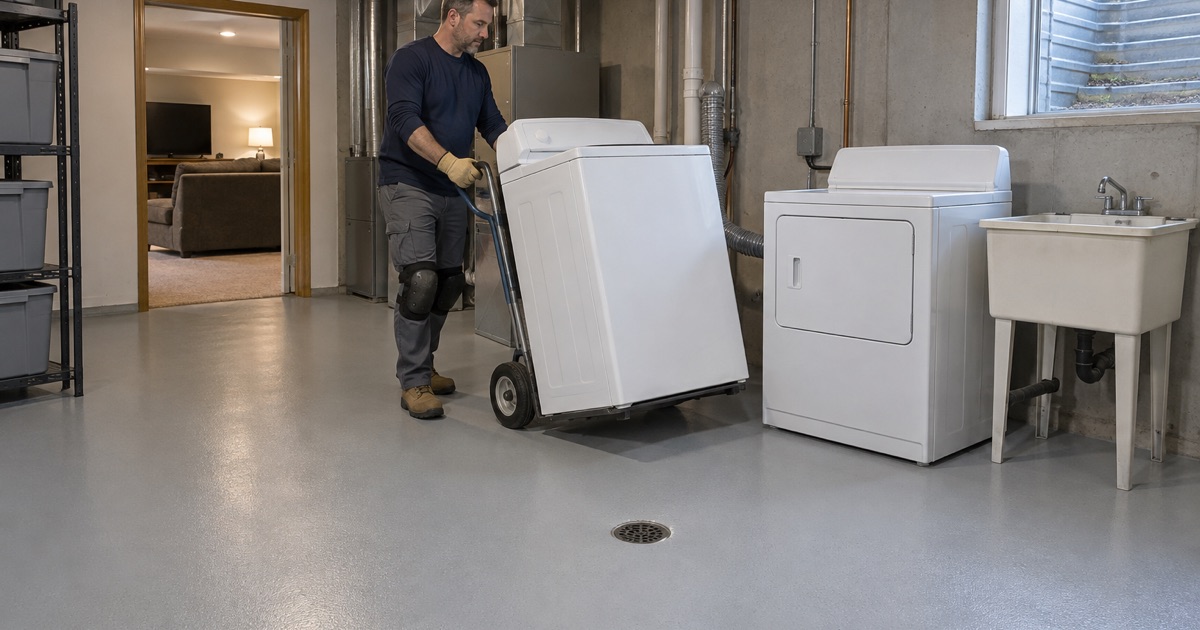
A basement floor drain is the last line of defense against a leak from a water heater, washer or pipe. We leave it open and working, keep grinding slurry out of the drain line, and taper the coating into the drain body so water still runs toward it.
Grinding dust is captured at the machine by vacuum rather than washed down the drain. Concrete fines settle in traps and lines, and they are a common cause of the next backup.
Urbandale’s Foundation Drain Disconnection Program
Urbandale’s Foundation Drain Disconnection Program, under City Code Chapter 59, is moving older homes’ footing drains off the sanitary sewer, usually by adding a sump pump. It applies mainly to homes built before sump services became standard in the early 1980s, and where the city has built storm sewer and a sump service stub, the owner must disconnect.
A new sump pit means a cut and patched basement slab and a new lid in the floor. If that work is coming, we plan the coating around the patch and the lid, and we recommend letting the new concrete cure and testing it before it is coated.
Preparing an Old Basement Floor
Paint, Patching and Tile Mastic
Older basement floors often carry decades of layers: floor paint, patching compound, carpet glue and black tile mastic. We grind them down to sound concrete, because a new coating bonds only as well as the weakest layer under it, and old mastic is usually the weakest of all.
Where old tile adhesive may contain asbestos, as some older black mastics do, it needs to be tested before anyone grinds it. We raise that question at the walk-through rather than discovering it with a grinder running.
Cracks and Uneven Areas
Shrinkage cracks, settlement cracks and low spots are mapped and filled before coating. Most basement cracks are stable and can be filled and ground flush, but a crack that keeps opening or one that lets water in is a sign of a problem a coating cannot solve.
Soil Under the Slab
Urbandale sits on Des Moines Lobe till, from well-drained Clarion soils on the rises to poorly drained Coland-Terril drainageways, and on the Dallas County side Webster clay loam swales where the water table sits about six inches down. Two basements a few streets apart can sit on very different moisture, which is why we test each one rather than assuming from the neighbor’s floor.
Choosing a Basement Floor System
Moisture-Mitigation Primer
When the test shows more vapor than a standard epoxy tolerates, we specify a moisture-mitigation primer under the coating. It is built to hold back vapor that would otherwise blister the floor, but it does not stop liquid water or hydrostatic pressure from a high water table.
Laundry Rooms, Workshops and Gyms
Laundry rooms get a texture near the washer and a coved edge where water could run under the wall. Workshops get a harder, thicker system for dropped tools, and home gyms get a finish that handles weights and rubber mats. We set the texture and topcoat for each room rather than coating the whole basement the same way.
Low-Odor Products for Living Spaces
Because a basement shares air with the rest of the house, we offer low-odor products as a comfort and re-entry choice. They are not an Iowa legal requirement, and we do not sell them as one, but they make it easier to live in the house while the floor cures.
What a Coating Is Not
A floor coating is not waterproofing and not radon mitigation. Radon testing and mitigation in Iowa take a state credential under Iowa Code chapter 136B, so we never sell a floor coating as radon work. If either is a concern, it is solved by the right professional before the floor is finished.
- 20+ Years on Iowa Slabs
- Moisture Tested Before Pricing
- Coats and Thickness in Writing