Urbandale Epoxy Flooring brings more than 20 years of epoxy flooring work to Ankeny, and lately a growing share of the calls we take ask for something other than a showroom garage. Homeowners want a practice court in a heated outbuilding, and business owners want game lines in a spare warehouse bay. Those are reasonable goals, but they start from a different place than a garage coating does.
Before we price any floor, we open the concrete with a diamond grinder or a shot blaster rather than an acid etch, and we write a moisture test into the scope. The proposal names the product line, the coat count and the finished thickness, so you can hold the result up against the quote once the work is done.
This page covers what changes when a slab is meant for a game rather than a car. It explains why a smooth, glossy floor is the wrong base, what the concrete underneath has to do, and how lines get laid out. Where a dedicated sport surface is the better answer, we say so plainly.
Pickleball in Ankeny, and Why a Court Is Its Own Floor
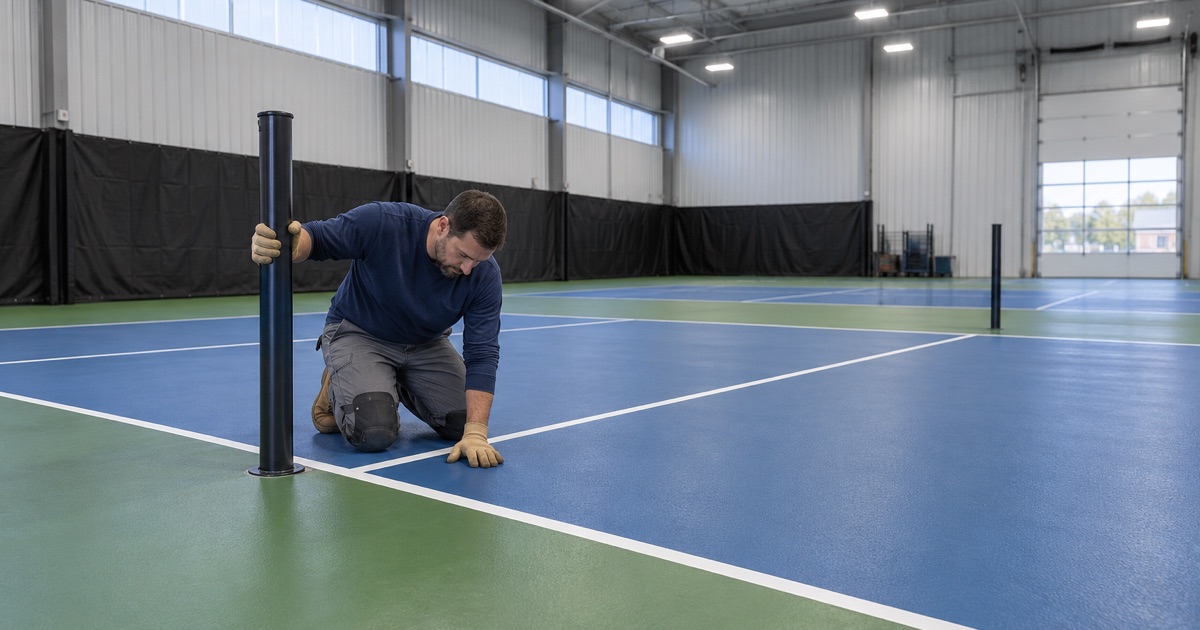
Seven indoor courts and twelve outdoor ones
Ankeny plays the game indoors and out. Polk County Pickleball, at 2222 SW Vintage Parkway, runs seven indoor courts in a climate-controlled building with Novaplay surfacing and full-length dividers, open from 7:00 a.m. to 10:00 p.m. Monday through Saturday. Across town, the city’s Rally Complex at 725 SW Prairie Trail Parkway has 12 stand-alone, lighted courts.
We have no connection to either facility, and we do not know how their slabs were built. We mention them because they show what local players are used to: a dedicated acrylic sport surface, not a garage floor with tape on it. That expectation follows the game home to a basement, a pole barn or a flex bay.
A sport surface is not a showroom coating
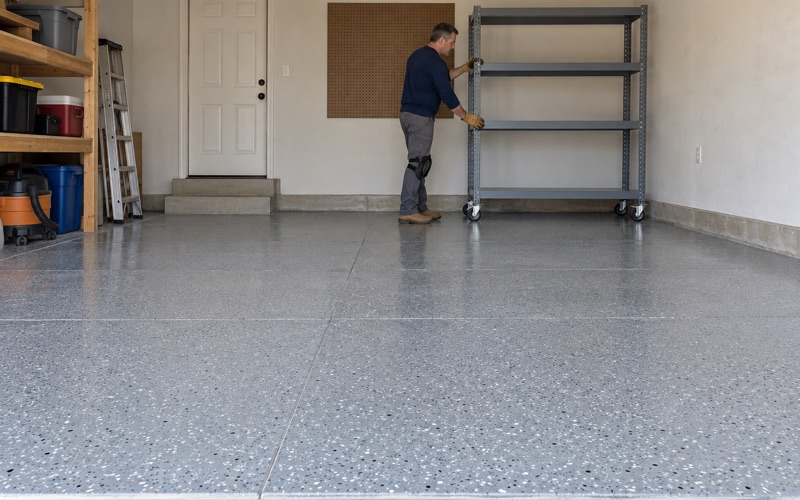
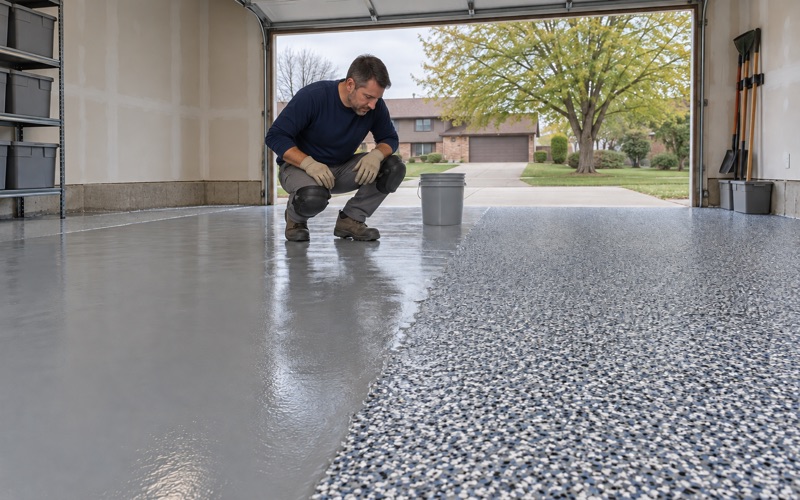
A garage system is built to shrug off hot tire pickup, brine and dropped tools. A 100% solids epoxy base with a vinyl flake broadcast and a polyaspartic topcoat does that job well, but its surface is designed to be hosed off, not played on. Ball bounce, shoe grip and glare under bright fixtures were never what that system was chosen for.
A court coating maker’s spec describes a layered acrylic system instead: resurfacer coats, at least two color coats, then line paint. We are not a certified sports-surface installer, and for a full regulation court we will tell you so and suggest a specialist. Where we help is the concrete itself, which decides whether any court system holds.
Where Ankeny players want a court
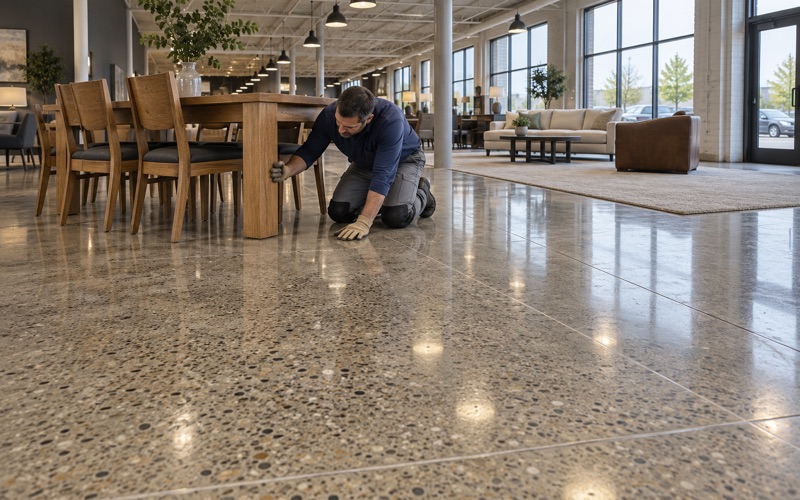
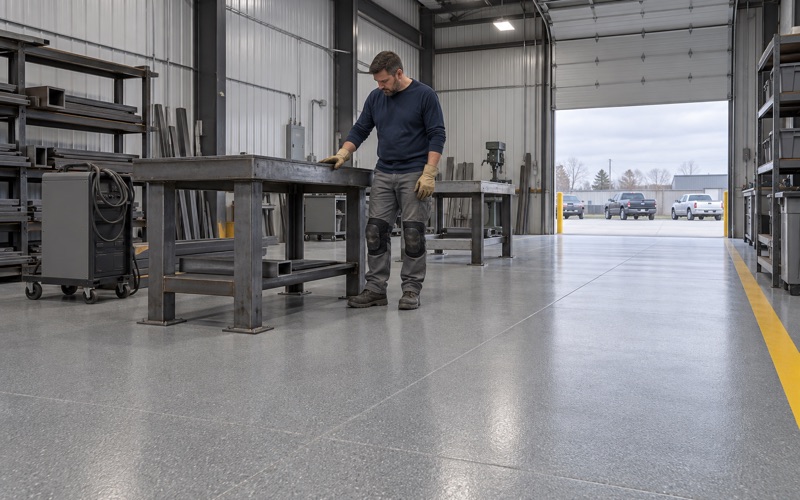
The spaces we see are heated garages, detached outbuildings, basements with enough ceiling height, and flex bays with a warehouse in back. Each has a different slab history. A garage may have been sealed at the pour, an outbuilding may have no vapor barrier at all, and a flex bay may carry years of forklift wear and old paint.
Heat matters too. NCEI 1991-2020 normals put the Ankeny cooperative station at 149.7 nights a year at or below 32 degrees, against 127.9 at Des Moines International Airport, so the city sits somewhere between the two. An unheated space spends much of the year too cold for most resins to cure, which sets the work window before anything else does.
Looking for epoxy-flooring closer to Norwalk? See Epoxy-Flooring Services in Norwalk.
Why a Steel-Troweled Slab Gets Profiled First
What the court spec asks of the concrete
The SportMaster spec sheet for its pickleball surfacing over concrete (CMT-72, revised March 2025) is blunt about the finish. New concrete should carry a medium broom finish or a similar roughened texture, and it must never be steel troweled. If a shot blaster is used to build that texture, the sheet recommends a profile of CSP 3 or 4.
That matters because most interior slabs in garages, shops and warehouses are finished the opposite way. A steel trowel closes the surface, draws fines to the top and leaves a dense, slick skin. Paint or acrylic laid over that skin has very little to grip, and it tends to let go in sheets once traffic and temperature swings go to work on it.
Grinding or blasting to a measurable profile
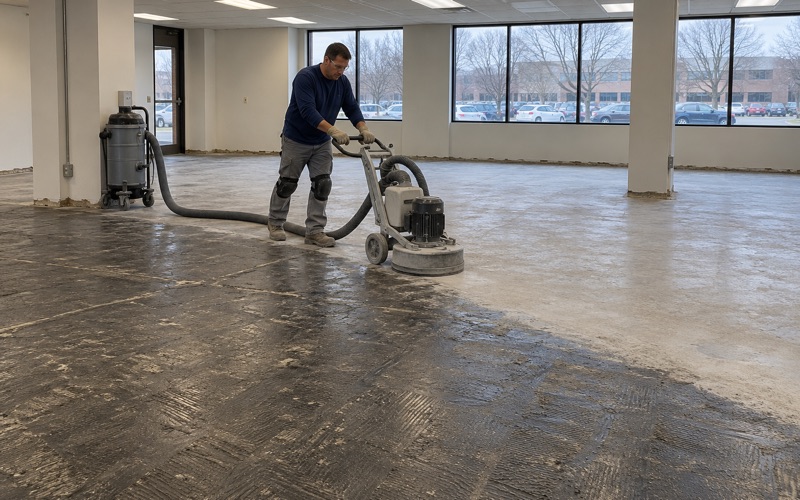
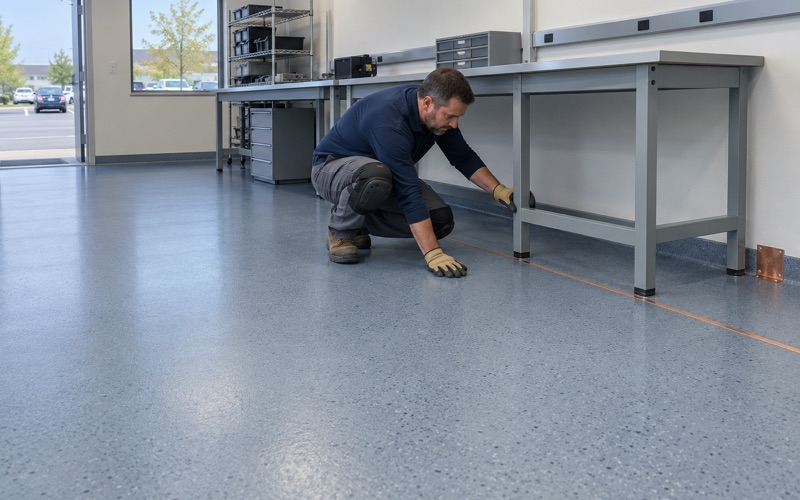
We open every slab mechanically, with diamond grinding or shot blasting, and acid etching is not part of our method. The ICRI CSP 1-10 scale gives everyone a common reference, and a CSP 3 or 4 reads like coarse sandpaper under the hand. Grinding dust is captured at the machine by vacuum rather than washed toward a floor drain or a storm inlet.
Profiling also shows us what is underneath. We map cracks, spalls and any old sealer or coating before pricing, and if a slab is too far gone, we say it should be repaired or replaced first. A court magnifies defects: a crack that disappears under flake on a garage floor can send a ball sideways on a game surface.
Densified and sealed slabs
A slab treated with a lithium silicate densifier or a cure-and-seal product needs extra attention, because those treatments are meant to tighten the surface. After profiling we check how the concrete takes water and primer before committing to a system. If it still repels them, more grinding comes before any coat goes down.
This step is easy to skip and expensive to get wrong. A primer that sits on top of a sealed skin can look perfect for a season and then lift where players pivot hardest. We would rather spend another pass with the grinder than return to scrape a failed court off the floor.
Vapor, Cure and Low Spots Under an Indoor Court
The vapor barrier under the slab
The same spec sheet starts below the concrete. It calls for a suitable vapor barrier beneath the slab and adequate perimeter drainage, so moisture cannot gather under the surface. It also rules out curing compounds; the concrete is moisture cured only, and new pours cure 28 days before surfacing begins.
On an existing slab, nobody can dig up the base to look, so we measure instead. ASTM F2170 in-situ relative humidity probes or an ASTM F1869 calcium chloride test, with an ASTM D4263 plastic sheet as a quick screen, tell us what the slab is giving off. That reading goes into the scope before the price is final.
What a coating cannot do
A floor coating is not a fix for a wet slab, and it does not stop water moving up from the ground. If readings run high, the options are a moisture-mitigation primer rated for the level we found or a decision not to coat at all. Moisture is also the first exclusion we explain in any warranty, before the job is sold.
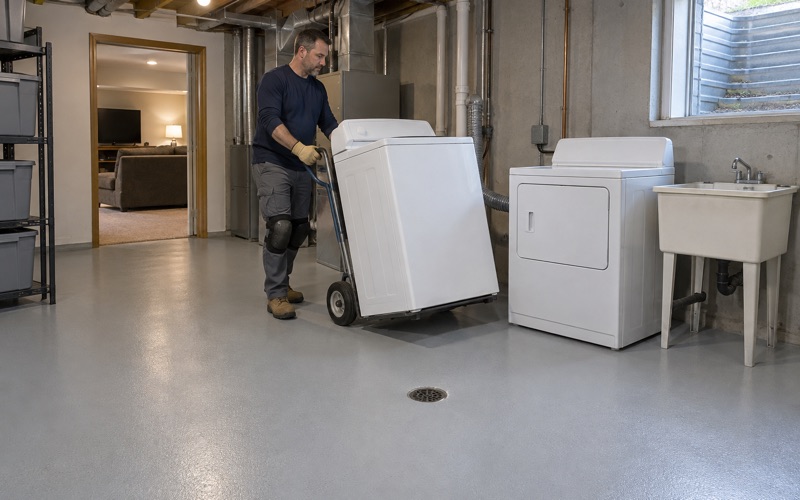
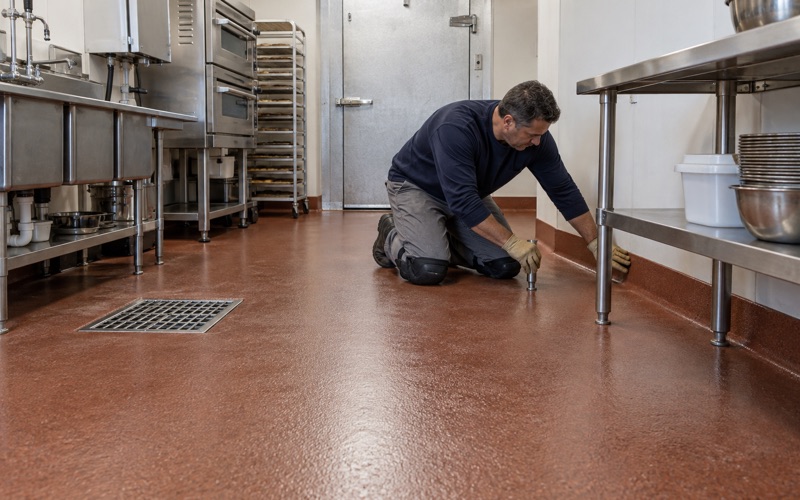
Where a basement court is planned, the sump pit and floor drain stay open and working. Coating work goes around sump lids and drain grates, never over them. If the space has a history of water after storms, that history decides the system long before anyone picks a court color.
Bird baths and flatness
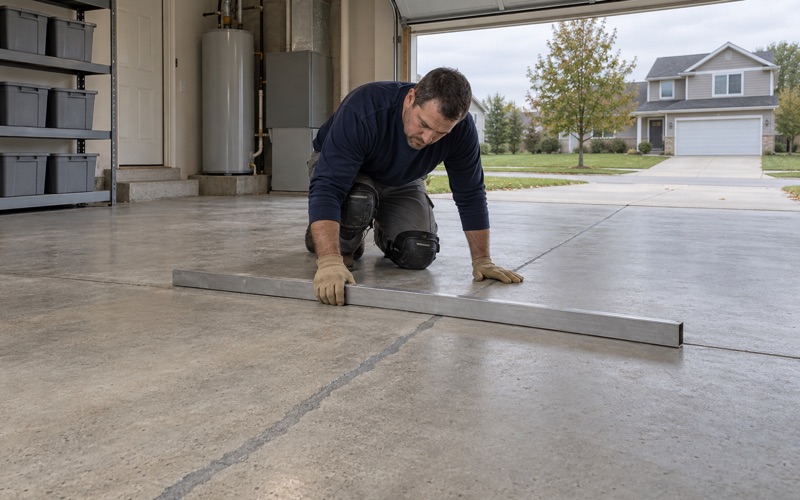
Low spots matter far more on a court than in a garage. The spec has any bird bath of 1/8 inch or deeper leveled before resurfacer goes down, because standing water and a dead spot both change how the ball plays. We check a profiled slab with a long straightedge and mark every low area before a single coat is mixed.
Patching follows, with a repair mortar feathered out to the surrounding grade. It is slower than it sounds, since each fill needs to cure before the next layer. We log slab temperature and the dew point spread at the surface at every stage, and we schedule coats by those readings rather than by the calendar.
Laying Out Lines to USA Pickleball’s Standard
Court size and 2-inch lines
The USA Pickleball rulebook sets the court at 20 by 44 feet for singles and doubles, measured to the outside of the lines. It asks for 2-inch lines, all one color, clearly contrasting with the playing surface. The minimum playing area is 30 by 60 feet, which leaves room to move behind the baseline and beside the sidelines.
Rule numbers can change from one edition to the next, so we work from the current text rather than a remembered one. No floor we coat carries any approval or sanction from USA Pickleball, and we never describe one that way. What we can deliver is a layout measured to the published dimensions.
Keeping the edges crisp
The court spec lays a line primer under the masking tape before line paint, so color does not bleed under the edge, then at least one coat of line paint. On a garage or flex-bay floor we follow the same idea: seal the tape edge first, then paint. A fuzzy edge is the most visible flaw on any finished court.
Contrast is a choice as much as a rule. A blue playing field with white lines reads well under strong overhead light, while dark gray on light gray can vanish as a winter afternoon fades. We mock up colors on a section of the profiled slab so you judge them on your own concrete, under your own fixtures.
Sharing a slab with cars or forklifts
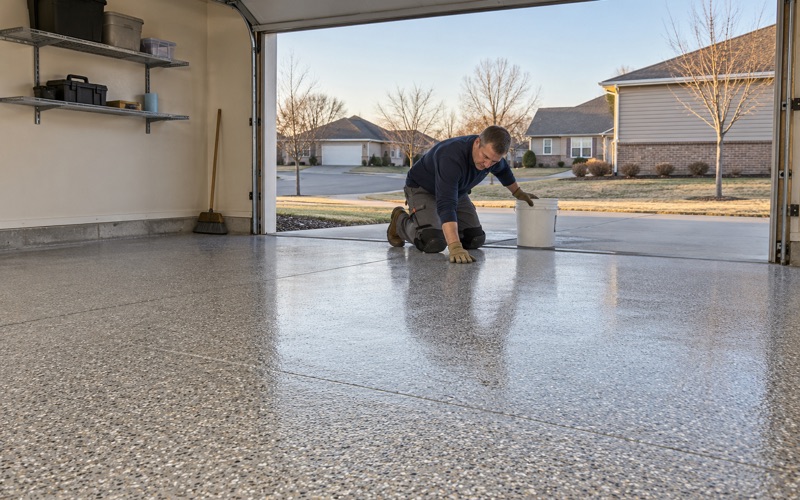
Many requests are for a dual-use space: a garage that parks vehicles all winter and hosts games in summer, or a warehouse bay that stays a warehouse on weekdays. In those spaces we talk through which use wins when they conflict. Brine and rock salt riding in from November through March punish a soft court coating quickly.
Where vehicles share the floor, we often recommend a durable base system with painted game lines as a practice area, and we describe it as exactly that. Where the space is dedicated to play, a textured acrylic sport system over properly profiled concrete is the better path. Either way, the proposal names the products, the coats and the finished thickness.
- 20+ Years on Iowa Slabs
- Moisture Tested Before Pricing
- Coats and Thickness in Writing