Urbandale Epoxy Flooring brings more than 20 years of epoxy-flooring work to Ames, coating shop bays, fleet garages, home garages and basements across the city. Our proposals are written so you can hold the finished floor against them: the product line, the number of coats and the finished thickness are all named on paper before any work is scheduled.
Every Ames slab we coat is opened with a diamond grinder or a shot blaster, never an acid etch, so the resin has a real profile to grip. Before a price is final, we map cracks, spalls and failing old coatings, and we write a moisture test into the scope. If a slab needs repair or replacement before it can carry a coating, we tell you that first.
This page is about one thing that is changing on Ames floors: more neat biodiesel in shops and fueling areas. We cover what the fuel does to painted concrete, how we choose a topcoat for that exposure, and the cleanup habits that decide how long the floor lasts.
CyRide’s Biodiesel Buses and What They Signal for Ames Shops
A city transit fleet moving to B100
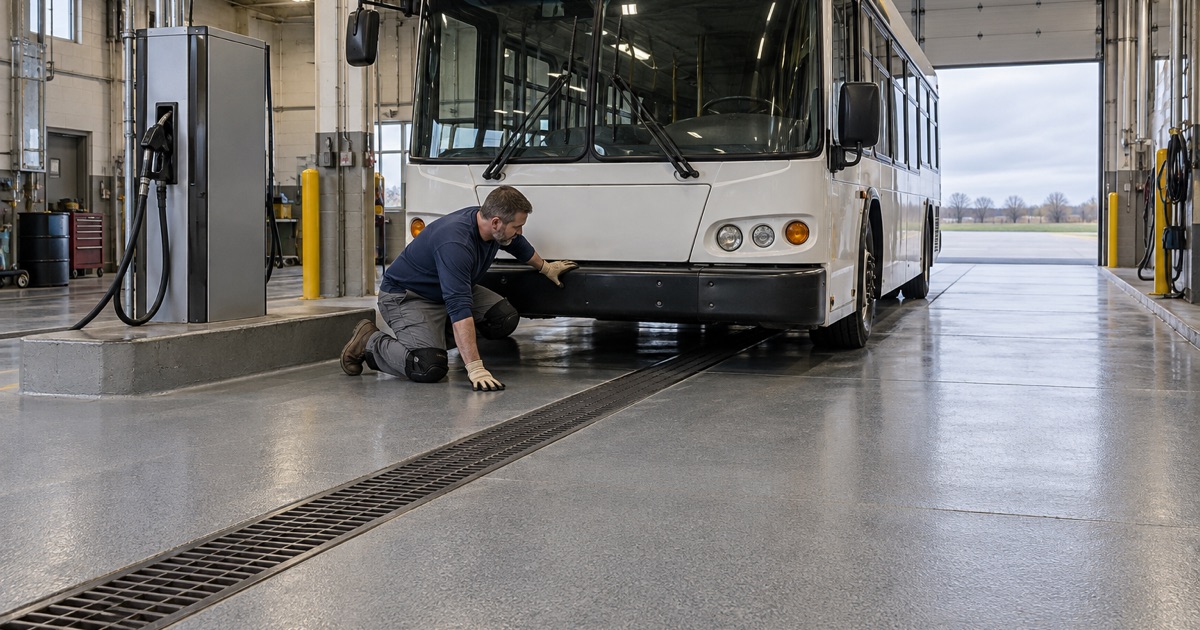
CyRide, the transit system that serves Ames and the university, has already run five buses on B100, which is 100 percent biodiesel, through a pilot that used fuel from Chevron REG. In November 2025 the City of Ames announced a 14.6 million dollar federal grant to expand the CyRide facility and move further in that direction.
According to the city, the project provides indoor storage for the entire fleet, adds maintenance capacity for articulated and clean-fuel vehicles, and converts 20 buses to B100. It includes an underground B100 fuel tank and on-site blending equipment for year-round use, and it now moves into design and development. We have no relationship with CyRide, the city or the fuel supplier.
Why a transit project matters to a private floor
We mention the CyRide plan because it shows neat biodiesel is no longer a curiosity in Ames. When a large public fleet commits to B100, the fuel and the people who service those engines become more common in the area, and some of that work and some of that fuel reaches private repair shops, farm buildings and fleet garages.
A shop owner who starts handling B100 or high blends often keeps the same floor routine used for ordinary diesel. That is where trouble starts. The coating that shrugged off years of diesel drips may react very differently to neat biodiesel, and the difference usually shows up as softening or dulling near the fill point before anyone connects it to the fuel.
Looking for epoxy-flooring closer to Boone? See Epoxy-Flooring in Boone.
B100 Is a Solvent: What That Means for a Coated Floor
What the federal handling guide says
The NREL Biodiesel Handling and Use Guide, now in its sixth edition, states it plainly: B100 is a good solvent. It may loosen or dissolve varnish and sediments left in tanks and fueling systems by conventional diesel. The same guide says spills should be cleaned up immediately, because B100 may not be compatible with some types of paint.
That warning was written about fuel equipment, but a floor coating is a paint film too. A drip that sits under a fill nozzle or beneath a filter change for a weekend is in long contact with the resin. We read the guide’s language as a reason to choose the coating carefully and to treat every biodiesel drip as something to remove, not ignore.
What we look for on an existing floor
When we walk an Ames shop that already handles biodiesel, we look at the coating where fuel lands most often. Soft spots, a tacky feel, dull patches or a film that lifts at the edges near fueling or filter stations are the signs we note. Those areas get mapped with the cracks and spalls so the proposal reflects them.
Sometimes the right answer is a full grind and a new system. Other times the coating is sound except in a few high-contact zones, and we recommend repairs there along with a better topcoat. Either way, we explain what failed and why before you commit to a price.
Gaskets, hoses and galvanized parts are a separate question
The NREL guide also notes that B100 is not compatible with some hoses and gaskets, and that it degrades in contact with zinc, which includes galvanized surfaces. Those are equipment issues, not floor issues, and we leave them to whoever services your fueling gear.
We raise them only because a leaking fitting is often the real source of a soft patch on a coated floor. If the same spot keeps getting wet, the fix starts at the dispenser or the line above it. Recoating under an active drip just restarts the clock on the same failure.
Choosing a Topcoat for Fueling and Service Areas
Matching the system to B100 contact
No floor coating is immune to neat biodiesel, and we never describe one that way. What we do is confirm the topcoat with the coating maker for B100 contact in the areas where fuel will land, using that maker’s own chemical-resistance data for the specific product. The proposal names that product and its role in the system.
In practice, a fueling or service bay usually gets a 100% solids epoxy base for build and bond, with a chemical-resistant topcoat on top. Polyaspartic and polyurea topcoats are common choices for shops, and in some heavy-duty bays urethane cement is worth discussing. The right answer depends on the fuel, the traffic and how quickly drips get wiped up.
Preparation, profile and moisture
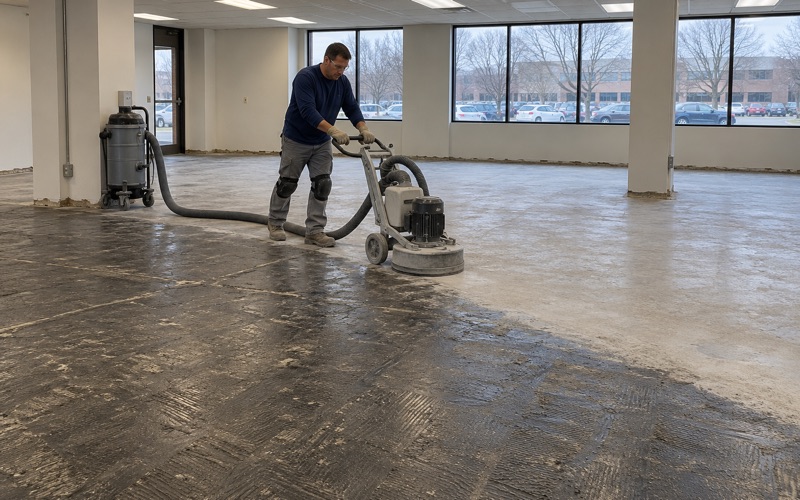
A fuel-resistant topcoat still fails if the base layer is poorly bonded. We grind or shot blast to an ICRI concrete surface profile suited to the system, capture the dust at the machine with a vacuum rather than washing it toward a floor drain, and repair cracks before coating. A floor that is only as strong as its weakest bond will lift first where fuel attacks it.
Moisture testing comes next, whether the slab is in a shop or a garage. Depending on the floor, we use ASTM F2170 in-situ relative humidity probes or ASTM F1869 calcium chloride testing. If readings are high, a moisture-mitigation primer goes into the scope, and the warranty conversation starts with what moisture excludes.
Traction where floors get slick
Biodiesel on a smooth coating is slippery, and a fueling bay sees boots, creepers and hand trucks all day. We specify slip resistance through the broadcast and topcoat, typically a quartz aggregate broadcast sized to the traffic, rather than promising a nonslip floor as a slogan.
The tradeoff is cleanability. A heavier texture grips better but holds more residue, which matters on a floor where drips must come up fast. We set the texture for the work done in each zone, which sometimes means a rougher surface at the fill point and a smoother one where carts roll.
Wipe-Up, Rags and B20 Versus B100
A cleanup routine that protects the coating
The best topcoat for B100 still depends on what happens after a drip. Following the NREL guidance, spills should be cleaned up immediately rather than left to soak in, and that habit does more to extend a shop floor’s life than any single product choice. We talk through the routine before the job is finished, not after the first soft spot.
A coated floor is not spill containment and should never be treated as one. If your operation needs a containment plan for fuel storage, that is a separate engineering question. Our job is a floor that resists incidental contact and is easy to wipe clean, so fuel does not sit long enough to soften the film.
Soaked rags and the self-heating risk
The same federal guide warns that biodiesel-soaked rags can cause spontaneous combustion if not handled properly. It advises washing rags with soap and water and drying them in a well-ventilated area before disposal. A pile of fuel-soaked shop rags in a corner is a fire hazard, whatever the floor beneath it.
We raise this with Ames shop owners because floor cleanup and rag handling are one routine. A fresh coating makes drips easy to wipe, which means more rags. Planning where those rags go, and how they are washed and dried, belongs in the same conversation as the topcoat.
How blends change the exposure
B20 and lower blends behave much more like ordinary diesel than neat biodiesel does. A home garage or a small shop running B20 in a pickup or tractor generally sees the same exposure a diesel floor sees. The solvent concern grows as the blend approaches B100, so we ask what fuel is actually used.
For a home garage in Ames, the bigger enemy is usually winter. Brine and rock salt ride in on tires from November through March, and cure schedules follow slab temperature and dew point rather than the calendar. An unheated garage in a central Iowa winter waits until conditions allow the coating to cure properly.
Floors in older and newer Ames buildings
Ames has a wide spread of building ages, from houses built before 1940 to more than 600 units built since 2020. We test the garage slab regardless of the year the house went up, because a newer house is not proof of a drier slab. The moisture readings decide the system.
The same rule applies to shops. A fleet bay built recently can still carry high moisture, and an older shop slab may be dry but heavily contaminated after years of fuel handling. Either way, the grinding, testing and proposal come first, and the coating choice follows what the slab actually tells us.
- 20+ Years on Iowa Slabs
- Moisture Tested Before Pricing
- Coats and Thickness in Writing