Urbandale Epoxy Flooring has put more than 20 years into epoxy flooring in Altoona and the rest of the metro, and the floors that teach us the most are the ones carrying heavy, slow-moving loads. When a shop needs a slab that is sealed, smooth and continuous rather than merely glossy, the coating becomes part of the material-handling system. That is the work this page is about.
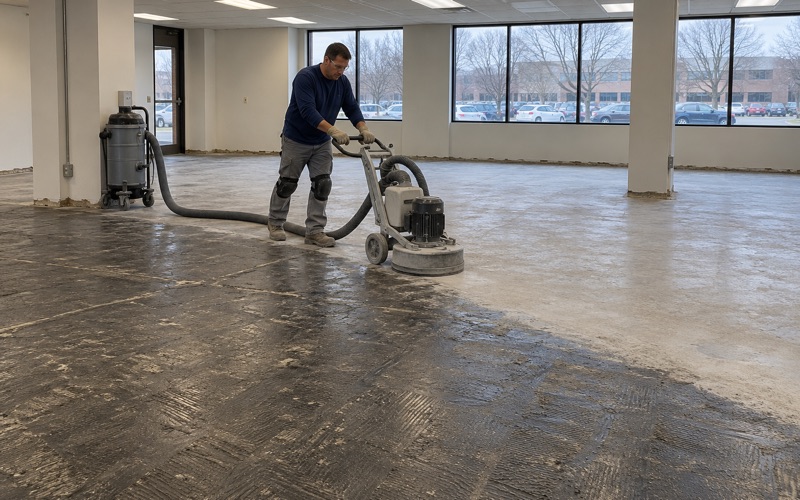
Every slab we coat is opened mechanically, with a diamond grinder or a shot blaster, and never with an acid etch. Grinding cuts a measurable profile on the ICRI CSP scale and removes the weak top layer, so the primer bonds to sound concrete. On an industrial floor that bond decides whether the surface stays intact under traffic or lifts in sheets.
Before a price is final, we map the cracks, spalls and any old coating, and we put a moisture test into the written scope. The proposal names the product line, the coat count and the finished thickness, so a plant engineer can hold the delivered floor against the quote. When a slab needs repair or replacement before any coating, we say so plainly.
Module Fabrication on 21st Street NW
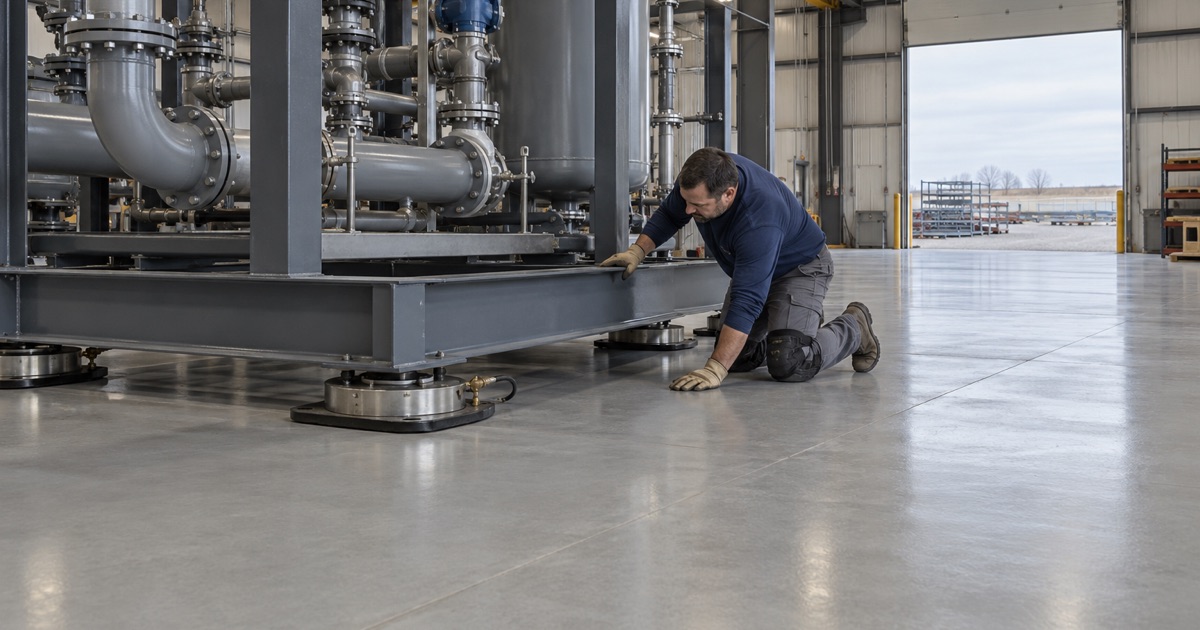
Altoona’s industrial base has moved past warehousing into building things under a roof. In October 2024, Baker Group announced a 90,000-square-foot offsite manufacturing facility at 2770 21st Street NW, where skilled craftspeople construct custom piping, electrical, sheet metal and automation modules in one building. The company says the plant can handle and transport modules weighing in excess of 77,000 pounds.
Why offsite assembly changes the floor
Module fabrication brings field construction indoors. Instead of assembling piping racks or electrical skids on a jobsite, crews build them on a plant floor and move the finished unit out through large bay doors; Baker’s announcement mentions multiple 24-by-23-foot doors. The floor stops being a place where things sit and becomes the route every finished module has to travel.
Heavy units can cross a shop floor several ways: overhead cranes, heavy dollies or air casters. Baker Group’s own description does not say which method its Altoona plant uses, and we have no relationship with the company, so we make no claim about its equipment or its floors. We use the building as an example of the kind of work now happening in Altoona, nothing more.
What a heavy-assembly owner should ask first
The useful question for any module shop is how loads will move, because that choice sets the floor’s job. A crane-served bay asks the slab mainly to resist dropped steel and abrasion. A bay where loads float on air asks for something stricter: a surface that holds pressure, stays smooth to a few thousandths of an inch and has no breaks for air to escape through.
We start that conversation with the equipment maker’s floor specification in hand, not a color chart. The maker’s document sets the targets, and our proposal answers them line by line: surface preparation, crack treatment, step correction, coating system and finished thickness. Where the slab cannot meet a target without repair, the proposal says so before any work is scheduled.
Looking for epoxy-flooring closer to Carlisle? See Carlisle Epoxy-Flooring.
How an Air Caster Floats a Load, and What Breaks the Film
An air caster carries its load on a thin film of compressed air instead of wheels. AeroGo’s floor surface specification for concrete floors, EI-14, puts that film at approximately 3-5 thousandths of an inch, with pressure in some cases up to 50 pounds per square inch pushing down on the floor. That film is why the floor matters so much.
Why the surface has to be non-porous
If concrete is porous, the air finds the pores and leaves through the slab instead of lifting the load. The maker’s own wording is that the fluid escapes and is wasted and the system loses much of its efficiency, so operating surfaces for fluid film systems should be non-porous. Bare concrete, even a well-finished slab, can bleed enough air to matter.
EI-14 also notes that concrete, the most common industrial floor, can easily be made non-porous with commercial sealants. That is where a coating earns its place. A properly bonded 100% solids epoxy closes the pores across the travel path, so the air stays under the caster and the compressor is not working to pressurize the slab.
Peaks, valleys and a film a few thousandths thick
Porosity is one failure; texture is the other. The specification describes concrete peaks of 15 to 20 thousandths of an inch that reach through the air film and abrade the caster surface. A floor that looks smooth to a forklift driver can still be rough enough to wear casters and leak air at every high spot.
The sketch in EI-14 labels a good surface as one where the surface coating fills the concrete valleys. The goal is not a thick decorative layer but a continuous, even skin over the ground profile. That is a different target from a garage floor with a vinyl flake broadcast, where texture is added on purpose, and it changes which systems we put on the table.
Levelness and drift
Air-film loads have almost no rolling resistance, so slope matters more than on a wheeled floor. The maker’s specification sets levelness at no more than 0.1 percent slope; past that, loads drift and need guide wheels. A coating does not flatten a sloped slab, so we survey the travel path early and report where the concrete itself falls outside the target.
Where the slab misses that target, the fix is in the concrete: grinding high areas or placing a leveling underlayment before the coating goes down. We would rather price that honestly up front than coat a slope and let the owner discover drift on the first lift.
Sealing, Crack Filling and Step Blending to the Maker’s Spec
EI-14 asks for surface continuity without cracks, steps or other interruptions through which fluid losses can occur. Our sequence for an air-film travel path follows that wording, and every step is written into the proposal before work starts.
Opening the slab and testing for moisture
We profile the slab with diamond grinding or shot blasting, chosen to suit the concrete and the existing finish, and capture the dust at the machine by vacuum rather than washing it toward a floor drain. Grinding also takes down the peaks the specification warns about, which is the first step toward the smooth surface an air caster needs.
Moisture testing comes next and appears in the scope, not as an optional add. We use ASTM F2170 in-situ relative humidity probes or ASTM F1869 calcium chloride testing, depending on the slab, because vapor pushing up from below is a common cause of coating failure and a standard warranty exclusion. Where readings run high, a moisture-mitigation primer goes into the system.
Cracks filled smooth and flush
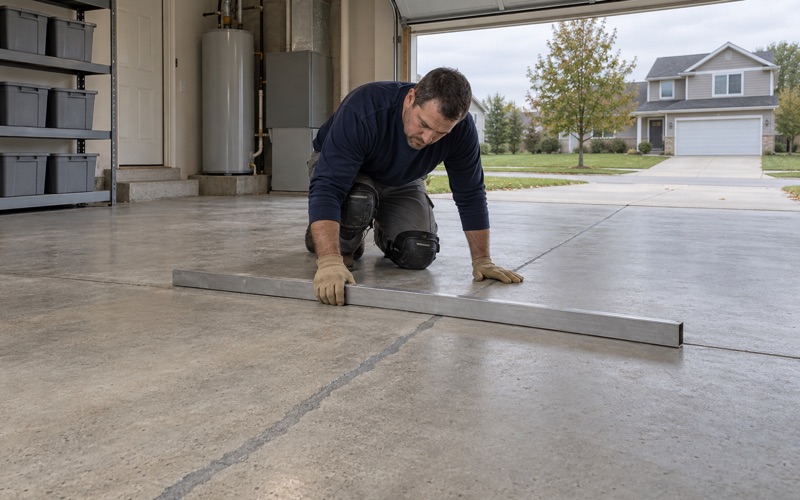
The maker’s direction for cracks is to epoxy fill them smooth and flush. We rout cracks clean, fill them with a rigid epoxy, and grind the fill level with the surrounding concrete so the caster crosses without a ridge or a dip. A crack left proud by even a few thousandths becomes the kind of peak that wears a caster.
Not every crack belongs under a coating. Where mapping shows a crack is still moving, or a slab section is broken and rocking, we say before pricing that the concrete needs repair first. Filling an active crack and coating over it produces a neat floor for a few months and a broken film path after that.
Blending steps and sealing the path
Steps between slab pours, patch edges and old coating lines all interrupt the film. EI-14 calls for steps to be blended by grinding to a 1:20 slope and then sealed. We grind those transitions to the ramp, then carry the coating across them so the travel path reads as one continuous surface.
The specification closes with a plain requirement: coatings shall be securely bonded to the concrete and present a uniformly finished operating surface. Bond is why we never acid etch, and uniformity is why we hold cure schedules to slab temperature and dew point rather than a calendar date. A topcoat that blushes or cures unevenly is not a uniform surface, whatever it looks like.
Heavy-Assembly Floors in Altoona’s Other Industrial Buildings
Altoona’s industrial growth goes well beyond one plant. Altoona Now reported roughly 2.7 million square feet of warehouse space built or under construction in 2023, and the city’s 2023 annual report counted more than 2 million square feet of new warehouse space. With about 1,600 acres of development-ready land, new slabs will keep arriving.
Equipment, fabrication and service shops
Ziegler CAT operates at 1500 and 1600 Ziegler Drive NW, and a business report describes two buildings enclosing 200,000 square feet on 42 acres. Summit Products, listed as a metal and plastic fabrication and powder coating shop serving RV, motorcoach and truck accessory markets, runs more than 140,000 square feet. Shops like these move heavy pieces every day and wear floors hard.
For those floors the question is the same one a module shop answers: how do loads cross the slab? Shops that weld and grind need a coating chosen for heat and impact, while a bay that may one day float loads on air needs a sealed, continuous path. We match the system to the work instead of selling one product to every bay.
New buildings and young slabs
Newer Altoona buildings arrive with heavier slabs. The Altus Commerce Center’s Building A on 20th Avenue SW, built in 2022, is listed with a 7-inch reinforced floor slab over a vapor barrier, and the I-80 Distribution Center is listed with a 7-inch slab and 32-foot clear height. A tenant fitting out assembly space inherits whatever finish that slab was given.
A vapor barrier under a slab helps but is not a guarantee, so we still test before coating, the same way we test a garage in a new house. We explain warranty exclusions before the job is sold, and moisture vapor transmission and hydrostatic pressure are the first ones we name. A coating is a wearing surface, never flood protection.
Working around a running shop
Most industrial clients cannot shut a plant for a week. We phase work bay by bay, with night and weekend windows where a line has to keep running, and we schedule each section’s return to service around the cure rather than the clock. Where a renovation reaches beyond the floor surface, the City of Altoona is the building authority to check with first.
When a section is done, we leave the plant team the product line, the coat count and the finished thickness for their records. That paper trail matters on an air-film path, where the maker’s specification is the yardstick, and on any heavy floor that will need a recoat years from now.
- 20+ Years on Iowa Slabs
- Moisture Tested Before Pricing
- Coats and Thickness in Writing