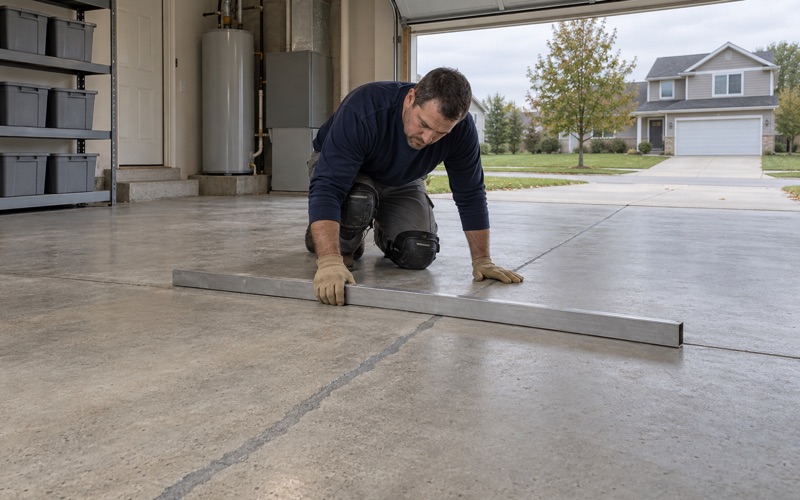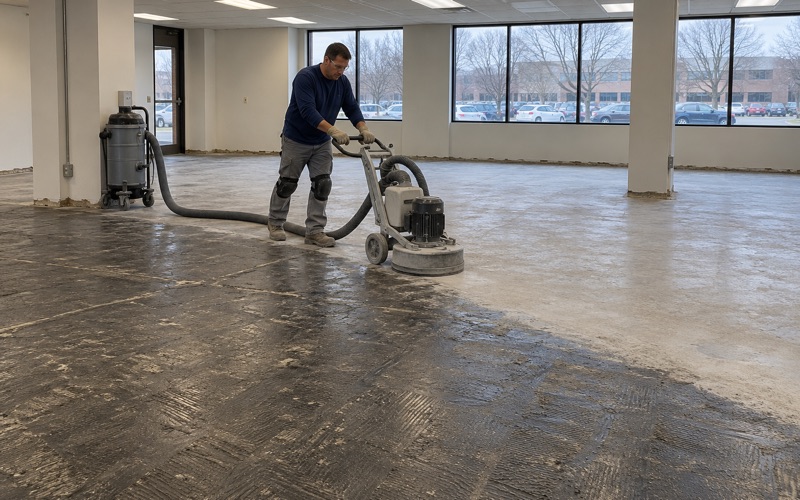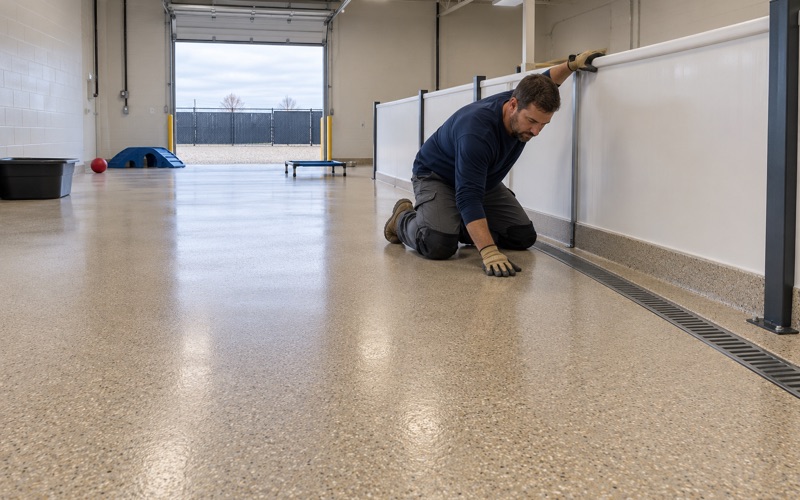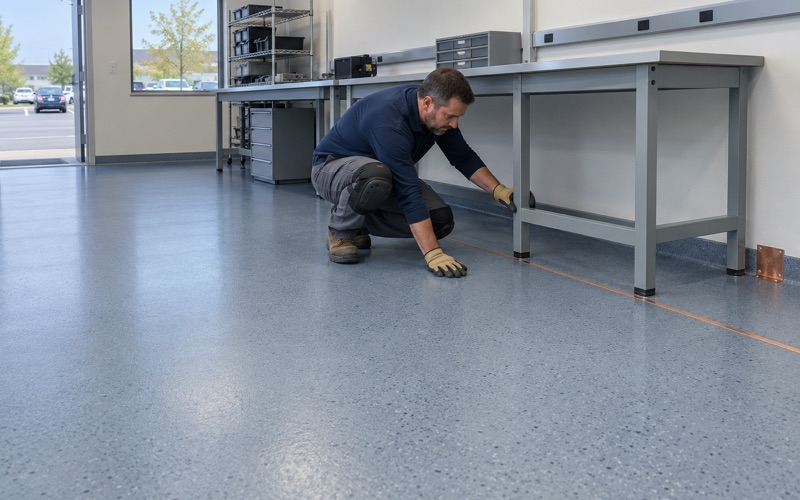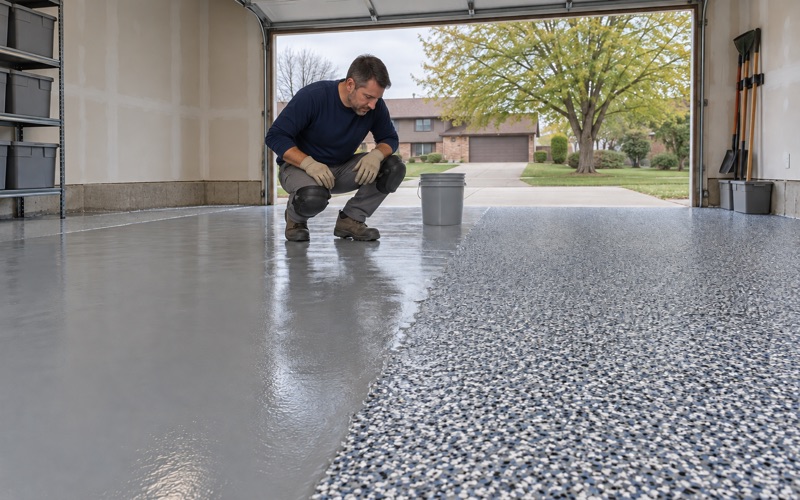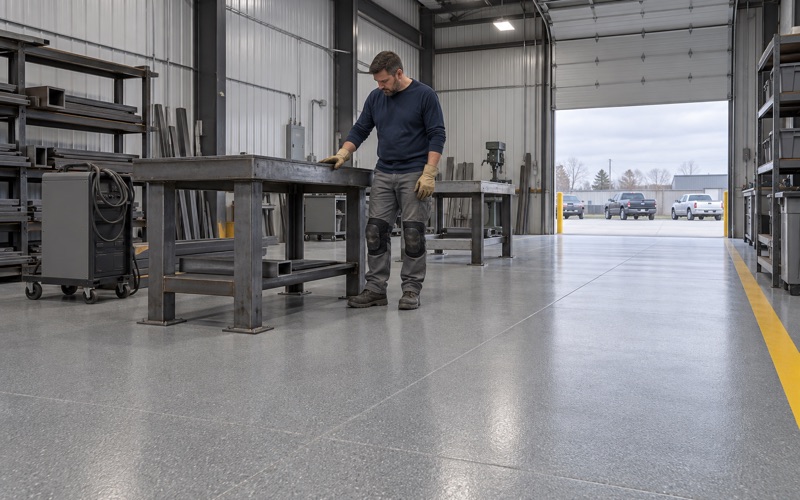
Urbandale Epoxy Flooring has spent more than 20 years putting epoxy flooring in Adel and across central Iowa onto garages, shops and the working floors of seed and farm buildings. Our crews open every slab with a diamond grinder or a shot blaster instead of an acid etch, so the coating has a real profile to grip rather than a smooth skin it can peel away from.
Before a price is final, we map the cracks, spalls and old coatings on the floor, and we write a moisture test into the scope. If a slab needs repair or replacement before it deserves a coating, we tell you so up front rather than coating over the problem and hoping it holds.
Our proposals name the product line, the coat count and the finished thickness, which gives you something concrete to check the finished floor against. We also walk through what the warranty excludes before you sign, starting with moisture, because that is the exclusion most owners never hear about until it matters.
Seed Country Around Adel
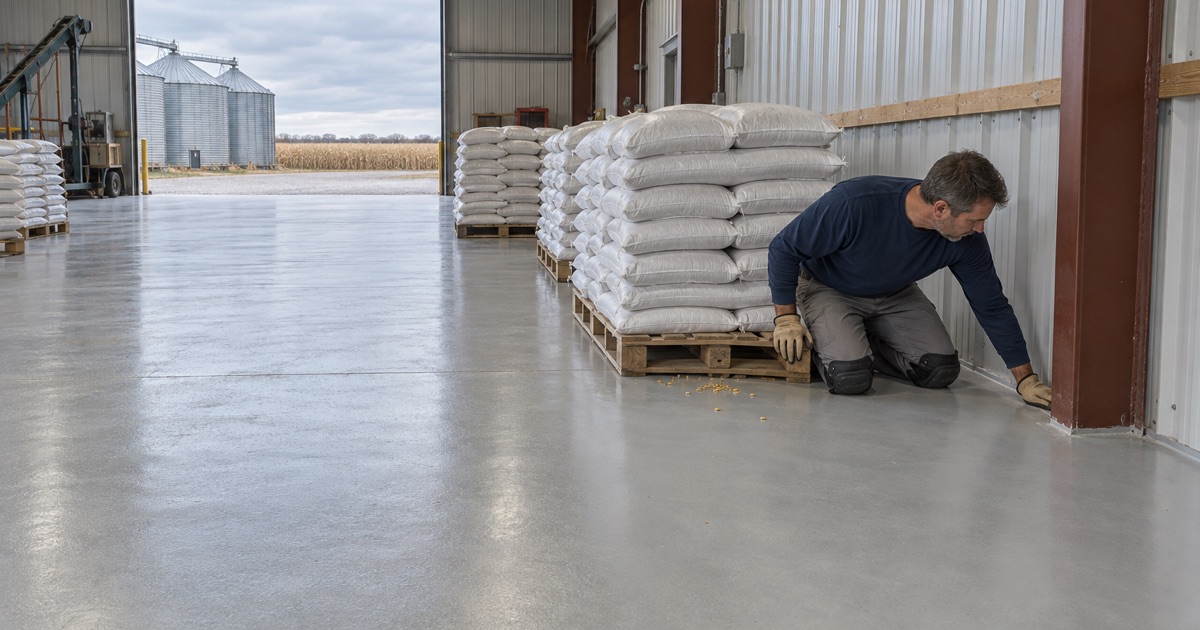
Most of what we do on seed floors comes back to one fact about this part of Dallas County: a great deal of seed is grown, conditioned, stored and moved here. That work leaves a steady trickle of seed and dust on concrete, and the floor underneath decides whether the trickle can be cleaned up or quietly accumulates.
Stine Seed and the Laredo Trail Farm
Adel is the Dallas County seat, set along the North Raccoon River, and the seed business is a large part of the country around it. Stine Seed Company introduces Adel, Iowa as its home and describes itself as the nation’s largest independently owned corn and soybean breeder. Its headquarters and seed farm sit on Laredo Trail, just outside the city limits in Washington township.
A Stine harvest post from that farm cites roughly 1,400 acres of seed corn among about 4,200 acres of corn. We have never worked for Stine and have not seen its floors. We mention it because seed work on that scale shapes the sheds, shops and storage buildings found throughout the countryside around town.
Bulk Seed Tenders Built in Town
Inside Adel, Iowa Spring Manufacturing has made springs and harrow tines on Greene Street since 1977, and a farm-equipment supplier directory also lists the company under bulk seed handling equipment and bulk seed tenders. Seed passes through a lot of hands and machines in this area before it ever reaches a planter in the field.
Every one of those hand-offs, from conditioning to bagging to loading a tender, puts some seed and seed dust on a floor. Most of it gets swept up at the end of a shift. The part that does not usually ends up somewhere a broom never reaches, and that hidden part is what our seed-floor work is built around.
What We Coat Around Adel
Our seed-related work runs from farm seed sheds and pole buildings with poured slabs to warehouse bays where bagged seed sits stacked on pallets. Plenty of our Adel calls are still ordinary garages, too; 39.9 percent of homes in the city were built since 2010, alongside an older core built in 1939 or earlier.
Whatever the building, the slab gets tested. A newer house is not proof of a drier slab, and a newer shed is not proof of a tight, crack-free floor. We look at the concrete in front of us, measure what it is doing, and price the job on that rather than on the date the building went up.
Looking for epoxy-flooring closer to Pleasant Hill? See Epoxy-Flooring in Pleasant Hill.
Where Spilled Seed Goes and What Breeds There
A seed floor rarely fails in a way anyone notices. It fails by holding things. Every crack, open joint and gap at the wall is a small pocket that collects material faster than it can be cleaned out, and those pockets are the part of the building that matters most to a pest program.
Floor Cracks, Open Joints and the Wall Line
Seed is small, round and slippery, and seed dust is finer still. On a bare concrete floor both drift toward the low spots: hairline floor cracks, sawcut control joints that were never filled, spalled edges, and the gap where the slab meets the wall. A pallet jack or a loader tire packs a little more material into them on every pass.
Those spaces sit out of sight and are nearly impossible to clear with a broom. A floor can look freshly swept at the end of the day while every crack in it still holds a thin line of kernels and powder, packed tight and slowly building up as the season goes on.
Why Stored-Product Insects Like a Broken Floor
Stored-product insects need very little to get started: a food supply, shelter and low light. Survey and extension guidance keeps pointing at the same places. The National Khapra Beetle Survey guidance from Purdue, published in 2025, says larvae in empty bins and warehouses gather in cracks in the floor or walls, and that areas with cracks and crevices are at greatest risk.
Army Public Health fact sheets describe warehouse and drugstore beetles turning up in spilled product in the cracks, crevices and seams of floors. None of this is a claim about any building in or near Adel. It describes how a damaged floor gives these insects a place to breed where nobody is looking.
What a Coating Can and Cannot Do
We want to be plain about this: a floor coating is not pest control. It kills nothing and prevents nothing on its own. What it can do is take away the hiding places, by filling the cracks, closing the wall joint and leaving a smooth, continuous surface that can actually be cleaned all the way across.
Insect management stays with the owner and whoever runs the pest program. Our job is the floor underneath that program, so the cleaning it depends on reaches the whole surface rather than only the strips of concrete between the cracks. A good floor makes a good sanitation routine possible; it does not replace one.
Vacuum, Don’t Wash: Sanitation Needs a Sealed Surface
The cleaning method and the floor have to agree with each other. Guidance for stored-product areas favors dry cleaning, and dry cleaning only works fully on a surface with nowhere for debris to hide. That is where a coated, crack-filled floor earns its place in a seed building.
The Case Against the Hose
University of Florida IFAS guidance advises vacuuming rather than washing where stored products are kept, because water carries fine particles down into cracks. A hose looks thorough, but on a cracked slab it rinses seed dust into exactly the voids where it does the most harm, then leaves that material damp.
Kansas State guidance adds that cracks should be sealed so they lose their food-collecting properties. Put those two recommendations together and the floor becomes the deciding factor. A vacuum can only pick up what sits on the surface, so the surface itself has to be continuous for the method to finish the job.
A Floor a Vacuum Can Finish
A coated floor over filled cracks gives a vacuum head a flat, closed surface to work across. Seed dust stays on top where the machine can lift it instead of settling into a joint. Spills also show up clearly against a uniform color, which makes the next cleanup faster and more complete.
We keep the finish texture modest in seed rooms. Slip resistance comes from the broadcast and topcoat we specify, and we pick them to give footing without leaving a rough grain that holds dust. On seed floors, a fine quartz aggregate broadcast under the topcoat usually balances those two needs better than a heavy texture would.
Keeping Our Own Dust Contained
Preparing a slab makes dust of its own, and we do not want to add to the problem we came to solve. Grinding dust is captured at the machine by vacuum rather than washed toward a floor drain or swept out a door, and the cracks are vacuumed clean before any filler goes in.
That habit matters twice in a seed building. Concrete dust left in a crack would weaken the bond of the filler, and wash water sent into a joint would carry debris back into the very voids we were hired to close. A dry, vacuumed slab is where every crack repair on our jobs begins.
Filling Cracks and Sealing the Wall Joint
The repair work is where a seed floor is won or lost. A coating rolled over open cracks just bridges them with a thin film that splits again, and a floor that stops a few inches short of the wall leaves the worst gap in the building untouched.
Mapping the Slab First
Every seed-shed job starts with a walk of the slab. We mark each crack, spall and old patch, note where earlier coatings or sealers are failing, and look closely at the wall line all the way around the room. That map is what the price is built on, so nothing is guessed at once the work starts.
Some slabs are not ready for a coating. A floor that is heaving, broken through or holding water needs concrete repair or replacement first, and we say so before you spend money on a finish. The moisture test in our scope tells us whether vapor coming up through the slab will fight the coating.
Crack Filling Before the Coating
After diamond grinding or shot blasting opens the surface, we rout the cracks clean and vacuum them out. They are then filled with a rigid epoxy filler and ground flush, so the coating passes over them as one surface instead of dipping into each line and leaving a shallow trough that collects dust.
Sawcut joints in a seed room are filled the same way, because here their job is simply to keep debris out. Spalled edges are rebuilt before the base coat goes down. The goal is a floor without a single open seam where seed or seed dust can lodge between cleanings.
Sealing Where Floor Meets Wall
The wall line is the gap most floors leave open, and it is often the dirtiest spot in the building. We close it by carrying the coating tight to the wall and sealing the joint, or by building a cove where the owner wants a rounded transition that a vacuum nozzle can follow.
Cure timing follows the slab, not the calendar. Many seed sheds are unheated, and in a central Iowa winter we wait until slab temperature and the dew point spread allow a proper cure. Coating a slab that is too cold shows up later as amine blush or a soft film, and that is one corner we will not cut.
- 20+ Years on Iowa Slabs
- Moisture Tested Before Pricing
- Coats and Thickness in Writing